Just as Sydney pressed Rabbit Hill into my hands when she found out I never read it, so I pressed Little Toot into her hands when she said she never heard of it. What she actually did was laugh out loud when I innocently mentioned the title, but I've forgiven her. She now says she enjoyed the book, but she still thinks Little Toot is a dumb title -- and, indeed, the other tugboats on the river do laugh at Little Toot, though not at his father, who is named, uh, Big Toot.
Don't laugh! This was one of my favorite books as a kid, one I frequently checked out of the public library in Batesburg, S.C. Published in 1939, it was the first children's book by Hardie Gramatky (1907-1979), who had been a comic-strip artist, a Disney animator and a magazine illustrator. He was best known as a watercolorist, with exhibitions at the Whitney, the Metropolitan, the Art Institute of Chicago, etc. It's interesting to compare the brushwork of the Little Toot illustrations with that in Gramatky's waterfront paintings, like this one.
Gramatky's New York studio overlooked the East River, and he got the idea for Little Toot while watching the tugboats. While Little Toot's river is unnamed in the book, it seems to be not the East River but the Hudson, as at one point Little Toot gets in the way of a big tug "bound down stream to pick up a string of coal barges from Hoboken."
Throughout, I note as an adult, Little Toot is lauded for the amount of pollution he emits: "What he couldn't create in sound, Little Toot made up for in smoke. From his chubby smokestack he would send up a volley of smoke balls which bubbled over his wake like balloons." At the climax, Little Toot's "S.O.S." smoke signal helps save the day. Environmental qualms aside, I still love Little Toot.
Wednesday, September 27, 2006


Sunday, September 24, 2006
The Frostburg Arion Band
The next time a music buff mentions the Rolling Stones' remarkable 44-year history as a band, say, "Ah, that's nothing. How about the Frostburg Arion Band?"
I took this photo of the band in performance Saturday in the Upper Quad at Frostburg State University's first Appalachian Festival. Guess how many years this band has been performing.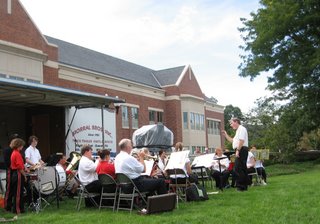 The answer: 129 years. A group of German-Americans in Frostburg, Md., founded the German Arion Band in 1877. I believe that's Ronald Horner of Frostburg State's music faculty, a veteran of the Israel Philharmonic and the Pittsburgh Symphony, leading the current incarnation in Sousa's "Liberty Bell March," a.k.a. the theme from Monty Python's Flying Circus.
In the late 19th and early 20th century, just about every U.S. town of any size had at least one community brass band, peopled by shopkeepers and farmers and kids; it was the era saluted in Meredith Willson's musical The Music Man. In towns with substantial immigrant populations, it wasn't unusual to have one German-American band, one Italian-American band, etc. Most community bands disappeared as the 20th century ground on, but not this one.
There have been a few changes, of course. During the anti-German hysteria of World War II (discussed upstream on this blog), the band changed its name from the German Arion Band to the Frostburg Arion Band.
The band long since stopped relying exclusively on German-Americans, though that ethnicity still abounds in these hills. Today the band is mostly young people, including several members of the Frostburg State University marching band. The musicians in the red uniforms had just run up the hill from the halftime show; this was their second of three gigs on Saturday. Let's see Keith Richards manage that.
Today's band, alas, is in financial distress. Its little revenue from local gigs doesn't come close to meeting expenses, and the 106-year-old band hall on Uhl Street sorely needs repairs and restoration.
The band's namesake, the legendary Corinthian musician Arion, was the "Jolly Mon" of ancient Greece; he was rescued by dolphins after pirates threw him overboard. But who will rescue the Frostburg Arion Band?
I took this photo of the band in performance Saturday in the Upper Quad at Frostburg State University's first Appalachian Festival. Guess how many years this band has been performing.
 The answer: 129 years. A group of German-Americans in Frostburg, Md., founded the German Arion Band in 1877. I believe that's Ronald Horner of Frostburg State's music faculty, a veteran of the Israel Philharmonic and the Pittsburgh Symphony, leading the current incarnation in Sousa's "Liberty Bell March," a.k.a. the theme from Monty Python's Flying Circus.
In the late 19th and early 20th century, just about every U.S. town of any size had at least one community brass band, peopled by shopkeepers and farmers and kids; it was the era saluted in Meredith Willson's musical The Music Man. In towns with substantial immigrant populations, it wasn't unusual to have one German-American band, one Italian-American band, etc. Most community bands disappeared as the 20th century ground on, but not this one.
There have been a few changes, of course. During the anti-German hysteria of World War II (discussed upstream on this blog), the band changed its name from the German Arion Band to the Frostburg Arion Band.
The band long since stopped relying exclusively on German-Americans, though that ethnicity still abounds in these hills. Today the band is mostly young people, including several members of the Frostburg State University marching band. The musicians in the red uniforms had just run up the hill from the halftime show; this was their second of three gigs on Saturday. Let's see Keith Richards manage that.
Today's band, alas, is in financial distress. Its little revenue from local gigs doesn't come close to meeting expenses, and the 106-year-old band hall on Uhl Street sorely needs repairs and restoration.
The band's namesake, the legendary Corinthian musician Arion, was the "Jolly Mon" of ancient Greece; he was rescued by dolphins after pirates threw him overboard. But who will rescue the Frostburg Arion Band?
Foucault's pendulum and Foucault's Pendulum
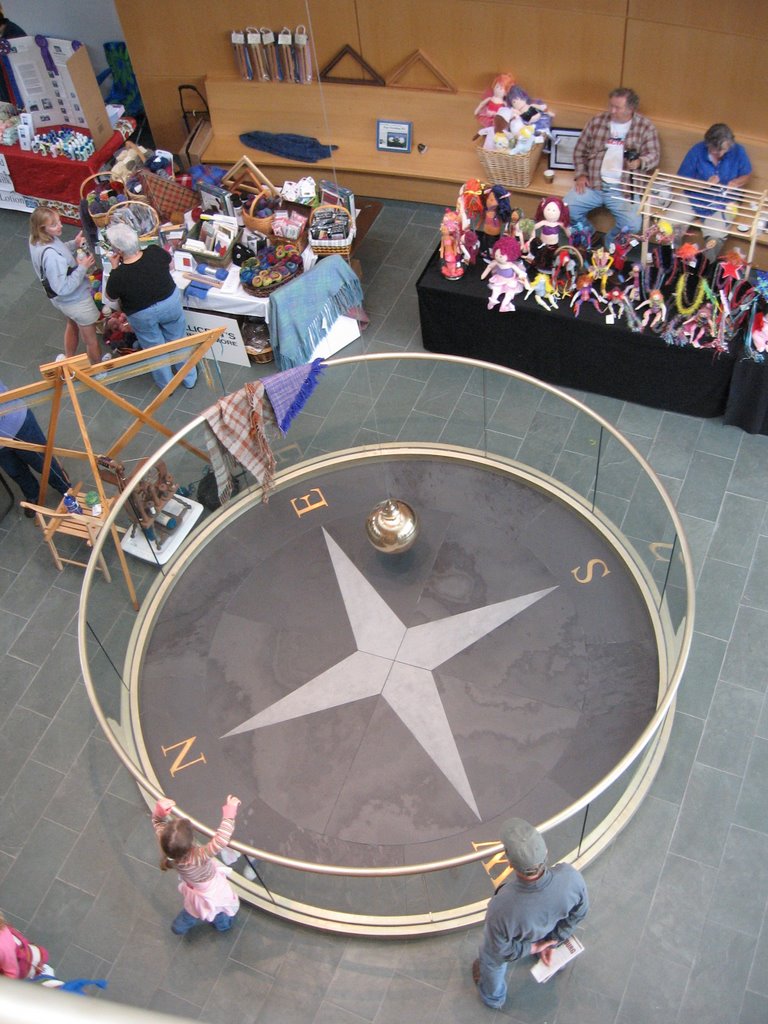
Saturday, Sydney and I attended -- and much enjoyed -- the first Appalachian Festival at Frostburg State University. As much of it took place in the science building, I took the opportunity to photograph my favorite object on campus, this fine Foucault's pendulum that hangs in the three-story atrium, demonstrating the Earth's rotation by day and night to anyone who passes by.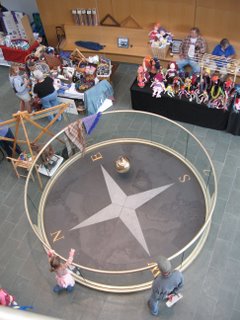 During my first trip to Paris, in 1991, I visited Leon Foucault's original pendulum in the Musée des Arts et Métiers. I went there on a sort of pilgrimage because the climax of Umberto Eco's 1988 novel Foucault's Pendulum takes place in the museum, at the pendulum. So long before tourists were tracing the steps of Robert Langdon in The Da Vinci Code, I was tracing Casaubon's steps in Foucault's Pendulum.
The two novels have a lot in common, as both are obsessed with outlandish conspiracy theories involving the Knights Templar, but Eco's novel is much longer, much harder to read, and much more snarky. As a lark, its scholar-heroes invent the mother of all conspiracy theories (after considering, then dismissing, the Mary Magdalene conspiracy theory as old hat), with disastrous consequences. Eco's novel has not yet been turned into a summer blockbuster starring Tom Hanks, but I'm sure Eco is doing pretty well for himself nevertheless.
The novel Foucault's Pendulum was recommended to me by my then-News & Record colleague Dave Stroble, who waved it at me one day and exulted, "You have to read this! I'm only a hundred pages into it, but it must have been written just for you!" I ran right out and bought a copy, read it with delight over the next couple of weeks, then returned to Dave's desk and said, "OK, I'm ready to talk about Foucault's Pendulum now." Dave went ashen and cried, "Don't tell me you actually finished that thing!" He had made it through 150 pages or so before giving up.
 During my first trip to Paris, in 1991, I visited Leon Foucault's original pendulum in the Musée des Arts et Métiers. I went there on a sort of pilgrimage because the climax of Umberto Eco's 1988 novel Foucault's Pendulum takes place in the museum, at the pendulum. So long before tourists were tracing the steps of Robert Langdon in The Da Vinci Code, I was tracing Casaubon's steps in Foucault's Pendulum.
 The two novels have a lot in common, as both are obsessed with outlandish conspiracy theories involving the Knights Templar, but Eco's novel is much longer, much harder to read, and much more snarky. As a lark, its scholar-heroes invent the mother of all conspiracy theories (after considering, then dismissing, the Mary Magdalene conspiracy theory as old hat), with disastrous consequences. Eco's novel has not yet been turned into a summer blockbuster starring Tom Hanks, but I'm sure Eco is doing pretty well for himself nevertheless.
The novel Foucault's Pendulum was recommended to me by my then-News & Record colleague Dave Stroble, who waved it at me one day and exulted, "You have to read this! I'm only a hundred pages into it, but it must have been written just for you!" I ran right out and bought a copy, read it with delight over the next couple of weeks, then returned to Dave's desk and said, "OK, I'm ready to talk about Foucault's Pendulum now." Dave went ashen and cried, "Don't tell me you actually finished that thing!" He had made it through 150 pages or so before giving up.
Thursday, September 21, 2006

A new monarch
Sydney's mother, Fran Bowling, and Sydney's Aunt Charlotte Sartin both raise monarch butterfies, a good habit they acquired in the classroom during years of teaching school. They collect larvae or cocoons, tend them in jars, then release the adult monarchs when they're ready to spread their wings. Sydney and I didn't arrive in Roanoke, Va., this past weekend in time to see this monarch climb out of its cocoon, but we were present to see Fran release it. These photos were taken in its first moments out of the jar. 
 If you love monarchs as we do, please learn to love milkweed, too; it's the only plant on which monarchs will lay eggs, and the only plant on which monarch caterpillars feed. Too often, flourishing stands of roadside milkweed get needlessly mowed down or destroyed by herbicides, thus destroying the monarchs' only habitat. Learn to recognize milkweed, and plant it and protect it wherever you can.

 If you love monarchs as we do, please learn to love milkweed, too; it's the only plant on which monarchs will lay eggs, and the only plant on which monarch caterpillars feed. Too often, flourishing stands of roadside milkweed get needlessly mowed down or destroyed by herbicides, thus destroying the monarchs' only habitat. Learn to recognize milkweed, and plant it and protect it wherever you can.
The toad at rest
This last shot wouldn't fit in the previous post, but I wanted to show everyone that when we left it, the toad was safe and resting up from all the attention. And just to show all you engineers that I do understand the concept of scale, here's another reunion photo, in which Sydney demonstrates the impressive size of a Damson plum.
 And just to show all you engineers that I do understand the concept of scale, here's another reunion photo, in which Sydney demonstrates the impressive size of a Damson plum.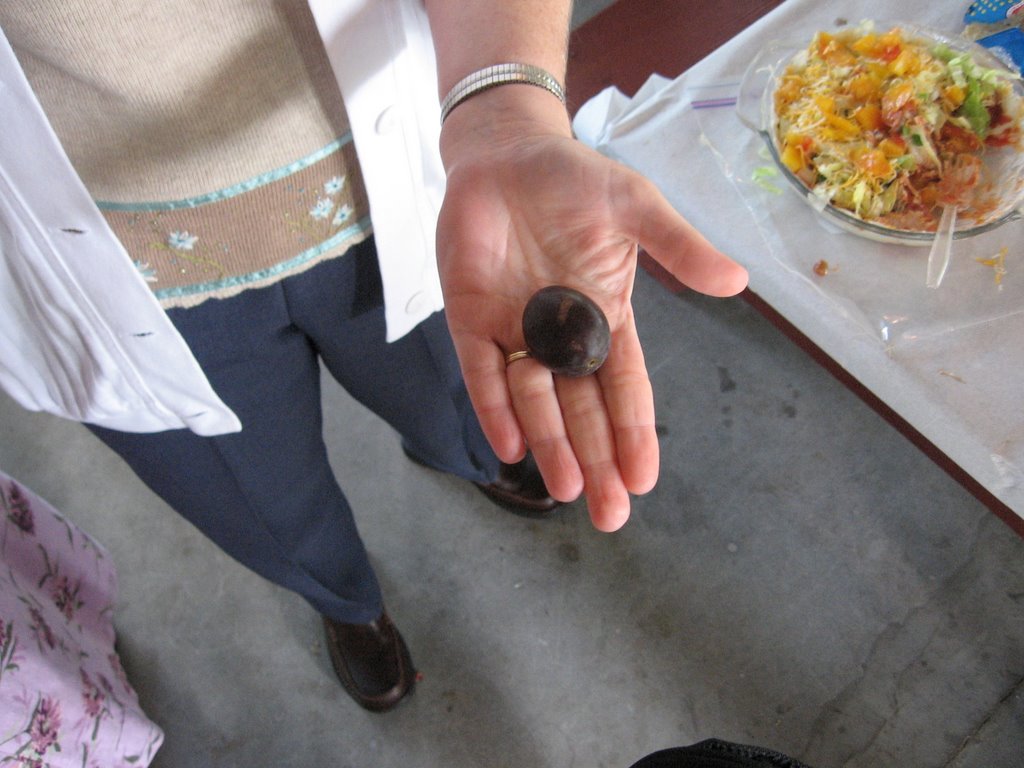
Toad herding: A photo narrative
Sunday we went to Sydney's family reunion on her mother's side, the Staffords and Stafford descendants, which is held in the Town Park pavilion in Rich Creek, Va. While setting up, Sydney's relatives found one of the picnic tables already occupied by a large toad. By the time we arrived, the toad had been moved out of the way, hidden in the corner behind a trash can, where I took this photo of it. The photo, alas, gives no sense of scale, but this was a big toad.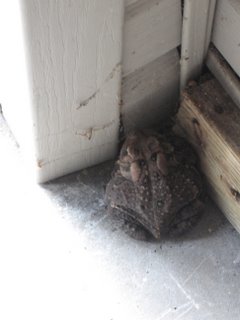 Because we worried the toad would get stepped on or otherwise injured, we decided it needed to be carried across the park, toward the woods. Sydney's mother, Fran Bowling, is a retired elementary-school teacher and therefore a veteran wrangler of wildlife, so she matter-of-factly scooped the toad onto a paper plate. The toad was too big for the plate, though, so Fran wound up herding the reluctant toad toward the woods, away from the pavilion.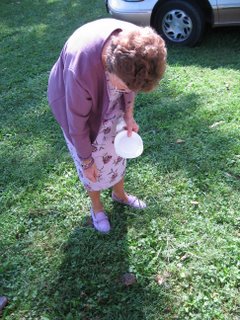

 Impatient, Sydney's Uncle Pat Sartin finally snatched up the toad bare-handed and carried it a reasonable distance out of harm's way. So lightning-quick were his actions that no camera could record them, but I later got this photo of Pat, triumphant.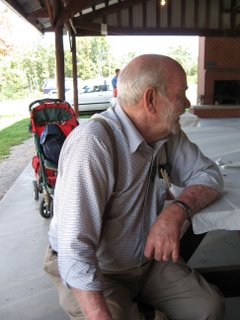
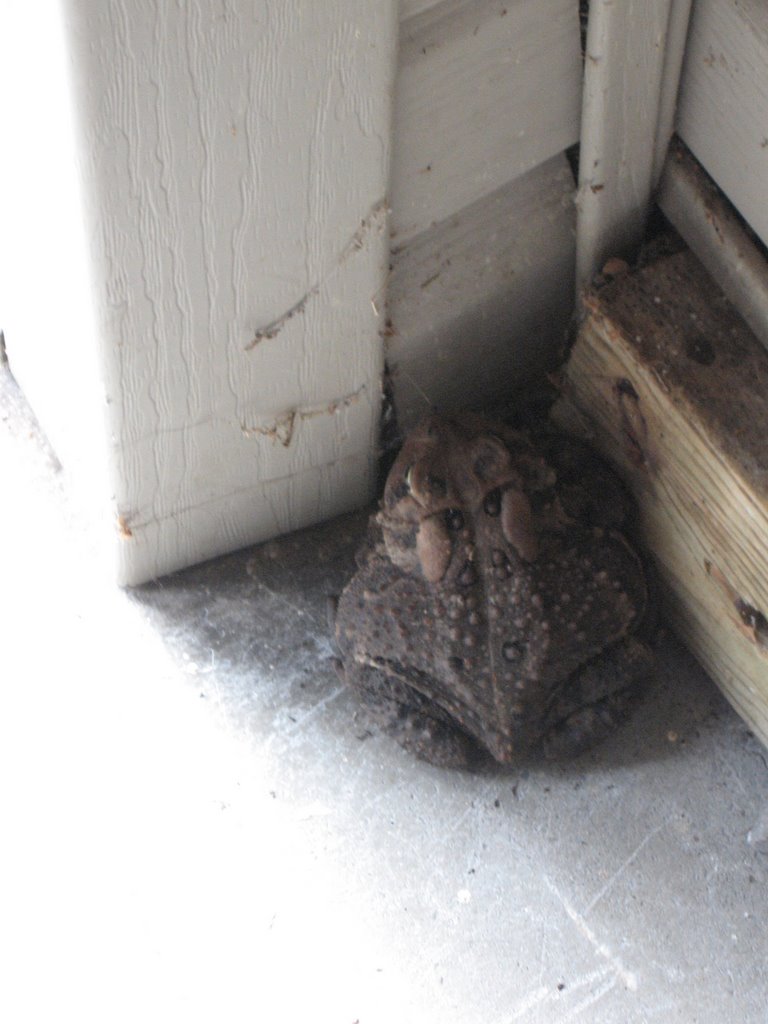 Because we worried the toad would get stepped on or otherwise injured, we decided it needed to be carried across the park, toward the woods. Sydney's mother, Fran Bowling, is a retired elementary-school teacher and therefore a veteran wrangler of wildlife, so she matter-of-factly scooped the toad onto a paper plate. The toad was too big for the plate, though, so Fran wound up herding the reluctant toad toward the woods, away from the pavilion.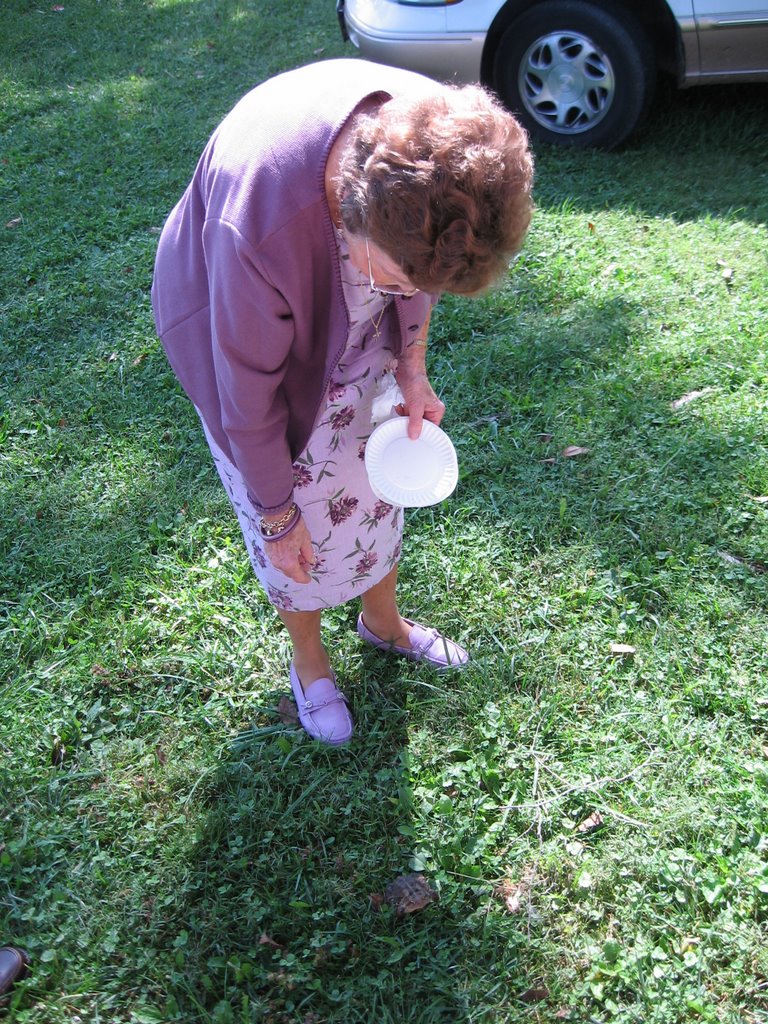

 Impatient, Sydney's Uncle Pat Sartin finally snatched up the toad bare-handed and carried it a reasonable distance out of harm's way. So lightning-quick were his actions that no camera could record them, but I later got this photo of Pat, triumphant.
My modeling career
Normally only my byline appears at eTrucker.com, but now I'm a photo illustration. Sydney was behind the camera. I was so "in character" that I nearly fell asleep during the shoot!
Monday, September 11, 2006
Five years later
Sunday night, in my room at the Hampton Inn nearest the Baltimore airport, I reached inside my toiletries bag and found that my shampoo had leaked, that the cap hadn't been screwed on tightly.
That's odd, I thought. I distinctly remember checking the cap for tightness while I packed this morning.
My next thought was: The security guard who opened and searched my suitcase after I checked it must have opened the shampoo bottle to make sure it was shampoo and not an explosive.
There was no polite card in my suitcase like the ones I occasionally found in 2002 and 2003, cards saying, in effect, "So sorry we had to search your suitcase, we trust we didn't disturb anything too badly, thanks for understanding." I don't really expect those cards anymore.
Earlier Sunday, at the Charlotte, N.C., airport, the polite federal officer who tested my CPAP machine -- which never was pulled at a security checkpoint before 2006, but which invariably gets pulled now -- told me some airports now ban CPAP machines as carry-ons, requiring them to go into the hold as checked luggage instead.
Such a reassuring sound "checked luggage" now has in the mouths of security experts. We'll all be OK, they imply, if we just get the dicey stuff out of the cabin and into "checked luggage." Never mind that checked luggage brought down Pan Am Flight 103.
I didn't say any of this to the security guard, of course. He doesn't make the policy. I'm not sure anyone does.
Here's a quiz. Was my assumption that my suitcase and shampoo had been searched
A) Likely correct, given our current search-and-surveillance society; or
B) Likely incorrect, possibly even paranoid, but understandable given our current search-and-surveillance society.
Whatever my answer, it must be A or B. I can imagine no C.
All this went through my mind as I stood in my hotel room, staring at my suitcase. I shook my head and thought: Enough. I secured my shampoo and went to bed.
That's odd, I thought. I distinctly remember checking the cap for tightness while I packed this morning.
My next thought was: The security guard who opened and searched my suitcase after I checked it must have opened the shampoo bottle to make sure it was shampoo and not an explosive.
There was no polite card in my suitcase like the ones I occasionally found in 2002 and 2003, cards saying, in effect, "So sorry we had to search your suitcase, we trust we didn't disturb anything too badly, thanks for understanding." I don't really expect those cards anymore.
Earlier Sunday, at the Charlotte, N.C., airport, the polite federal officer who tested my CPAP machine -- which never was pulled at a security checkpoint before 2006, but which invariably gets pulled now -- told me some airports now ban CPAP machines as carry-ons, requiring them to go into the hold as checked luggage instead.
Such a reassuring sound "checked luggage" now has in the mouths of security experts. We'll all be OK, they imply, if we just get the dicey stuff out of the cabin and into "checked luggage." Never mind that checked luggage brought down Pan Am Flight 103.
I didn't say any of this to the security guard, of course. He doesn't make the policy. I'm not sure anyone does.
Here's a quiz. Was my assumption that my suitcase and shampoo had been searched
Whatever my answer, it must be A or B. I can imagine no C.
All this went through my mind as I stood in my hotel room, staring at my suitcase. I shook my head and thought: Enough. I secured my shampoo and went to bed.
Wednesday, September 06, 2006
I am the Wig Man! Goo goo goo joob!
I'm unusual among Marylanders in that I am not running for the U.S. Senate this year. According to the sample primary ballots in today's paper, 10 Republicans and 18 Democrats are running, plus who knows how many third-party candidates. I guess that's what happens when a five-term incumbent decides to retire.
In a crowded field, Republican candidate Daniel Vovak stands out, as these photos demonstrate. Wherever he goes, Vovak wears a George Washington-esque white wig. Asked why, he explains: "It evokes the Whig roots of the Republican Party and its reliance on the founders' version of the United States Constitution." Besides, he says, it's great publicity.
Vovak's campaign website seems to be down, just like R.J. Reynolds', but Wikipedia is meeting the needs of the Republic by giving him comprehensive coverage.
I deeply admire Vovak's opposition to the Maryland state flag, which he rightly calls "the ugliest flag in America." He adds: "In fact, after further study, I have concluded Maryland has the ugliest flag in the world."
I also deeply admire Vovak's announcement that he has hired a psychic to direct negative energies toward the GOP front-runner in the Senate race, Lt. Gov. Michael Steele. "My volunteer campaign staff deduced it was less expensive to hire a psychic campaign manager who would curse Michael Steele than to spend a half million dollars on consultants," Vovak says. "Nancy Reagan used a psychic, and I admire her. We got a good deal on a great psychic."
I disagree, alas, with Vovak's position on Pluto, which he says should be declared a planet by Congress. I fear this would be a slippery slope. Next thing you know, Congress would declare that H20 is the symbol not for water but gold, or that the value of pi is officially 12 because that was Roger Staubach's number with the Dallas Cowboys.
On the other hand, I deeply admire that Vovak has a position on Pluto.
Most of all, I deeply admire Vovak's crusade to have himself listed on the ballot as Daniel "The Wig Man" Vovak and not Daniel "Wig Man" Vovak, which is how he is indeed listed. Apparently the state of Maryland drew the line at "The," because one must draw lines somewhere, lest chaos reign. In his statement denouncing the loss of his "The," Vovik omitted every occurrence of "the." Brilliant tactic should be emulated by other campaigns at first opportunity, as most routine announcements gain great interest by absence of common word, and think of savings on paper alone!
Some scoff at the Wig Man's chances in the Sept. 12 primary. No way the GOP will go for that, you say. I say: You never know.
In a crowded field, Republican candidate Daniel Vovak stands out, as these photos demonstrate. Wherever he goes, Vovak wears a George Washington-esque white wig. Asked why, he explains: "It evokes the Whig roots of the Republican Party and its reliance on the founders' version of the United States Constitution." Besides, he says, it's great publicity.
Vovak's campaign website seems to be down, just like R.J. Reynolds', but Wikipedia is meeting the needs of the Republic by giving him comprehensive coverage.
I deeply admire Vovak's opposition to the Maryland state flag, which he rightly calls "the ugliest flag in America." He adds: "In fact, after further study, I have concluded Maryland has the ugliest flag in the world."
I also deeply admire Vovak's announcement that he has hired a psychic to direct negative energies toward the GOP front-runner in the Senate race, Lt. Gov. Michael Steele. "My volunteer campaign staff deduced it was less expensive to hire a psychic campaign manager who would curse Michael Steele than to spend a half million dollars on consultants," Vovak says. "Nancy Reagan used a psychic, and I admire her. We got a good deal on a great psychic."
I disagree, alas, with Vovak's position on Pluto, which he says should be declared a planet by Congress. I fear this would be a slippery slope. Next thing you know, Congress would declare that H20 is the symbol not for water but gold, or that the value of pi is officially 12 because that was Roger Staubach's number with the Dallas Cowboys.
On the other hand, I deeply admire that Vovak has a position on Pluto.
Most of all, I deeply admire Vovak's crusade to have himself listed on the ballot as Daniel "The Wig Man" Vovak and not Daniel "Wig Man" Vovak, which is how he is indeed listed. Apparently the state of Maryland drew the line at "The," because one must draw lines somewhere, lest chaos reign. In his statement denouncing the loss of his "The," Vovik omitted every occurrence of "the." Brilliant tactic should be emulated by other campaigns at first opportunity, as most routine announcements gain great interest by absence of common word, and think of savings on paper alone!
Some scoff at the Wig Man's chances in the Sept. 12 primary. No way the GOP will go for that, you say. I say: You never know.
Blundering into Berlin
In a recent interview with the Florida Baptist Witness ("Publishing Good News since 1884"), U.S. Rep. Katherine Harris, R-Fla., said she opposes secular government and supports a theocracy instead. The separation of church and state is a lie, the U.S. Senate candidate said:
Her congressional staff also has been remarkable for turnover. Since Harris took office in 2003, she's been through four chiefs of staff and four press secretaries.
The first ex-Harris for Senate campaign manager, Dornan, told The Palm Beach Post, "I have never in my life worked for somebody like her, ever, and hopefully I'll never have to again. ... She was an equal opportunity abuser." He told The Associated Press the Harris campaign is "one of the most disastrous ever run in the United States."
I reminisce about all this because Katherine Harris, "disastrous" campaign and all, easily won this week's primary and now is the GOP candidate for U.S. Senate in Florida. Ain't politics grand?
I am reminded, as so often, of the movie Casablanca. Conrad Veidt calls Humphrey Bogart "just another blundering American," and Claude Rains replies: "We musn't underestimate American blundering. I was with them when they blundered into Berlin in 1918."
All those Florida Republicans who have been backing Anyone But Harris now have to decide: Vote Harris, or vote Democrat? If they close ranks and back the party, as party members used to do, the laughingstock could have the last laugh, and blunder her way straight to the U.S. Senate.
... We have to have the faithful in government, and over time, that lie we have been told, the separation of church and state, people have internalized, thinking that they needed to avoid politics, and that is so wrong because God is the one who chooses our rulers. And if we are the ones not actively involved in electing those godly men and women, and if people aren’t involved in helping godly men in getting elected, than we’re going to have a nation of secular laws. That’s not what our founding fathers intended, and that certainly isn’t what God intended. ... If you’re not electing Christians, then in essence you are going to legislate sin.Amid the ensuing furor, the Harris campaign released a statement saying, in effect, "Jews are OK, too," but letting the church-state comments stand. The statement included a quote from Harris' current campaign manager:
As the grandson of Holocaust survivors, I know that she encourages people of all faiths to engage in government so that our country can continue to thrive on the principles set forth by our Founding Fathers, without malice towards anyone.To clarify, this was Harris campaign manager Bryan Rudnick speaking, not Harris campaign manager Jim Dornan, who quit in November 2005; or Harris campaign manager Jamie Miller, who quit in April 2006; or Harris campaign manager Glen Hodas, who quit in July 2006.
Her congressional staff also has been remarkable for turnover. Since Harris took office in 2003, she's been through four chiefs of staff and four press secretaries.
The first ex-Harris for Senate campaign manager, Dornan, told The Palm Beach Post, "I have never in my life worked for somebody like her, ever, and hopefully I'll never have to again. ... She was an equal opportunity abuser." He told The Associated Press the Harris campaign is "one of the most disastrous ever run in the United States."
I reminisce about all this because Katherine Harris, "disastrous" campaign and all, easily won this week's primary and now is the GOP candidate for U.S. Senate in Florida. Ain't politics grand?
I am reminded, as so often, of the movie Casablanca. Conrad Veidt calls Humphrey Bogart "just another blundering American," and Claude Rains replies: "We musn't underestimate American blundering. I was with them when they blundered into Berlin in 1918."
All those Florida Republicans who have been backing Anyone But Harris now have to decide: Vote Harris, or vote Democrat? If they close ranks and back the party, as party members used to do, the laughingstock could have the last laugh, and blunder her way straight to the U.S. Senate.
Monday, September 04, 2006
Cranesville Swamp
Sydney and I had a wonderful time Sunday afternoon tramping around Cranesville Swamp in neighboring Garrett County, in far western Maryland along the West Virginia border.
This remarkable subarctic swamp formed during the last Ice Age and has been preserved intact the past 15,000 years in a quirky "frost pocket" that keeps the place colder and wetter than normal, and a haven for animal and plant species normally found nowhere south of Canada, including the southernmost tamarack forest in the United States.
We heard about this place before we moved to the neighborhood this summer, but we figured we'd better go see it quick, while it's still there. Like every other spot in North America, the Alleghenies are getting warmer, frost pockets and all.
Sydney and I especially enjoyed the 1,500-foot boardwalk over the peat bog, which is 3 feet deep in spots. That's impressive, since peat is formed by sphagnum moss growing and flourishing in the same spot for thousands of years. This is the least invasive boardwalk I ever saw, set at bog level and barely two people wide. In many places, the vegetation is reaching up through the planks to claim it.
The bog's surface is a thicket of shrubs and ground plants that teems in summer with bees and butterflies and, alas, flies, which ignored Sydney in order to feast on that lumbering buffet just behind her, namely me.
Other colorful inhabitants of the swamp and its woods of red spruce and hemlock include the tiny saw-whet owl, which could fit in the palm of the hand, and the sundew, a carnivorous plant that lacks the Venus' flytrap's press agent.
No, I didn't take any photos. The camera is in the shop, though it should be back Any Day Now.
More than 1,500 acres of the swamp and environs has been bought by the Nature Conservancy, which has planted thousands of red spruce and white pines since 2002, to replace trees unwisely logged at mid-century. The Conservancy also maintains the boardwalk, a network of single-file walking trails and a muddy parking lot that holds maybe a half-dozen cars. Big crowds of people aren't really wanted there, as the ecosystem is too delicate. Fortunately, the place is an hour off the interstate and impossible to find without close attention to the excellent directions on the Nature Conservancy's website.
That the Nature Conservancy needs all the help it can get probably goes without saying, but I'll say it anyway. Here's the website again.
This remarkable subarctic swamp formed during the last Ice Age and has been preserved intact the past 15,000 years in a quirky "frost pocket" that keeps the place colder and wetter than normal, and a haven for animal and plant species normally found nowhere south of Canada, including the southernmost tamarack forest in the United States.
We heard about this place before we moved to the neighborhood this summer, but we figured we'd better go see it quick, while it's still there. Like every other spot in North America, the Alleghenies are getting warmer, frost pockets and all.
Sydney and I especially enjoyed the 1,500-foot boardwalk over the peat bog, which is 3 feet deep in spots. That's impressive, since peat is formed by sphagnum moss growing and flourishing in the same spot for thousands of years. This is the least invasive boardwalk I ever saw, set at bog level and barely two people wide. In many places, the vegetation is reaching up through the planks to claim it.
The bog's surface is a thicket of shrubs and ground plants that teems in summer with bees and butterflies and, alas, flies, which ignored Sydney in order to feast on that lumbering buffet just behind her, namely me.
Other colorful inhabitants of the swamp and its woods of red spruce and hemlock include the tiny saw-whet owl, which could fit in the palm of the hand, and the sundew, a carnivorous plant that lacks the Venus' flytrap's press agent.
No, I didn't take any photos. The camera is in the shop, though it should be back Any Day Now.
More than 1,500 acres of the swamp and environs has been bought by the Nature Conservancy, which has planted thousands of red spruce and white pines since 2002, to replace trees unwisely logged at mid-century. The Conservancy also maintains the boardwalk, a network of single-file walking trails and a muddy parking lot that holds maybe a half-dozen cars. Big crowds of people aren't really wanted there, as the ecosystem is too delicate. Fortunately, the place is an hour off the interstate and impossible to find without close attention to the excellent directions on the Nature Conservancy's website.
That the Nature Conservancy needs all the help it can get probably goes without saying, but I'll say it anyway. Here's the website again.
Slithering away from Snakes
In reply to Mr. Cavin's comment below, I'll happily shake on Snakes on a Plane being a flop but not a bomb, a distinction I admire. Clearly Mr. Cavin and I are brothers, as we both care so much about such things.
I confess that I haven't seen the movie, and don't intend to; it never interested me as a movie, only as a business phenomenon. Keith "Reel Fanatic" Demko has seen it, and he comments:
I confess that I haven't seen the movie, and don't intend to; it never interested me as a movie, only as a business phenomenon. Keith "Reel Fanatic" Demko has seen it, and he comments:
To me, the flick delivered exactly what it promised, just a big ball of B-movie fun.'Nuff said!
Thursday, August 31, 2006
More Snakes than bucks
Mr. Cavin writes:
According to the Internet Movie Database, here are movies that did better on opening weekend this summer than Snakes on a Plane, which did $15 million. First I list the title, then the opening-weekend gross.
Pirates of the Caribbean: Dead Man's Chest $135 million
X-Men: The Last Stand $122 million
The Da Vinci Code $77 million
Ice Age: The Meltdown $68 million
Cars $60 million
Superman Returns $52 million
Mission: Impossible 3 $47 million
Talladega Nights $47 million
Click $40 million
Scary Movie 4 $40 million
The Break-Up $39 million
Over the Hedge $38 million
Nacho Libre $28 million
The Devil Wears Prada $27 million
Miami Vice $25 million
The Fast and the Furious: Tokyo Drift $23 million
Monster House $22 million
Poseidon $22 million
Little Man $21 million
You, Me and Dupree $21 million
Silent Hill $20 million
Step Up $20 million
Lady in the Water $18 million
World Trade Center $18 million
Invincible $17 million
The Omen $16 million
RV $16 million
"Let's make a summer action movie starring Samuel L. Jackson, hype it until its very title becomes a catchphrase on the lips of millions, open it on an August weekend with no competition, and make about half as much money as Nacho Libre" is not a recipe for Hollywood success, however you try to spin it.
Snakes on a Plane wound up making the same opening-weekend box office as Barnyard, made by people so stupid they don't know that bulls do not have udders.
Its first week, Snakes on a Plane grossed $20 million. Its second week, $6 million. At this rate, will it still be theaters a fourth week?
To paraphrase Bette Davis again: What. A. Flop.
(For what it's worth, the only other airliner-in-peril movie this summer, itself overhyped, grossed only $11 million its opening weekend. But United 93 already has grossed more than twice its cost; that seems a forlorn box-office hope for Snakes on a Plane.)
Based on information I read at The New York Times, I was under the impression that Snakes on a Plane was reaping the norm for a late summer horror release, and that any illusion of its poor performance was due to hopes being inflated by the internet hype phenomena (a lesson apparently no one took home after the halfhearted opening weekend of Steven Spielberg's AI). Certainly SOAP isn't bombing, though, just merely normal.This argument reminds me of Joan Crawford's in What Ever Happened to Baby Jane?
Joan Crawford: You wouldn't be able to do these awful things to me if I weren't still in this chair.True, Snakes on a Plane wouldn't be a belly flop if it hadn't been the most-hyped Internet phenomenon in Hollywood memory, with 31 million Google hits (as of a minute ago) compared to 8 million for the movie of the summer, Pirates of the Caribbean: Dead Man's Chest. But it WAS, Blanche! It WAS!
Bette Davis: But you ARE, Blanche! You ARE in that chair!
According to the Internet Movie Database, here are movies that did better on opening weekend this summer than Snakes on a Plane, which did $15 million. First I list the title, then the opening-weekend gross.
"Let's make a summer action movie starring Samuel L. Jackson, hype it until its very title becomes a catchphrase on the lips of millions, open it on an August weekend with no competition, and make about half as much money as Nacho Libre" is not a recipe for Hollywood success, however you try to spin it.
Snakes on a Plane wound up making the same opening-weekend box office as Barnyard, made by people so stupid they don't know that bulls do not have udders.
Its first week, Snakes on a Plane grossed $20 million. Its second week, $6 million. At this rate, will it still be theaters a fourth week?
To paraphrase Bette Davis again: What. A. Flop.
(For what it's worth, the only other airliner-in-peril movie this summer, itself overhyped, grossed only $11 million its opening weekend. But United 93 already has grossed more than twice its cost; that seems a forlorn box-office hope for Snakes on a Plane.)
Tuesday, August 29, 2006
Conversation overheard in Frostburg
Two guys in an athletic facility:
"Do you get Martin Luther King Day off?"
"That ain't a real holiday. Now, if we had a James Earl Ray Day ..."
Authentic American voters! There you have 'em, folks.
"Do you get Martin Luther King Day off?"
"That ain't a real holiday. Now, if we had a James Earl Ray Day ..."
Authentic American voters! There you have 'em, folks.
Snakes lacks legs
Before the movie Snakes on a Plane opened, my hero F. Brett Cox wondered aloud:
Amid all the opinion pieces about why the movie tanked (precious few of which concern themselves with whether the movie was any good), has anyone speculated that the recent mid-Atlantic terror scare has put people off airliner-in-peril movies?
It'll be interesting to see how the movie does after all the hype.Well, now we know: It bombed. The opening-weekend gross was $15 million, less than a third of what the virtually hype-free Talladega Nights raked in its first weekend.
Amid all the opinion pieces about why the movie tanked (precious few of which concern themselves with whether the movie was any good), has anyone speculated that the recent mid-Atlantic terror scare has put people off airliner-in-peril movies?
Everyone's talking about Little Georgie
I laughed loudly at this Arthur D. Hlavaty post, and was only mildly ashamed.
Christopher Rowe, meanwhile, is right in remembering that in Robert Lawson's children's book Rabbit Hill, the lyrics of Little Georgie's song come complete with a melody. I can't read music, alas, so it could be sung to the tune of "Happy Birthday" or "To Anacreon in Heaven," for all I know.
Christopher adds:
Kip W., meanwhile, recalls that Lawson was featured years ago in an exhibition of children's book illustrations at the Chrysler Museum of Art in Norfolk, Va. I have visited the Chrysler only once and had not thought about it in years, but it's a fine museum, highly recommended. Kip W. adds:
Christopher Rowe, meanwhile, is right in remembering that in Robert Lawson's children's book Rabbit Hill, the lyrics of Little Georgie's song come complete with a melody. I can't read music, alas, so it could be sung to the tune of "Happy Birthday" or "To Anacreon in Heaven," for all I know.
Christopher adds:
I sing little songs too. In fact, a lot of times I make up a little song for whatever story I'm working on; the one for "The Voluntary State" even made it into the text.Do you mean Tonight we'll remake Tennessee, every night we remake Tennessee? I am delighted to know this. It reminds me of the various creation myths in which the gods sing a world into being.
Kip W., meanwhile, recalls that Lawson was featured years ago in an exhibition of children's book illustrations at the Chrysler Museum of Art in Norfolk, Va. I have visited the Chrysler only once and had not thought about it in years, but it's a fine museum, highly recommended. Kip W. adds:
I remember in 8th grade, snickering because Lawson's drawing of a gangster called "Fish-Eye" looked a lot like one of my teachers.Now I want to see the illustration! What book was it in?
More "German" and "French"
Trent Hergenrader writes, in part:
During the First World War, I wonder, was it renamed "liberty chocolate cake"?
Trent also alerts us to the obscure word "cataglottism," meaning French kissing. He adds:
This is almost on-topic, but German Chocolate Cake gets its name from the type of chocolate (German's Sweet Chocolate) used ...I did not know that. The story is told here at the invaluable Snopes.com.
During the First World War, I wonder, was it renamed "liberty chocolate cake"?
Trent also alerts us to the obscure word "cataglottism," meaning French kissing. He adds:
Had I only known this in high school, so much would be so different today...My knowing that word in high school would have helped me not at all. I knew many terms for acts I was at no risk of actually enjoying. I would, however, have inserted the word into snarky remarks: "What's the matter? Cataglottism got your tongue?"
Sunday, August 27, 2006
Boy: Tales of Childhood
I was taken aback by Roald Dahl’s memoir Boy: Tales of Childhood, but I suppose I shouldn’t have been; this is the author of Switch Bitch, after all. With rare exceptions, all Dahl’s childhood memories are awful: surgeries without anesthetic, a car accident that cut off his nose, and above all, vicious beatings by sadistic schoolmasters, one of whom went on to become Archbishop of Canterbury. Dahl writes:
By now I am sure you will be wondering why I lay so much emphasis upon school beatings in these pages. The answer is that I cannot help it. All through my school life I was appalled by the fact that masters and senior boys were allowed literally to wound other boys, and sometimes quite severely. I couldn't get over it. I never have got over it. It would, of course, be unfair to suggest that all masters were constantly beating the daylights out of all the boys in those days. They weren't. Only a few did so, but that was quite enough to leave a lasting impression of horror upon me. It left another more physical impression upon me as well. Even today, whenever I have to sit for any length of time on a hard bench or chair, I begin to feel my heart beating along the old lines that the cane made on my bottom some fifty-five years ago.On a cheerier note, I was pleased to learn in Boy that young Dahl and all his classmates at Repton were tasters for the new confections being developed by the Cadbury chocolate company:
Cadbury's were using some of the greatest chocolate-bar experts in the world to test out their new inventions. We were of a sensible age, between thirteen and eighteen, and we knew intimately every chocolate bar in existence, from the Milk Flake to the Lemon Marshmallow. Quite obviously our opinions on anything new would be valuable. All of us entered into this game with great gusto, sitting in our studies and nibbling each bar with the air of connoisseurs, giving our marks and making our comments. "Too subtle for the common palate," was one note that I remember writing down.Young Dahl's daydreams about how wonderful it would be to work in the inventing-room at Cadbury's resulted, of course, in his second children's book, Charlie and the Chocolate Factory, 35 years later.
More information german to the measles
Somewhere upstream, I declared that the G in "german measles" ought to be lowercased, since it means german as in "germane," not German the nationality. Beth replies:
Neither the Oxford English Dictionary nor Webster’s New World Dictionary gives the origin of the term "German measles," but both uppercase the G, and the OED goes further by listing the illness under "German" with a capital G, not "german" with a little g. So Beth’s argument is looking pretty good, and Ye Humble Blogsmith is feeling more humble than usual.
Can anyone point us to a definitive origin of "German measles," or is this one of the (countless) terms for which no such definitive origin is known?
As for whether "German measles" might have been a jingoistic way of saying "faux measles," it’s interesting that the earliest appearances of "German measles" cited by the OED are medical journals of the late 19th century, the Bismarck era, when anti-German sentiment may have been at high tide.
Still, the term isn’t as obviously insulting as "Welsh rabbit" or "Dutch courage" or "Irish taxi" (a wheelbarrow). And "French kiss" seems, to modern sensibilities, downright complimentary!
Is your source really sure it's from germanus or is this a folk etymology? I'd wager a guess that it's German measles just because this is a colloquial way of indicating "not true/not standard/from elsewhere" -- like Welsh rabbit or French kissing or Dutch courage.A touch, a touch, I do confess!
Neither the Oxford English Dictionary nor Webster’s New World Dictionary gives the origin of the term "German measles," but both uppercase the G, and the OED goes further by listing the illness under "German" with a capital G, not "german" with a little g. So Beth’s argument is looking pretty good, and Ye Humble Blogsmith is feeling more humble than usual.
Can anyone point us to a definitive origin of "German measles," or is this one of the (countless) terms for which no such definitive origin is known?
As for whether "German measles" might have been a jingoistic way of saying "faux measles," it’s interesting that the earliest appearances of "German measles" cited by the OED are medical journals of the late 19th century, the Bismarck era, when anti-German sentiment may have been at high tide.
Still, the term isn’t as obviously insulting as "Welsh rabbit" or "Dutch courage" or "Irish taxi" (a wheelbarrow). And "French kiss" seems, to modern sensibilities, downright complimentary!
Subscribe to:
Posts (Atom)
