There was an old episode of the radio horror series Lights Out titled "A Day at the Dentist's," written by Arch Oboler. Stephen King remembered it fondly (if fondly is the word), and devoted several pages to it in his non-fiction book Danse Macabre, 25 years ago. It's the one about the hapless guy with the toothache who picks the wrong dentist. Turns out that even though he doesn't know this dentist from Adam, the dentist knows him very well indeed, and has been nursing a grudge against him for years ... and years ... and years ... all the while fantasizing about what he would do, if one fine day, this guy were to walk in, unsuspecting, and climb into that dental chair.
You can guess the rest (the sound effect of a drill was prominent). You've probably read, or seen, countless other catchpenny horror stories involving acts of revenge just that fortuitous, and just that unlikely. But now The Associated Press reminds me that terribly unlikely things do happen, occasionally. According to the police in Charlotte, N.C., a woman who went in for a routine facelift just happened to pick the wrong plastic surgeon's office -- where a nurse anesthetist was one of her high-school classmates, one who believed the patient had stolen her boyfriend 30 years before, and who had been nursing a grudge against the patient for years ... and years ... and years ...
The patient never woke up from that routine procedure, and now the nurse anesthetist, Sally Jordan Hill, is charged with first-degree murder.
It's just like the Lights Out episode!
Tuesday, October 31, 2006


Two quotes of the season
"It was my hand that took those precious lights out of this ole dark world."
-- From the confession handwritten by serial killer Danny Rolling shortly before his execution Oct. 25 in Florida
"Halloween is a night for amateurs."
-- Marilyn Manson, quoted in a recent issue of People
-- From the confession handwritten by serial killer Danny Rolling shortly before his execution Oct. 25 in Florida
"Halloween is a night for amateurs."
-- Marilyn Manson, quoted in a recent issue of People
The Molotov cocktail
A recent headline in the Cumberland (Md.) Times-News: "Teenagers found with Molotov cocktails."
My surprise is not, alas, that two 13-year-olds were fooling around with homemade incendiary devices -- I was 13 myself once -- but that the term "Molotov cocktail" still has any currency, even among newspaper copy editors. Surely these 13-year-olds, asked to name the things they just made, would have said "firebombs" or some more current slang term.
The late Vyacheslav Mikhailovich Molotov, one of Stalin's most devoted henchmen, was also apparently one of the smartest, as he lived to age 96 -- perhaps a record among Stalin's henchmen! During Stalin's ill-advised invasion of Finland in 1939, Molotov, then serving as Stalin's foreign minister, infamously told the world that those Soviet planes weren't dropping bombs on the Finns; no, the Finns were hungry, and the kindly Soviets were coming to their rescue, by dropping packages of food. The Finns promptly dubbed the Soviet bombs "Molotov breadbaskets" or "Molotov picnic baskets," and dubbed the homemade incendiaries they lobbed at Soviet tanks "Molotov cocktails."
The forgotten Finn who coined that mordant term more than 65 years ago has had the last laugh over the old Stalinist, I guess. Who other than historians would remember Molotov today, if not for the Molotov cocktail?
My surprise is not, alas, that two 13-year-olds were fooling around with homemade incendiary devices -- I was 13 myself once -- but that the term "Molotov cocktail" still has any currency, even among newspaper copy editors. Surely these 13-year-olds, asked to name the things they just made, would have said "firebombs" or some more current slang term.
The late Vyacheslav Mikhailovich Molotov, one of Stalin's most devoted henchmen, was also apparently one of the smartest, as he lived to age 96 -- perhaps a record among Stalin's henchmen! During Stalin's ill-advised invasion of Finland in 1939, Molotov, then serving as Stalin's foreign minister, infamously told the world that those Soviet planes weren't dropping bombs on the Finns; no, the Finns were hungry, and the kindly Soviets were coming to their rescue, by dropping packages of food. The Finns promptly dubbed the Soviet bombs "Molotov breadbaskets" or "Molotov picnic baskets," and dubbed the homemade incendiaries they lobbed at Soviet tanks "Molotov cocktails."
The forgotten Finn who coined that mordant term more than 65 years ago has had the last laugh over the old Stalinist, I guess. Who other than historians would remember Molotov today, if not for the Molotov cocktail?
Happy Halloween
Tonight we had 104 trick-or-treaters, a personal best for the Duncan household. (Trick-or-treaters are among the things I obsessively count, but it doesn't stop there.) We nearly ran out of candy bars, which is unusual. Normally we stock up for the sake of "the little children," then get to eat most of the candy ourselves, after we turn off the porch light. This afternoon, as Sydney was headed to Food Lion, I carefully instructed her: "Remember, the little children love Milky Ways best, followed by Snickers and Three Musketeers; the little children are also partial to Reese's cups." That dodge didn't work this year. The older I get, the fewer dodges I have.
Our favorite costume this year was a honeybee, worn by the tiniest child of the evening -- male or female, we don't know -- who toddled alone up the long dark walk to our porch and stood there, openmouthed and wide-eyed, as he/she looked up, up, up at me through the glass door, clearly expecting to be gobbled up at any moment, then gamely tapped on the glass anyway, as softly as a leaf lands.
Between goblins, Sydney graded papers, and I watched a nifty Peter Lorre double feature on Turner Classic Movies: Mad Love and The Beast with Five Fingers.
As I type this, neighbor kids on a sugar high, with their masks shoved onto the tops of their heads, are asking each other: "What was up with that creepy guy with the legal pad, counting out loud and trying to take back the Milky Ways?"
Our favorite costume this year was a honeybee, worn by the tiniest child of the evening -- male or female, we don't know -- who toddled alone up the long dark walk to our porch and stood there, openmouthed and wide-eyed, as he/she looked up, up, up at me through the glass door, clearly expecting to be gobbled up at any moment, then gamely tapped on the glass anyway, as softly as a leaf lands.
Between goblins, Sydney graded papers, and I watched a nifty Peter Lorre double feature on Turner Classic Movies: Mad Love and The Beast with Five Fingers.
As I type this, neighbor kids on a sugar high, with their masks shoved onto the tops of their heads, are asking each other: "What was up with that creepy guy with the legal pad, counting out loud and trying to take back the Milky Ways?"
Monday, October 30, 2006
The cognac on Poe's grave
It’s good, on the eve of Halloween, to reflect that I now live in the state where Edgar Allan Poe is buried -- in the old Westminster Hall cemetery at Fayette and Greene streets in Baltimore.
I visited Poe’s grave once, as we all do, and took the tour, but I had forgotten about the famed annual bottle of brandy until Ed Hendricks, the Catholic chaplain at Frostburg State University, reminded us of it last week during our book-club meeting. (I don't remember how the subject came up, but it wasn't because we were being served brandy, worse luck.) According to the Edgar Allan Poe Society of Baltimore:
Thinking about Poe is appropriate this time of year not just because of Halloween but also because of the longstanding (if unprovable) theory that Poe died as the result of abuse by political gangs on Election Day in Baltimore. More on that here.
I visited Poe’s grave once, as we all do, and took the tour, but I had forgotten about the famed annual bottle of brandy until Ed Hendricks, the Catholic chaplain at Frostburg State University, reminded us of it last week during our book-club meeting. (I don't remember how the subject came up, but it wasn't because we were being served brandy, worse luck.) According to the Edgar Allan Poe Society of Baltimore:
Since 1949, on the night of the anniversary of Poe's birth [Jan. 19], a mysterious stranger has entered this cemetery and left as tribute a partial bottle of cognac and three roses on Poe's grave. The identity of the stranger, referred to affectionately as the Poe Toaster, is unknown. The significance of cognac is uncertain as it does not feature in Poe's works as would, for example, amontillado. The presumption for the three roses is that it represents the three persons whose remains are beneath the monument: Poe, his mother-in-law (Maria Clemm) and his wife Virginia. Out of respect, no attempt is made to stop or hinder him.Or her, or them. Surely the 57-year tradition is kept going by a number of people, for tourism purposes if nothing else. Why did it start in 1949? Presumably because that year marked the centennial of Poe’s death in 1849.
Thinking about Poe is appropriate this time of year not just because of Halloween but also because of the longstanding (if unprovable) theory that Poe died as the result of abuse by political gangs on Election Day in Baltimore. More on that here.
Saturday, October 28, 2006
Welcome to Nikep/Pekin
On Route 36 south of Lonaconing, Md., on George’s Creek, sits the old mining community of Nikep. Or is it Pekin?
How this community came to have two names, each the reverse of the other, was explained by Washington Post reporter John Kelly in two “Answer Man” columns in 2004. Here’s the first one; here’s the second.
Pekin, pronounced PEE-kin, was the original name, supposedly because it was on approximately the same latitude as ancient Pekin, the capital of China. At some point, the Post Office got tired of mail addressed to Pekin, Md., getting sent by mistake to Pekin, Ind. – one of the several other U.S. Pekins at that same latitude.
The Post Office fixed the problem by arbitrarily reversing the name of Maryland’s Pekin to form Nikep, which most locals pronounce as if it rhymes with “hiccup.” But many Pekin residents and businesses, including the railroad, refused to observe the new name, so confusion has reigned ever since – even though Nikep/Pekin long since lost its ZIP Code and its post office, the reason for the change in the first place. Its residents’ postal address is now Lonaconing.
China’s Pekin, meanwhile, became Peking and now Beijing.
Lots of place names in the United States are formed by reversed spellings. Dan Tilque has an interesting article on the subject, with addenda.
How this community came to have two names, each the reverse of the other, was explained by Washington Post reporter John Kelly in two “Answer Man” columns in 2004. Here’s the first one; here’s the second.
Pekin, pronounced PEE-kin, was the original name, supposedly because it was on approximately the same latitude as ancient Pekin, the capital of China. At some point, the Post Office got tired of mail addressed to Pekin, Md., getting sent by mistake to Pekin, Ind. – one of the several other U.S. Pekins at that same latitude.
The Post Office fixed the problem by arbitrarily reversing the name of Maryland’s Pekin to form Nikep, which most locals pronounce as if it rhymes with “hiccup.” But many Pekin residents and businesses, including the railroad, refused to observe the new name, so confusion has reigned ever since – even though Nikep/Pekin long since lost its ZIP Code and its post office, the reason for the change in the first place. Its residents’ postal address is now Lonaconing.
China’s Pekin, meanwhile, became Peking and now Beijing.
Lots of place names in the United States are formed by reversed spellings. Dan Tilque has an interesting article on the subject, with addenda.
Thursday, October 26, 2006
The Old Stone House

Soon after Sydney and I moved to western Maryland this summer, we discovered scenic U.S. 40 through Garrett County – not the U.S. 40 that shares four lanes with I-68, but Alternate U.S. 40 just north of the interstate, the old National Pike. By far the most striking building on U.S. 40 is this large stone house overlooking Little Meadows, the valley named by George Washington during the 1754 campaign. When we first laid eyes on it, we assumed that it was very old and that it once had been an inn.
Months later, in the marvelous souvenir shop at the Penn Alps restaurant in Grantsville, we picked up a copy of Strange and Unusual True Stories of Garrett County, published by the Garrett County Historical Society. Lo, there was a photo of "the Old Stone House,” built as an inn in 1818 by Jesse Tomlinson, who chose Little Meadows not only for its scenic beauty but for its opportune location on the National Pike about a day’s ride from Cumberland.
Tomlinson’s inn was built to last, of blocks of stone 2 feet and 3 feet square, with chimneys 30 feet wide at the base and 2-foot-deep windowsills. A community center, the inn housed a general store and the county’s first post office. Stagecoach passengers feasted on mutton, venison, turkey, pheasant and brook trout for 50 cents per person; the wagoners, whose trade was essential, got a discount, plus corn whiskey at 3 cents a shot. During their nights of revelry, someone surely sang “The Wagoner’s Lad”:
Your parents don't like me because I am poorAccording to the historical society, celebrated 19th-century guests at the inn included Henry Clay, Jenny Lind, P.T. Barnum and four U.S. presidents: Jackson, Taylor, Polk and President-elect Harrison. But which Harrison? All the other notables named being pre-Civil War, I’m guessing William Henry Harrison – en route from Ohio to his fatal inauguration, maybe?
They say I'm not worthy of entering your door
I work for my living, my money's my own
And if they don't like me, they can leave me alone
Of course, there are ghost stories. One of the bedrooms is said to have a perpetually bloodstained floor. The historical society passes along an even better legend, as it was retold in a 1951 article in Garrett County’s newspaper, The Republican:
The most intriguing story is about a beautiful, heavily veiled woman with quantities of expensive luggage bearing foreign labels, who got off the stage to spend the night at Stone House. She had her supper brought to her room and did not once set foot outside of her door. The next morning one of the little servant boys brought her hot water. But she had disappeared. All of her baggage remained, but there was no trace of her. The woods were searched as thoroughly as possible, but she was never found; and to this day no one knows who she was.From the outside, the building seems to be in good shape. It’s clearly a private residence now, so do respect the residents’ privacy, but if you’d like to drive past this marvelous old building, leave I-68 at Exit 22 and take U.S. 219 north to U.S. 40, then turn right, down the hill toward Frostburg. The Old Stone House is just ahead on your left.
The Republican again, in 1951:
The Old Stone House can still tell many a good tale, but we are too hurried to listen. It sits foursquare in solid strength by the highway and will still be there when we have gone on, clear out of the picture. There is something very sad about its position, still so close to the road it served, but so remote from the present life of that road.

Monday, October 16, 2006
Sand Spring Run
The stream is Sand Spring Run, which courses through the arboretum on the Frostburg State University campus. The upstream and downstream photos were taken from the bridge in the bottom photo.

Whenever I cross this unnamed bridge, especially this time of year, I think of the church-bridge in Washington Irving's "The Legend of Sleepy Hollow," beyond which travelers were safe from the Headless Horseman. Most of campus, I reckon, lies on the Horseman's side of the bridge.



Whenever I cross this unnamed bridge, especially this time of year, I think of the church-bridge in Washington Irving's "The Legend of Sleepy Hollow," beyond which travelers were safe from the Headless Horseman. Most of campus, I reckon, lies on the Horseman's side of the bridge.





Way, Bear
 Our daily walk to campus involves a wooded shortcut that we call the Bear Path, because bears occasionally forage through these woods in season. Sydney's ritual on this stretch is to keep murmuring, "Way, Bear. Way, Bear." This photo of Sydney and Lily on the Bear Path makes it look much more remote than it really is. It's essentially the meeting place of three wooded backyards, and the three houses are just out of camera range.
Sunday, October 15, 2006

Lunk
We're still unpacking, of course, as we just moved in June, and the most recent box I unearthed demonstrates that the more boxes Sydney packed, the more tired and absentminded she became -- and the less sympathetic toward our valuables. Sydney retorts: "You try writing upside down and backward!"
 Sydney retorts: "You try writing upside down and backward!"
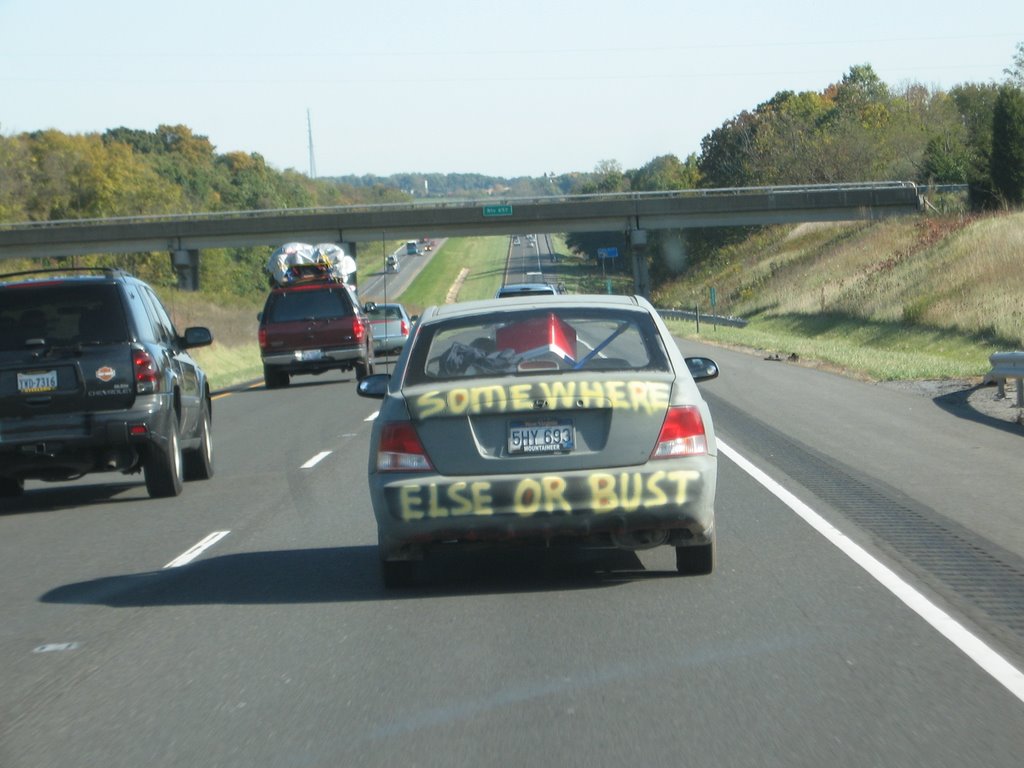


Two headed redneck zombies from outer space, in the woods
According to a flier we picked up in an I-81 convenience store today, this year's big Halloween attraction at Professor Cline's Haunted Monster Museum at Natural Bridge, Va., can be summarized as "Two Headed Redneck Zombies from Outer Space -- in the Woods."
Sunday, October 08, 2006
Everyday movie quotes
In our daily conversation, Sydney and I often fall back on lines from movies -- usually for a laugh, sometimes just because they're so handy. Here are some examples. Can you identify the movie each line comes from?
This first one invariably (and unhelpfully) gets said whenever one of us asks, "Have you seen my keys?"
This first one invariably (and unhelpfully) gets said whenever one of us asks, "Have you seen my keys?"
The Devil thought he had the keys.This next invariably is said whenever one of us, headed to a bank or an ATM, asks, "Do you need money?"
Everybody needs money. That’s why they call it money.The following call-and-response is recited whenever we eat beans, which is shockingly often.
"How ‘bout more beans, Mr. Taggart?"These others just seem to come up naturally.
"I’d say you had enough."
And just what is it that you do ... do?Actually, those last two came not from movies but from a novel and a TV series, respectively. Though the novel line also wound up in a made-for-TV movie, come to think of it.
I am shocked, shocked.
Is correct.
It’s very nice. (Said in a bad French accent.)
Oh, deary dear.
Pull the string! (Said in an Eastern European accent.)
So much time and so little to do. Wait a minute. Strike that. Reverse it. Thank you.
Superstitious, perhaps. Baloney, perhaps not. (Said in that same Eastern European accent.)
What has it got in its pocketses?
Wrapped in plastic.
Wednesday, September 27, 2006
Little Toot
Just as Sydney pressed Rabbit Hill into my hands when she found out I never read it, so I pressed Little Toot into her hands when she said she never heard of it. What she actually did was laugh out loud when I innocently mentioned the title, but I've forgiven her. She now says she enjoyed the book, but she still thinks Little Toot is a dumb title -- and, indeed, the other tugboats on the river do laugh at Little Toot, though not at his father, who is named, uh, Big Toot.
Don't laugh! This was one of my favorite books as a kid, one I frequently checked out of the public library in Batesburg, S.C. Published in 1939, it was the first children's book by Hardie Gramatky (1907-1979), who had been a comic-strip artist, a Disney animator and a magazine illustrator. He was best known as a watercolorist, with exhibitions at the Whitney, the Metropolitan, the Art Institute of Chicago, etc. It's interesting to compare the brushwork of the Little Toot illustrations with that in Gramatky's waterfront paintings, like this one.
Gramatky's New York studio overlooked the East River, and he got the idea for Little Toot while watching the tugboats. While Little Toot's river is unnamed in the book, it seems to be not the East River but the Hudson, as at one point Little Toot gets in the way of a big tug "bound down stream to pick up a string of coal barges from Hoboken."
Throughout, I note as an adult, Little Toot is lauded for the amount of pollution he emits: "What he couldn't create in sound, Little Toot made up for in smoke. From his chubby smokestack he would send up a volley of smoke balls which bubbled over his wake like balloons." At the climax, Little Toot's "S.O.S." smoke signal helps save the day. Environmental qualms aside, I still love Little Toot.
Don't laugh! This was one of my favorite books as a kid, one I frequently checked out of the public library in Batesburg, S.C. Published in 1939, it was the first children's book by Hardie Gramatky (1907-1979), who had been a comic-strip artist, a Disney animator and a magazine illustrator. He was best known as a watercolorist, with exhibitions at the Whitney, the Metropolitan, the Art Institute of Chicago, etc. It's interesting to compare the brushwork of the Little Toot illustrations with that in Gramatky's waterfront paintings, like this one.
Gramatky's New York studio overlooked the East River, and he got the idea for Little Toot while watching the tugboats. While Little Toot's river is unnamed in the book, it seems to be not the East River but the Hudson, as at one point Little Toot gets in the way of a big tug "bound down stream to pick up a string of coal barges from Hoboken."
Throughout, I note as an adult, Little Toot is lauded for the amount of pollution he emits: "What he couldn't create in sound, Little Toot made up for in smoke. From his chubby smokestack he would send up a volley of smoke balls which bubbled over his wake like balloons." At the climax, Little Toot's "S.O.S." smoke signal helps save the day. Environmental qualms aside, I still love Little Toot.
Sunday, September 24, 2006
The Frostburg Arion Band
The next time a music buff mentions the Rolling Stones' remarkable 44-year history as a band, say, "Ah, that's nothing. How about the Frostburg Arion Band?"
I took this photo of the band in performance Saturday in the Upper Quad at Frostburg State University's first Appalachian Festival. Guess how many years this band has been performing. The answer: 129 years. A group of German-Americans in Frostburg, Md., founded the German Arion Band in 1877. I believe that's Ronald Horner of Frostburg State's music faculty, a veteran of the Israel Philharmonic and the Pittsburgh Symphony, leading the current incarnation in Sousa's "Liberty Bell March," a.k.a. the theme from Monty Python's Flying Circus.
In the late 19th and early 20th century, just about every U.S. town of any size had at least one community brass band, peopled by shopkeepers and farmers and kids; it was the era saluted in Meredith Willson's musical The Music Man. In towns with substantial immigrant populations, it wasn't unusual to have one German-American band, one Italian-American band, etc. Most community bands disappeared as the 20th century ground on, but not this one.
There have been a few changes, of course. During the anti-German hysteria of World War II (discussed upstream on this blog), the band changed its name from the German Arion Band to the Frostburg Arion Band.
The band long since stopped relying exclusively on German-Americans, though that ethnicity still abounds in these hills. Today the band is mostly young people, including several members of the Frostburg State University marching band. The musicians in the red uniforms had just run up the hill from the halftime show; this was their second of three gigs on Saturday. Let's see Keith Richards manage that.
Today's band, alas, is in financial distress. Its little revenue from local gigs doesn't come close to meeting expenses, and the 106-year-old band hall on Uhl Street sorely needs repairs and restoration.
The band's namesake, the legendary Corinthian musician Arion, was the "Jolly Mon" of ancient Greece; he was rescued by dolphins after pirates threw him overboard. But who will rescue the Frostburg Arion Band?
I took this photo of the band in performance Saturday in the Upper Quad at Frostburg State University's first Appalachian Festival. Guess how many years this band has been performing.
 The answer: 129 years. A group of German-Americans in Frostburg, Md., founded the German Arion Band in 1877. I believe that's Ronald Horner of Frostburg State's music faculty, a veteran of the Israel Philharmonic and the Pittsburgh Symphony, leading the current incarnation in Sousa's "Liberty Bell March," a.k.a. the theme from Monty Python's Flying Circus.
In the late 19th and early 20th century, just about every U.S. town of any size had at least one community brass band, peopled by shopkeepers and farmers and kids; it was the era saluted in Meredith Willson's musical The Music Man. In towns with substantial immigrant populations, it wasn't unusual to have one German-American band, one Italian-American band, etc. Most community bands disappeared as the 20th century ground on, but not this one.
There have been a few changes, of course. During the anti-German hysteria of World War II (discussed upstream on this blog), the band changed its name from the German Arion Band to the Frostburg Arion Band.
The band long since stopped relying exclusively on German-Americans, though that ethnicity still abounds in these hills. Today the band is mostly young people, including several members of the Frostburg State University marching band. The musicians in the red uniforms had just run up the hill from the halftime show; this was their second of three gigs on Saturday. Let's see Keith Richards manage that.
Today's band, alas, is in financial distress. Its little revenue from local gigs doesn't come close to meeting expenses, and the 106-year-old band hall on Uhl Street sorely needs repairs and restoration.
The band's namesake, the legendary Corinthian musician Arion, was the "Jolly Mon" of ancient Greece; he was rescued by dolphins after pirates threw him overboard. But who will rescue the Frostburg Arion Band?
Foucault's pendulum and Foucault's Pendulum
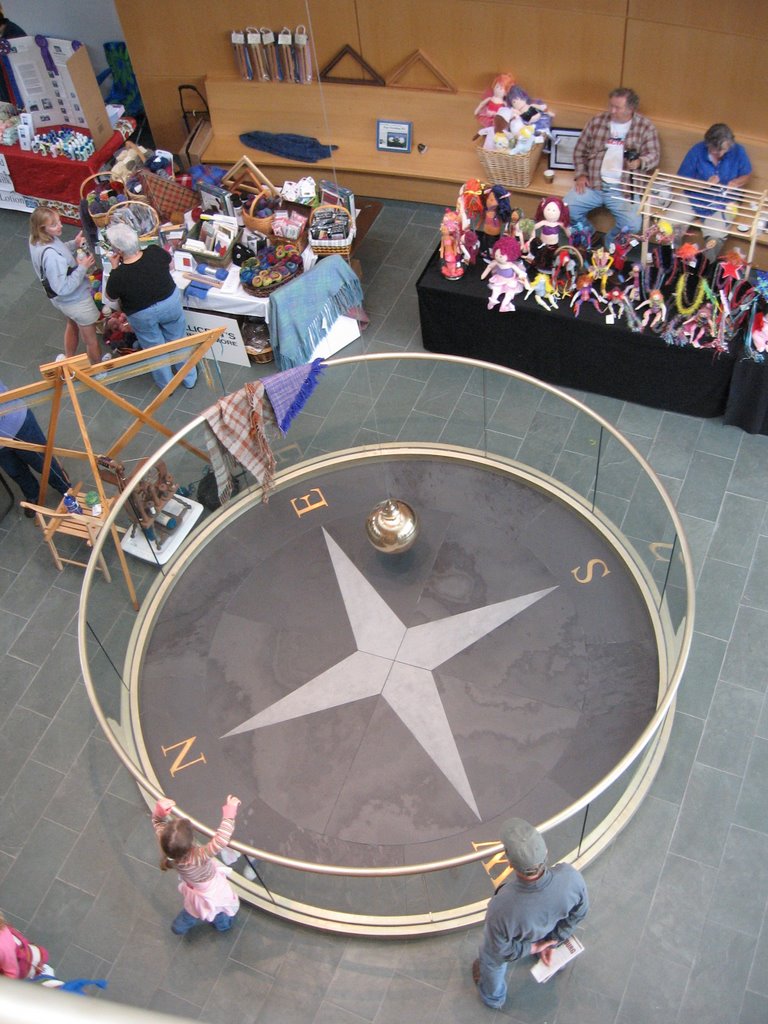
Saturday, Sydney and I attended -- and much enjoyed -- the first Appalachian Festival at Frostburg State University. As much of it took place in the science building, I took the opportunity to photograph my favorite object on campus, this fine Foucault's pendulum that hangs in the three-story atrium, demonstrating the Earth's rotation by day and night to anyone who passes by. During my first trip to Paris, in 1991, I visited Leon Foucault's original pendulum in the Musée des Arts et Métiers. I went there on a sort of pilgrimage because the climax of Umberto Eco's 1988 novel Foucault's Pendulum takes place in the museum, at the pendulum. So long before tourists were tracing the steps of Robert Langdon in The Da Vinci Code, I was tracing Casaubon's steps in Foucault's Pendulum.
The two novels have a lot in common, as both are obsessed with outlandish conspiracy theories involving the Knights Templar, but Eco's novel is much longer, much harder to read, and much more snarky. As a lark, its scholar-heroes invent the mother of all conspiracy theories (after considering, then dismissing, the Mary Magdalene conspiracy theory as old hat), with disastrous consequences. Eco's novel has not yet been turned into a summer blockbuster starring Tom Hanks, but I'm sure Eco is doing pretty well for himself nevertheless.
The novel Foucault's Pendulum was recommended to me by my then-News & Record colleague Dave Stroble, who waved it at me one day and exulted, "You have to read this! I'm only a hundred pages into it, but it must have been written just for you!" I ran right out and bought a copy, read it with delight over the next couple of weeks, then returned to Dave's desk and said, "OK, I'm ready to talk about Foucault's Pendulum now." Dave went ashen and cried, "Don't tell me you actually finished that thing!" He had made it through 150 pages or so before giving up.
 During my first trip to Paris, in 1991, I visited Leon Foucault's original pendulum in the Musée des Arts et Métiers. I went there on a sort of pilgrimage because the climax of Umberto Eco's 1988 novel Foucault's Pendulum takes place in the museum, at the pendulum. So long before tourists were tracing the steps of Robert Langdon in The Da Vinci Code, I was tracing Casaubon's steps in Foucault's Pendulum.
 The two novels have a lot in common, as both are obsessed with outlandish conspiracy theories involving the Knights Templar, but Eco's novel is much longer, much harder to read, and much more snarky. As a lark, its scholar-heroes invent the mother of all conspiracy theories (after considering, then dismissing, the Mary Magdalene conspiracy theory as old hat), with disastrous consequences. Eco's novel has not yet been turned into a summer blockbuster starring Tom Hanks, but I'm sure Eco is doing pretty well for himself nevertheless.
The novel Foucault's Pendulum was recommended to me by my then-News & Record colleague Dave Stroble, who waved it at me one day and exulted, "You have to read this! I'm only a hundred pages into it, but it must have been written just for you!" I ran right out and bought a copy, read it with delight over the next couple of weeks, then returned to Dave's desk and said, "OK, I'm ready to talk about Foucault's Pendulum now." Dave went ashen and cried, "Don't tell me you actually finished that thing!" He had made it through 150 pages or so before giving up.
Thursday, September 21, 2006

A new monarch
Sydney's mother, Fran Bowling, and Sydney's Aunt Charlotte Sartin both raise monarch butterfies, a good habit they acquired in the classroom during years of teaching school. They collect larvae or cocoons, tend them in jars, then release the adult monarchs when they're ready to spread their wings. Sydney and I didn't arrive in Roanoke, Va., this past weekend in time to see this monarch climb out of its cocoon, but we were present to see Fran release it. These photos were taken in its first moments out of the jar. 
 If you love monarchs as we do, please learn to love milkweed, too; it's the only plant on which monarchs will lay eggs, and the only plant on which monarch caterpillars feed. Too often, flourishing stands of roadside milkweed get needlessly mowed down or destroyed by herbicides, thus destroying the monarchs' only habitat. Learn to recognize milkweed, and plant it and protect it wherever you can.

 If you love monarchs as we do, please learn to love milkweed, too; it's the only plant on which monarchs will lay eggs, and the only plant on which monarch caterpillars feed. Too often, flourishing stands of roadside milkweed get needlessly mowed down or destroyed by herbicides, thus destroying the monarchs' only habitat. Learn to recognize milkweed, and plant it and protect it wherever you can.
Subscribe to:
Posts (Atom)
