The great pitcher Lefty Grove,
a member of the Baseball Hall of Fame, was from the coal town of Lonaconing, Md., just a few miles south of here. Because the World Series is over, and because the
Baseball Forever conference at Frostburg State University hasn’t started yet, I filled the void this morning with a miniature Lefty Grove pilgrimage.
My first stop (of two) was the
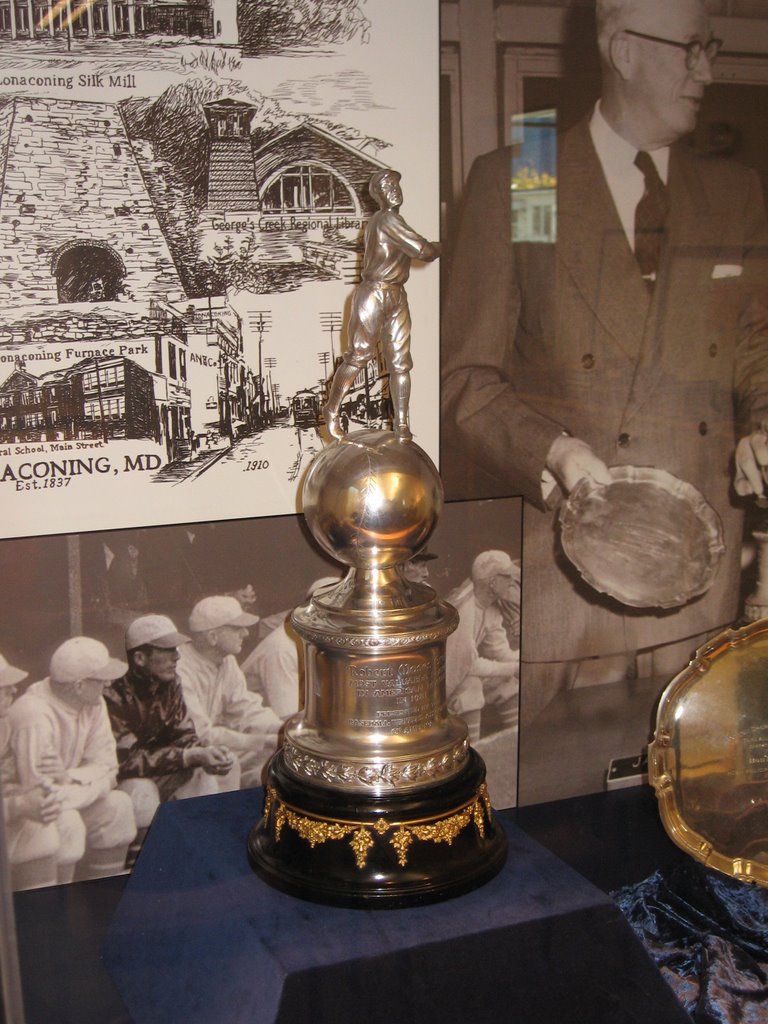
George’s Creek Regional Library in downtown Lonaconing, where Grove’s MVP trophy is on display.
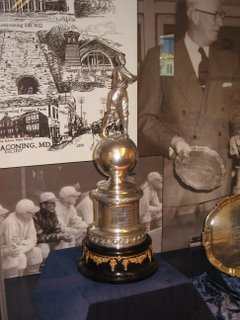
It reads:
Robert Moses Grove
MOST VALUABLE PLAYER
IN AMERICAN LEAGUE
IN 1931
PRESENTED BY THE
BASEBALL WRITERS ASSOCIATION
OF AMERICA
The figure on the trophy seems to be throwing with his right, but never mind; 1931 was the great left-hander’s best year. He went 31-4 for Connie Mack’s Philadelphia Athletics, including a 16-game winning streak, with an ERA of 2.06.
That Robert Moses Grove (1900-1975) would be known as Lefty was inevitable. In baseball, it was an era of nicknames. Lefty’s 1931 World Series teammates included Doc, Mule, Bing, Rube and Dib; their Series opponents that year included Sparky, Ripper, Chick, Pepper and Flint.
Lefty’s story is told by Jim Kaplan in his book
Lefty Grove: American Original and by Sarah Moses in the November 2006 issue of
Allegany Magazine. Lefty’s dad made $50 a month in the mines, hauling “sixteen tons” a day, as in the (much later) Merle Travis song. Lefty worked briefly alongside his dad and brother in the mines before deciding to do something else with his life. He announced, “I didn’t put that coal in the ground, I ain’t gonna take it out.”
In 1920, at age 20, he was hired to play Class C pro ball for the Blue Ridge League team in Martinsburg, W.Va., for $125 a month. Later that year, the Martinsburg owner sold Lefty to the Baltimore Orioles, then a top-paying minor-league team, for the cost of a new fence. For the rest of his life, Lefty proudly claimed he was the only player ever traded for a fence.
During an exhibition game as an Oriole, Lefty struck out Babe Ruth nine times. That sort of thing gets you noticed. In 1925, the Philadelphia Athletics bought his contract for a then-record $100,600 -- you have to wonder how the $600 was negotiated – and Lefty was a major leaguer at last. Ruth soon learned that exhibition game was no fluke; Lefty would hold the Babe to nine homers in 10 years.
In his 17 major-league seasons (nine with Philadelphia and eight with the Boston Red Sox), Lefty had a lifetime winning percentage of .680, with 300 career wins. His niece, Betty Holshey, told
Allegany Magazine that “Uncle Bob” sent the family a case of Wheaties whenever he won a game. “For the longest time,” she said, “we didn’t know there was any other cereal but Wheaties.”
Prematurely gray, Lefty presented to batters a severe and intimidating figure. A bad loser, he was known to berate teammates, rend uniforms, trash locker rooms in frustration. His United Press International obit would say he had “an explosive fast ball and temper to match.” Betty Holshey’s dad warned her, “You don’t want to cross your Uncle Bob.”
Batters didn’t cross him often. Lefty was a six-time All-Star, pitched in three World Series (four wins, two losses and two saves) and was on two world championship teams (the 1929 and 1930 Philadelphia A’s). He led the American League in strikeouts for seven seasons and in ERA for nine.
In his major-league career, he pitched 3,940 innings in 616 games, including 35 shutouts, for a lifetime ERA of 3.06.
In retirement, he came home to Lonaconing, ran a bowling alley, and taught lots of youngsters the finer points of baseball. The Baseball Hall of Fame in Cooperstown, N.Y., wanted his MVP trophy, the first awarded in the American League, but Grove said no, no one from “Coney” would be able to see it there, so he presented it instead to the local high school.
The school is long gone, and the trophy was in a bank vault for a while, before the library gave it a home in a $25,000, climate-controlled, high-security case alongside other Grove artifacts, including an autographed baseball and one of the great man’s golf clubs. Elsewhere in the History Room, a three-ring binder of Grove-related newspaper clippings is worth leafing through. His niece, I’m told, still has one of Uncle Bob’s Philadelphia uniforms; the library would love to have that in the case, too.
In his last years, Grove lived with his son and daughter-in-law in Norwalk, Ohio, and he died there the night of Thursday, May 22, 1975, apparently while watching television. (One wonders what was playing:
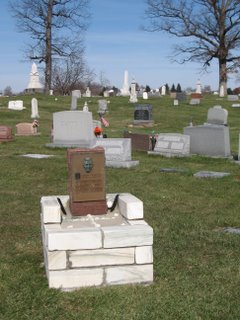
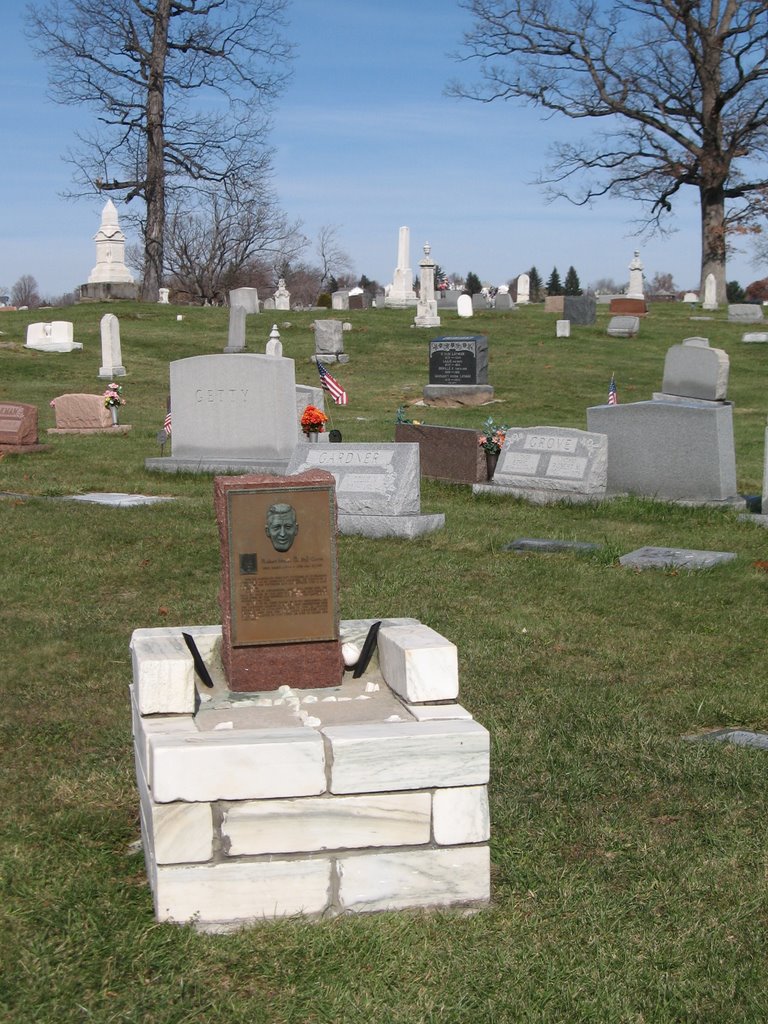
The Waltons, Ironside, Movin’ On?) He’s buried not in Lonaconing but in Frostburg, a few miles up the road from his hometown; his grave was my second and last stop of the day.
LONACONING DIRECTIONS: The George’s Creek Regional Library is easy to find on Lonaconing’s Main Street, a.k.a. Route 36. Take Exit 34 from I-68 at Frostburg and head south. As you enter the library, the History Room is straight ahead. A few blocks north along Main Street is Furnace Park, where a plaque commemorates Grove on the grounds of the old high school.
FROSTBURG DIRECTIONS: To reach the main entrance of Frostburg Memorial Park, take Grant Street south from U.S. 40, a.k.a. Main Street. The cemetery gate is at Grant and Green. Drive through the main entrance and up the hill past the flagpole, then turn right. At the intersection ahead is a plaque identical to the Lonaconing plaque; Grove’s tombstone is just up the hill behind it.
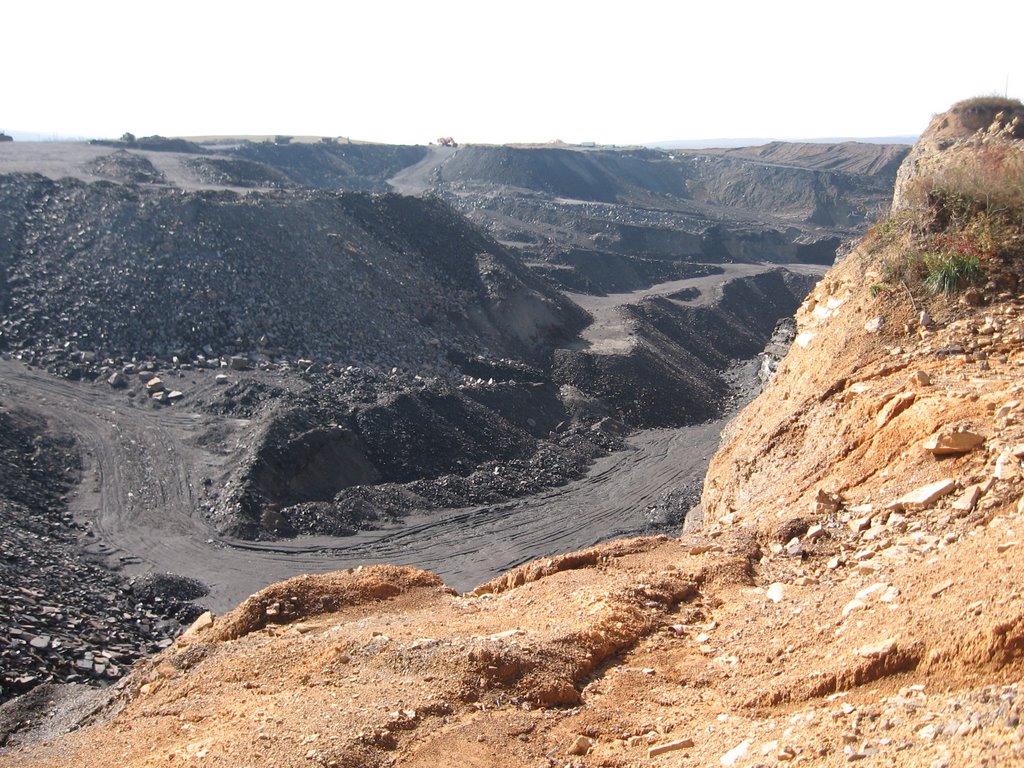 This man-made canyon is a surface coal mine just south of Frostburg, viewed from the east rim along Route 36. For scale, note the house-sized earth-moving machines on the far horizon.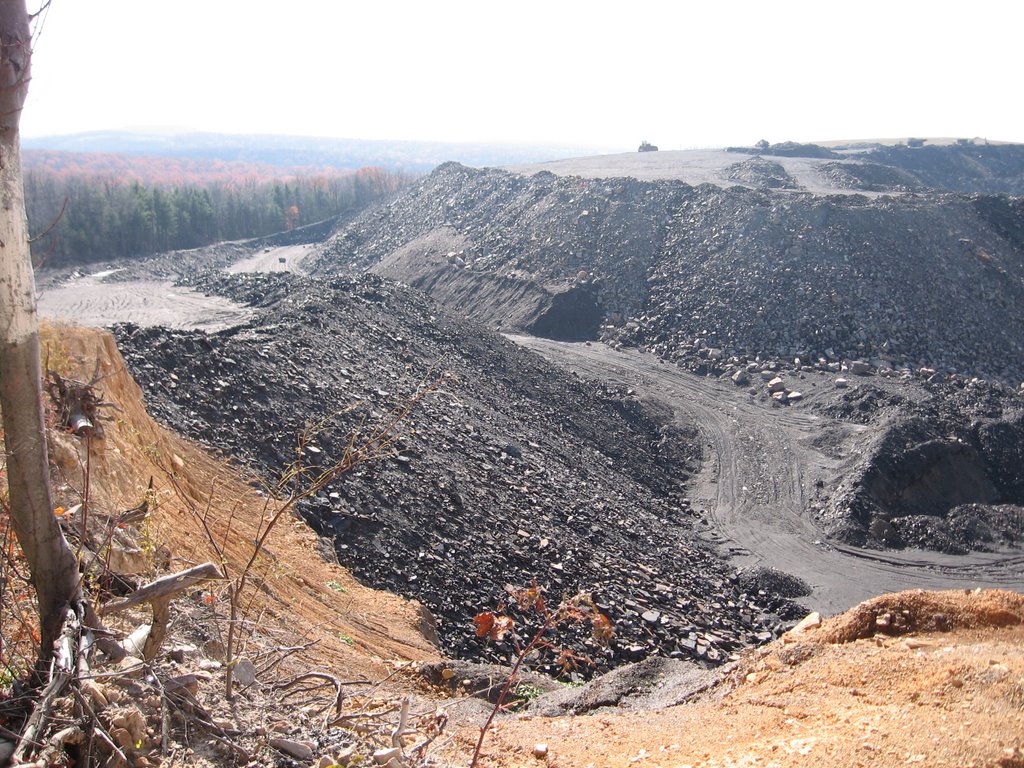
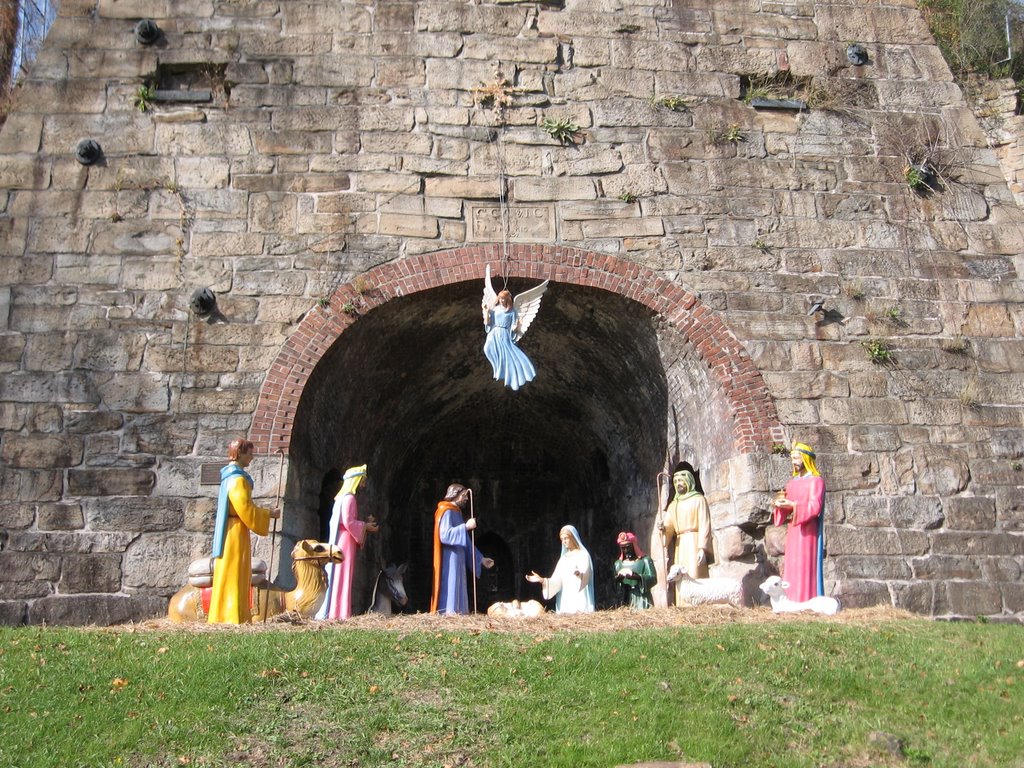 George's Creek Coal and Iron Co. Furnace No. 1 is the town's most striking landmark, a legacy of pre-Civil War industry. The town dates its founding from the year the furnace opened. The furnace produced pig iron from 1839 until 1856 and was the first iron furnace in the United States to successfully use not charcoal but coal and coke, both abundant in Allegany County. The George's Creek company soon, in fact, dropped the iron business to concentrate solely on the coal.
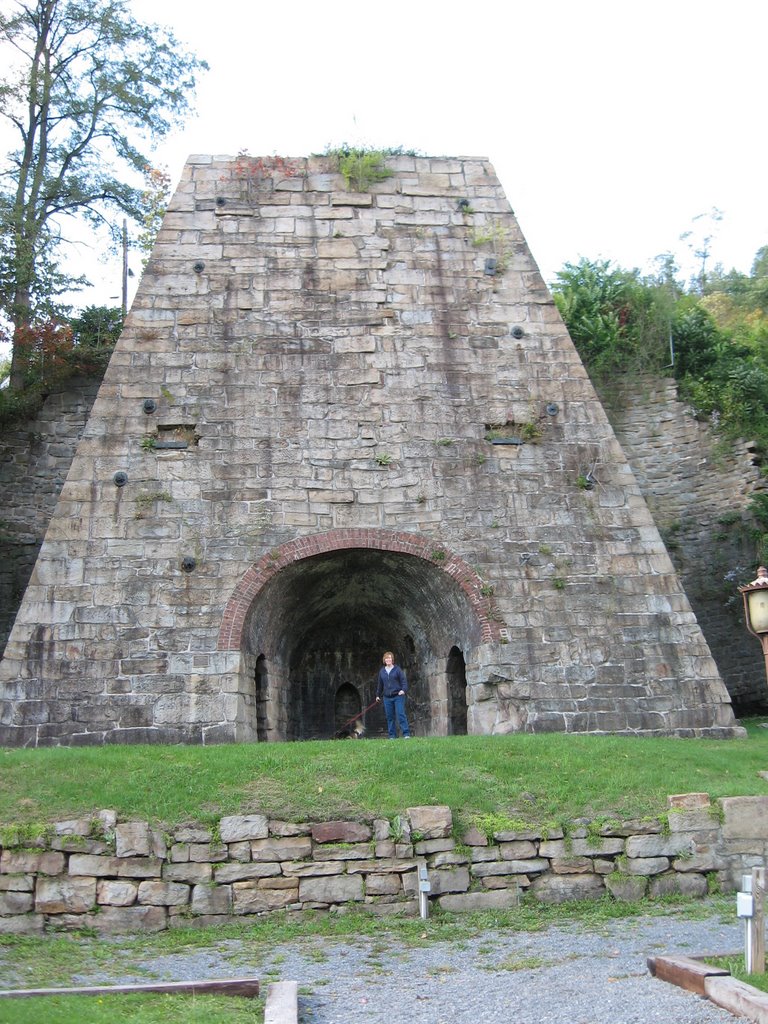 And here's a shot of Sydney "hiding" in the furnace mouth.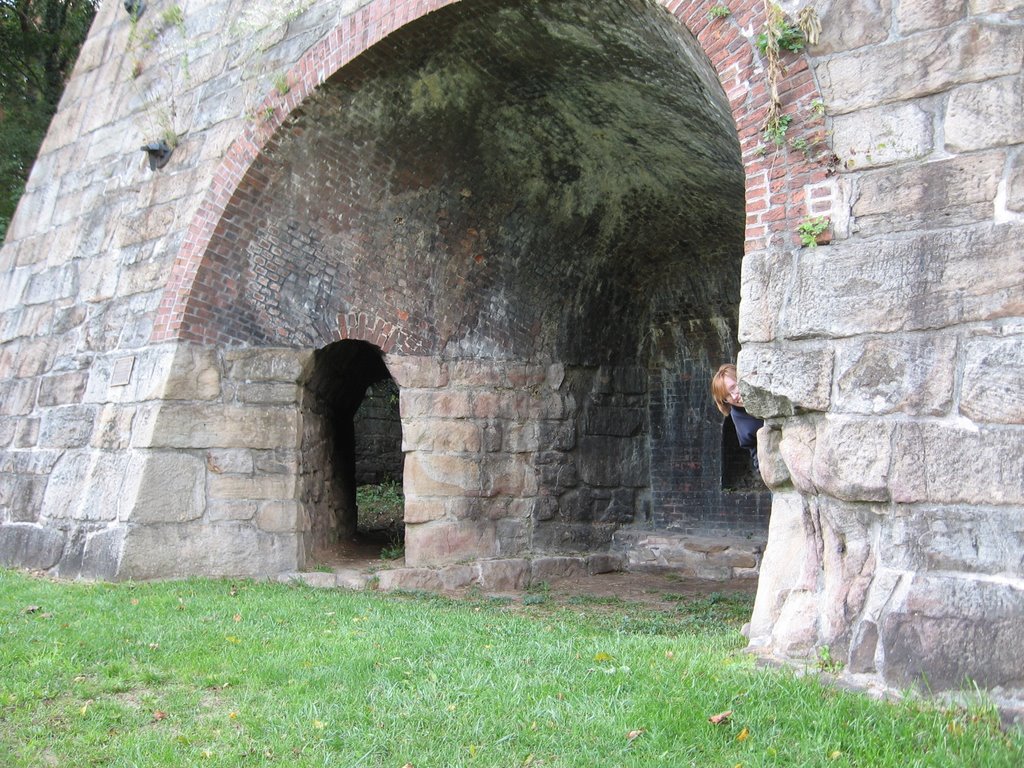
 It reads:
 LONACONING DIRECTIONS: The George’s Creek Regional Library is easy to find on Lonaconing’s Main Street, a.k.a. Route 36. Take Exit 34 from I-68 at Frostburg and head south. As you enter the library, the History Room is straight ahead. A few blocks north along Main Street is Furnace Park, where a plaque commemorates Grove on the grounds of the old high school.

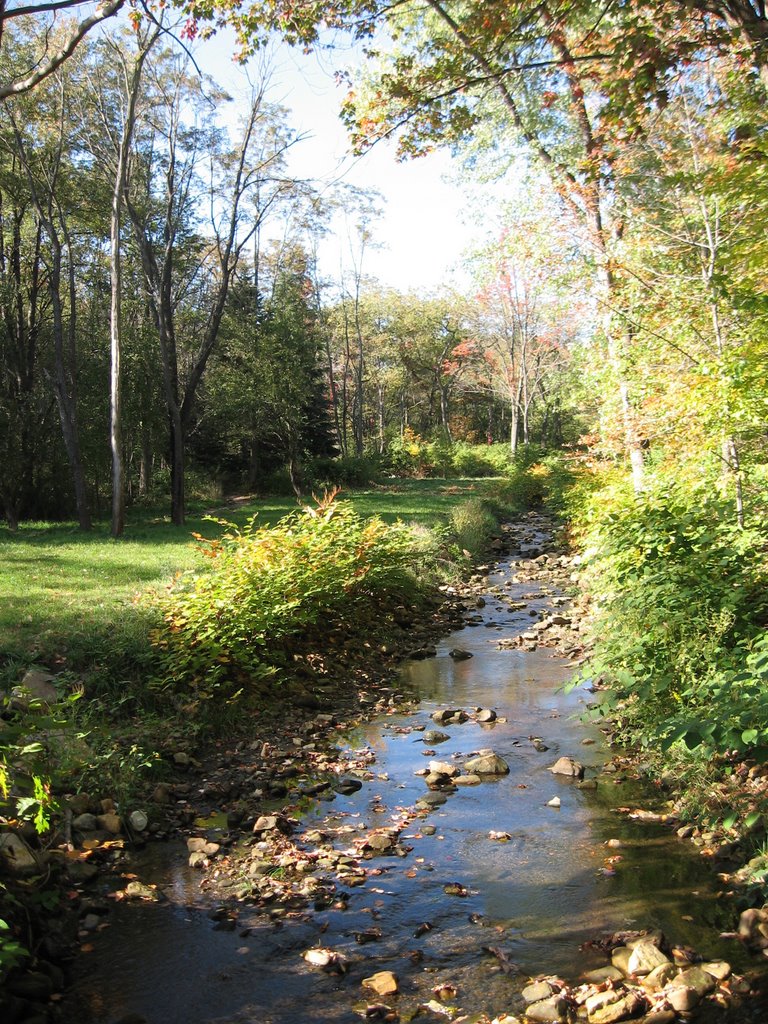
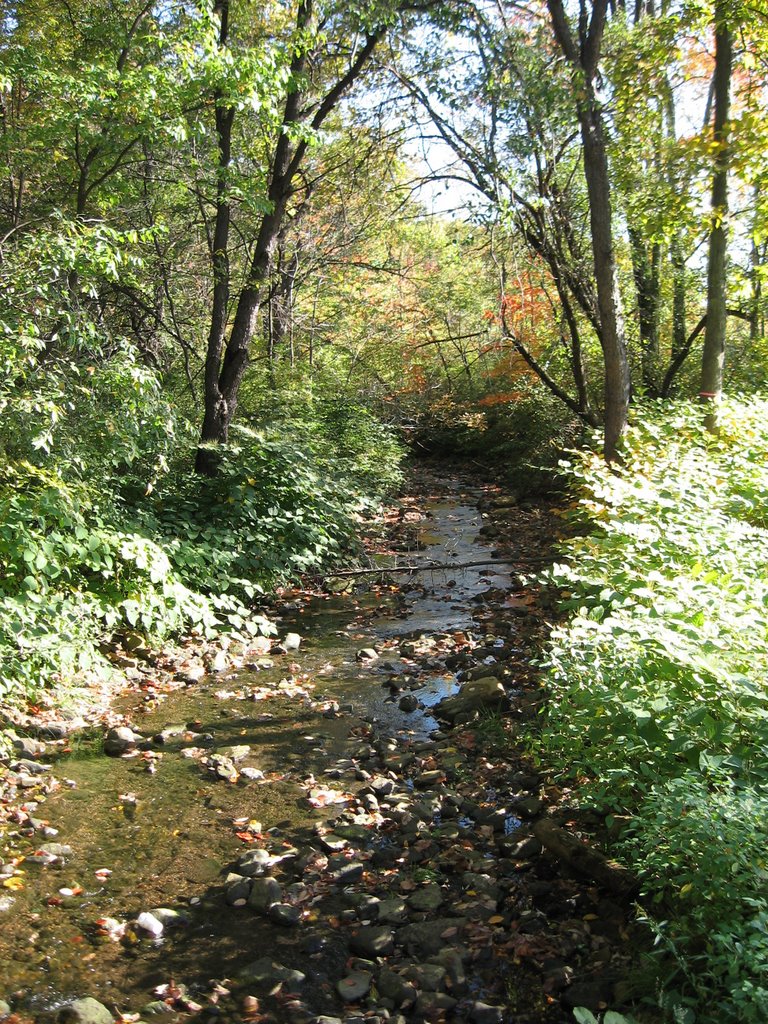

 Our daily walk to campus involves a wooded shortcut that we call the Bear Path, because bears occasionally forage through these woods in season. Sydney's ritual on this stretch is to keep murmuring, "Way, Bear. Way, Bear." This photo of Sydney and Lily on the Bear Path makes it look much more remote than it really is. It's essentially the meeting place of three wooded backyards, and the three houses are just out of camera range.
 Sydney retorts: "You try writing upside down and backward!"