These hunters are impressed by the bird dogging ability of poodles, but there are serious obstacles to more widespread acceptance.Note the license plate in the photo: HTG PDLS.
For one thing, the culture of dogs and hunting is aligned against the breed. The American Kennel Club puts them in the "non-sporting" group. In 2004, the National Rifle Association enlisted them as a symbol of presidential candidate John Kerry's lack of authenticity, using the slogan, "That dog won't hunt."
Tuesday, November 21, 2006
HTG PDLS
Hunters who go into the field not with "bird dogs," but with poodles, clearly are self-confident and independent, and I admire them. Check out this feature by Ben Shouse in The Argus Leader of Sioux Falls, S.D. An excerpt:


"A Mouth for Bluejohn"
My latest essay, "A Mouth for Bluejohn," is in the fall 2006 issue of NC State, the North Carolina State University alumni magazine. (It's on Page 11.)
The essay is about the words and phrases that I never heard before Sydney uttered them ("bluejohn," "have a mouth," "the mail has run," etc.), and the words and phrases that Sydney never heard before I uttered them ("faunching," "floojens," etc.).
The examples in the essay are far from exhaustive, of course. Sydney reminds me of one I was too demure to include: When I was growing up, my family never used the word "laxative," instead calling Milk of Magnesia an "active medicine," with an un-English emphasis on the adjective -- "ACTIVE medicine." This euphemism was news to her.
The essay is about the words and phrases that I never heard before Sydney uttered them ("bluejohn," "have a mouth," "the mail has run," etc.), and the words and phrases that Sydney never heard before I uttered them ("faunching," "floojens," etc.).
The examples in the essay are far from exhaustive, of course. Sydney reminds me of one I was too demure to include: When I was growing up, my family never used the word "laxative," instead calling Milk of Magnesia an "active medicine," with an un-English emphasis on the adjective -- "ACTIVE medicine." This euphemism was news to her.
Wednesday, November 15, 2006
The Clarysville Bridge
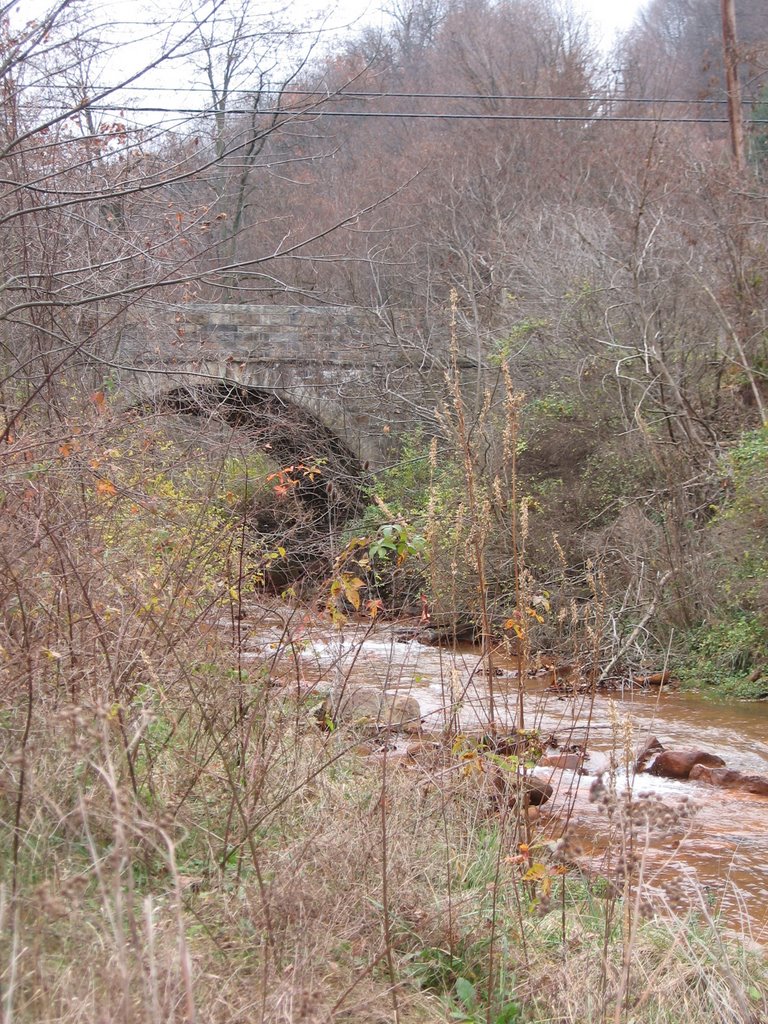 To get a good view of the Clarysville Bridge, at U.S. 40 and Route 55 between Frostburg and LaVale, I had to clamber through thorny bushes down to the streambank. The bridge, built in 1843 along the National Road, is a lot less impressive seen from the level of the highway:
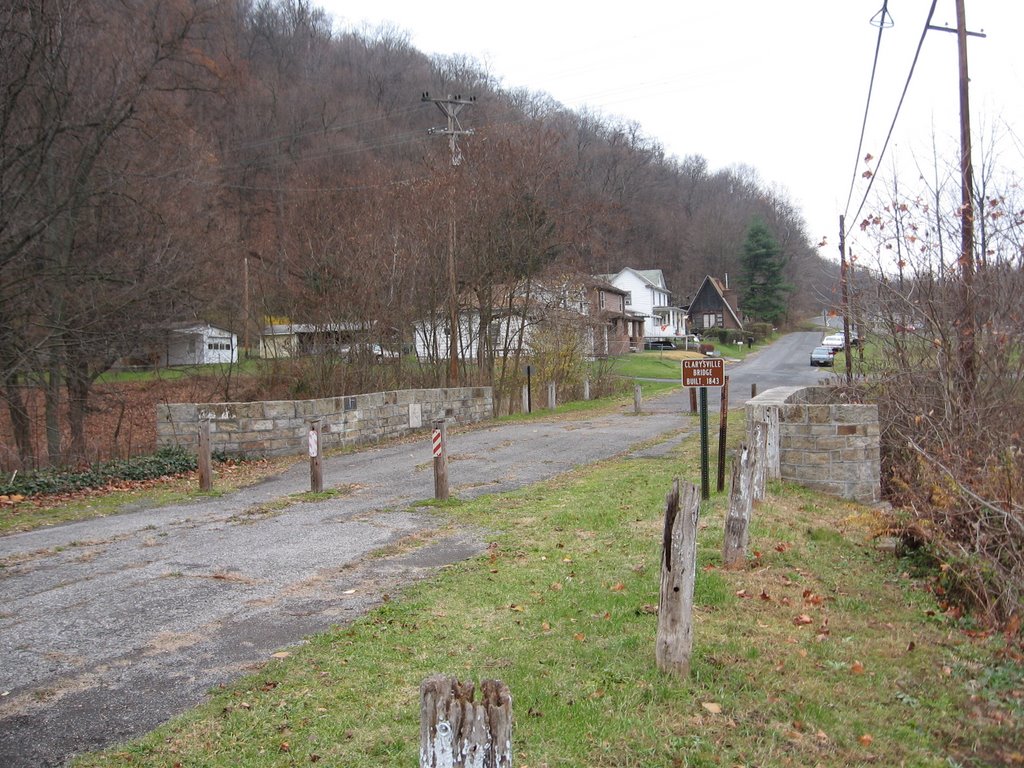 Unfortunately, the stream itself has the discoloration typical of acid mine drainage.

Saturday, November 11, 2006
Ate some burnt hoss flesh
One of my two favorite books (the other being Alice's Adventures in Wonderland) is James Thurber's memoir of his youth in Columbus, Ohio, My Life and Hard Times. I first encountered it when I was about 10, in the pages of The Thurber Carnival, a sort of greatest-hits collection that includes My Life and Hard Times in its entirety (all 115 pages). (I still recommend The Thurber Carnival to any unfortunate who hasn't met Thurber yet.) I picked up The Thurber Carnival at that young age because it was full of cartoons, and I loved cartoons. Enough backstory. My point is that at age 10, I thought the funniest part of this very funny book was this passage from early in Chapter Five, "More Alarms at Night":
I was sure then, and I am sure now, that while the expectation of Father bursting in -- the suspense of wondering when that would happen -- certainly heightened the entertainment value of the repetition, the repetition was entertaining in and of itself, indeed more entertaining than anything else on the record, and that the boys could have listened to "ate some burnt hoss flesh" for hours, had Father not inevitably burst in to complete his role in the (nightly?) drama. I was sure, too, that whatever "No News, or What Killed the Dog" might have been about, "ate some burnt hoss flesh" had to have been the absolute least fortunate line to repeat ad infinitum, the worst collection of syllables on offer, the record's nadir of taste. All this factored into my merriment, as did my utter mystification over what ELSE could possibly have been on that record, what else it might have been about.
This week, more than 30 years later, I finally found out. "No News, or What Killed the Dog" must have been the 19th-century version of "The Aristocrats," a lengthy, offensive shaggy-dog tale subject to endless variations, all of which lead inevitably to the same anticlimactic -- but, in context, grotesquely hilarious -- punchline. I know this because George G. Carey, in his book Maryland Folklore (Tidewater Publishers, 1989), includes a version told by Eastern Shore waterman Alex Kellam. It begins:
So now I finally know the context of "ate some burnt hoss flesh." And it's still funny! As David Letterman would say: For you students of comedy -- now, that's comedy.
Father was usually in bed by nine-thirty and up again by ten-thirty to protest bitterly against a Victrola record we three boys were in the habit of playing over and over, namely, "No News, or What Killed the Dog," a recitation by Nat Wills. The record had been played so many times that its grooves were deeply cut and the needle often kept revolving in the same groove, repeating over and over the same words. Thus: "ate some burnt hoss flesh, ate some burnt hoss flesh, ate some burnt hoss flesh." It was this reiteration that generally got father out of bed.As a child, I wept with laughter when I first read this passage, whenever I re-read this passage, and whenever I even thought about this passage. In fact, I took to amusing myself, whenever I was bored, by murmuring aloud, "ate some burnt hoss flesh, ate some burnt hoss flesh, ate some burnt hoss flesh," until I dissolved into giggles. (This helps explain why my childhood was interrupted periodically by serious conversations instigated by grave and concerned adults.)
I was sure then, and I am sure now, that while the expectation of Father bursting in -- the suspense of wondering when that would happen -- certainly heightened the entertainment value of the repetition, the repetition was entertaining in and of itself, indeed more entertaining than anything else on the record, and that the boys could have listened to "ate some burnt hoss flesh" for hours, had Father not inevitably burst in to complete his role in the (nightly?) drama. I was sure, too, that whatever "No News, or What Killed the Dog" might have been about, "ate some burnt hoss flesh" had to have been the absolute least fortunate line to repeat ad infinitum, the worst collection of syllables on offer, the record's nadir of taste. All this factored into my merriment, as did my utter mystification over what ELSE could possibly have been on that record, what else it might have been about.
This week, more than 30 years later, I finally found out. "No News, or What Killed the Dog" must have been the 19th-century version of "The Aristocrats," a lengthy, offensive shaggy-dog tale subject to endless variations, all of which lead inevitably to the same anticlimactic -- but, in context, grotesquely hilarious -- punchline. I know this because George G. Carey, in his book Maryland Folklore (Tidewater Publishers, 1989), includes a version told by Eastern Shore waterman Alex Kellam. It begins:
I heard the one about the rich plantation owner whose health went bad and the doctor ordered him away for six months' rest and he was to lose all contact with his friends and family. And so at the end of the six months he came back and his colored servant met him at the depot and took him home in the horse and buggy. On the way in he said to Sam,And so on and so on, potentially endlessly, with calamity piling upon calamity, until at the end we reach the punchline: "But other than that, there ain't no news." Carey calls this story "a once widely told American yarn."
"Now I've been gone six months and I haven't heard one thing from home. What's happened since I've been gone?"
He said, "Oh nothing, except one little thing. Since you've been gone your dog died."
He said, "The dog died? Well, what killed the dog?"
"Well, the dog eat some burnt horse flesh."
"Burnt horse flesh? How'd he get that?"
"Well, your barn burnt down and burnt up all the cows and horses, and after the fire the dog eat the burnt horse flesh and that's what killed the dog."
"Oh," he said, "my barn burned?"
He said, "Yessir, the barn burned."
He said, "How did the barn catch fire?"
"Well, it seems a spark flew over from the house ..."
So now I finally know the context of "ate some burnt hoss flesh." And it's still funny! As David Letterman would say: For you students of comedy -- now, that's comedy.
Friday, November 10, 2006
The wreck of the Edmund Fitzgerald
On this date in 1975, the freighter Edmund Fitzgerald was lost with all hands during a storm on Lake Superior. I was 11 years old, and while I was a faithful newspaper reader even then, and read every back issue of Newsweek that my Aunt Willa May passed me, I don't recall the wreck itself making much of an impression. The Newsweek writeup did, however, make a deep impression on Canadian singer-songwriter Gordon Lightfoot, and the song he was inspired to write and perform, "The Wreck of the Edmund Fitzgerald," left me thunderstruck the next year, 1976, whenever I heard it on the radio. I got plenty of opportunity to hear it; the song went to No. 2 on the pop charts. Since then, Lightfoot's bone-chilling six-and-a-half-minute epic has cropped up occasionally on lists of most-hated songs; its critics claim that it's too long, too slow and too maudlin, down there in the depths with "Seasons in the Sun." But I loved the song then, and I love it now, without the slightest irony or distance. I hear the opening, and I'm immediately cold, as if "twas the witch of November come stealin'." And without that song, what are the odds that I would remember the Edmund Fitzgerald at all? This is one of the only examples in my lifetime of a disaster that immediately gets set to music and sung into myth, like the Baltimore fire or the wreck of the Old 97. It's downright bardic, what Lightfoot did in that song.
Wednesday, November 08, 2006
How the Rolling Stone "10 Worst" fared
The day after the Democrats came back, I re-read Matt Taibbi's cover story in the Nov. 2 Rolling Stone, headlined "The Worst Congress Ever." It's full of eyebrow-scorching Mencken-style invective, for example the description of James Sensenbrenner Jr., R-Wis., as "an ever-sweating, fat-fingered beast who wields his gavel in a way that makes you think he might have used one before in some other arena, perhaps to beat prostitutes to death."
Sensenbrenner was listed as one of the magazine's "10 Worst Congressmen," all but one of them Republicans. Before the election, my assumption was that all 10 would sail through the election unscathed, in spite of -- or because of -- Rolling Stone's dudgeon. But it didn't work out that way: Two were voted out of office, one was forced into a runoff, and four others, while re-elected by the loyalists back home, will lose their positions of national power, namely their chairmanships, to Democrats. Here's the Rolling Stone "10 Worst" list, with the nicknames the magazine assigned them and their fate in Tuesday's election.
Dennis "The Highway Robber" Hastert, R-Ill., re-elected with 60 percent of the vote but lost his position as speaker of the House.
James "The Dictator" Sensenbrenner Jr., R-Wis., re-elected with 62 percent of the vote but lost his chairmanship of the Judiciary Committee.
Don "Mr. Pork" Young, R-Alaska, re-elected with 57 percent of the vote but lost his chairmanship of the Transportation Committee.
William "The Bribe Taker" Jefferson, D-La., led a crowded field with 30 percent of the vote but now faces a Dec. 9 runoff with the No. 2 candidate, a fellow Democrat (more on that below).
Jerry "The King of Payoffs" Lewis, R-Calif., re-elected with 66 percent of the vote but lost his chairmanship of the Appropriations Committee.
Tom "Mr. Bigotry" Tancredo, R-Colo., re-elected with 59 percent of the vote.
Dick "Enemy of the Earth" Pombo, R-Calif., chair of the Resources Committee, lost with 47 percent of the vote to his Democratic challenger's 53 percent.
Curt "The Conspiracy Nut" Weldon, R-Pa., lost with 44 percent of the vote to his Democratic challenger's 56 percent.
Hal "Homeland Security Hog" Rogers, R-Ky., won with 74 percent of the vote -- the biggest winning margin on this list.
Marilyn "The Queen of Gay Bashing" Musgrave, R-Colo., won with 46 percent of the vote -- the smallest winning margin on this list. (Her Democratic opponent got 43 percent.)
Jefferson was running against eight Democrats, three Republicans and a Libertarian. The three runner-up Democrats got 52 percent of the vote among them. Had all those rivals within his own party drawn straws, played rock-paper-scissors, etc., and put all their resources behind a single non-Jefferson Democrat, Jefferson would have lost this race outright, and Rolling Stone's batting average would be even higher.
But as it stands, at least 20 percent of the magazine's list was ousted, and another 40 percent of the list was demoted -- which still looks pretty prescient, in hindsight. I'll be interested to read Rolling Stone's "10 Worst" list in 2006.
(Thanks to Bob for pointing out my error in the original version of this post.)
Sensenbrenner was listed as one of the magazine's "10 Worst Congressmen," all but one of them Republicans. Before the election, my assumption was that all 10 would sail through the election unscathed, in spite of -- or because of -- Rolling Stone's dudgeon. But it didn't work out that way: Two were voted out of office, one was forced into a runoff, and four others, while re-elected by the loyalists back home, will lose their positions of national power, namely their chairmanships, to Democrats. Here's the Rolling Stone "10 Worst" list, with the nicknames the magazine assigned them and their fate in Tuesday's election.
Jefferson was running against eight Democrats, three Republicans and a Libertarian. The three runner-up Democrats got 52 percent of the vote among them. Had all those rivals within his own party drawn straws, played rock-paper-scissors, etc., and put all their resources behind a single non-Jefferson Democrat, Jefferson would have lost this race outright, and Rolling Stone's batting average would be even higher.
But as it stands, at least 20 percent of the magazine's list was ousted, and another 40 percent of the list was demoted -- which still looks pretty prescient, in hindsight. I'll be interested to read Rolling Stone's "10 Worst" list in 2006.
(Thanks to Bob for pointing out my error in the original version of this post.)
Tuesday, November 07, 2006
Black as the Pit from pole to pole
 This man-made canyon is a surface coal mine just south of Frostburg, viewed from the east rim along Route 36. For scale, note the house-sized earth-moving machines on the far horizon.
Sharpe and "Seanbean"
I am pleased to see on Dan's Slapinions blog that he read aloud to one of his children, when she was an infant, one of Bernard Cornwell's Sharpe novels.
Cornwell has written 21 of these Napleonic military adventures so far (the most recent being Sharpe's Fury), and 15 Sharpe movies (if I count correctly) have been filmed by the BBC, with Sean Bean in the title role. We watched the most recent, Sharpe's Challenge, earlier this year on BBC America; we even watched the making-of documentary. Sydney has no interest in making-of documentaries, the novels of Bernard Cornwell or the Napoleonic Wars, but her interest in Sean Bean approaches totality. She likes to pronounce "Sean" with a long E, to rhyme with "Bean," and say them quickly: "Seanbean."
The rest of the cast was good, too: Daragh O'Malley as Sharpe's burly sidekick Patrick Harper, Peter Hugo-Daly as the loathsome and toothy Sgt. Bickerstaff, Michael Cochrane as the pompous dimwit Gen. Simmerson. The villains were especially high-caliber: Toby Stephens and Padma Lakshmi, a.k.a. Maggie Smith's son and Salman Rushdie's wife. All worked hard, but Sydney paid them no heed, with Sean Bean around.
Cornwell has written 21 of these Napleonic military adventures so far (the most recent being Sharpe's Fury), and 15 Sharpe movies (if I count correctly) have been filmed by the BBC, with Sean Bean in the title role. We watched the most recent, Sharpe's Challenge, earlier this year on BBC America; we even watched the making-of documentary. Sydney has no interest in making-of documentaries, the novels of Bernard Cornwell or the Napoleonic Wars, but her interest in Sean Bean approaches totality. She likes to pronounce "Sean" with a long E, to rhyme with "Bean," and say them quickly: "Seanbean."
The rest of the cast was good, too: Daragh O'Malley as Sharpe's burly sidekick Patrick Harper, Peter Hugo-Daly as the loathsome and toothy Sgt. Bickerstaff, Michael Cochrane as the pompous dimwit Gen. Simmerson. The villains were especially high-caliber: Toby Stephens and Padma Lakshmi, a.k.a. Maggie Smith's son and Salman Rushdie's wife. All worked hard, but Sydney paid them no heed, with Sean Bean around.
Have you voted?
Besides having the best first name in Frostburg, Avalon Ledong has an excellent letter to the editor in today's Election Day edition of the Cumberland Times-News. A Malaysian-American who just got his U.S. citizenship this year, Ledong explains why he's voting today. He concludes:
America still has great promise and great potential. Not all of her dreams are yet realized. The best of the dream can still be yet to come. I want to be a part of making that happen.Here's an earlier Times-News profile of Ledong, who works in personnel at Frostburg State University.
So today I will vote in my first general election. It will be a proud moment for me and for my family. It will be a moment of faith in this country.
Sunday, November 05, 2006
Christ in the mouth of Moloch
While driving through Lonaconing, Md., yesterday, I happened upon a nativity scene in the mouth of the furnace.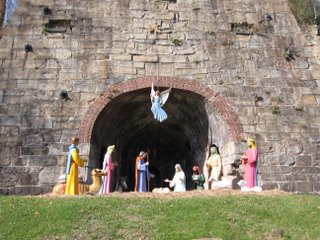 George's Creek Coal and Iron Co. Furnace No. 1 is the town's most striking landmark, a legacy of pre-Civil War industry. The town dates its founding from the year the furnace opened. The furnace produced pig iron from 1839 until 1856 and was the first iron furnace in the United States to successfully use not charcoal but coal and coke, both abundant in Allegany County. The George's Creek company soon, in fact, dropped the iron business to concentrate solely on the coal.
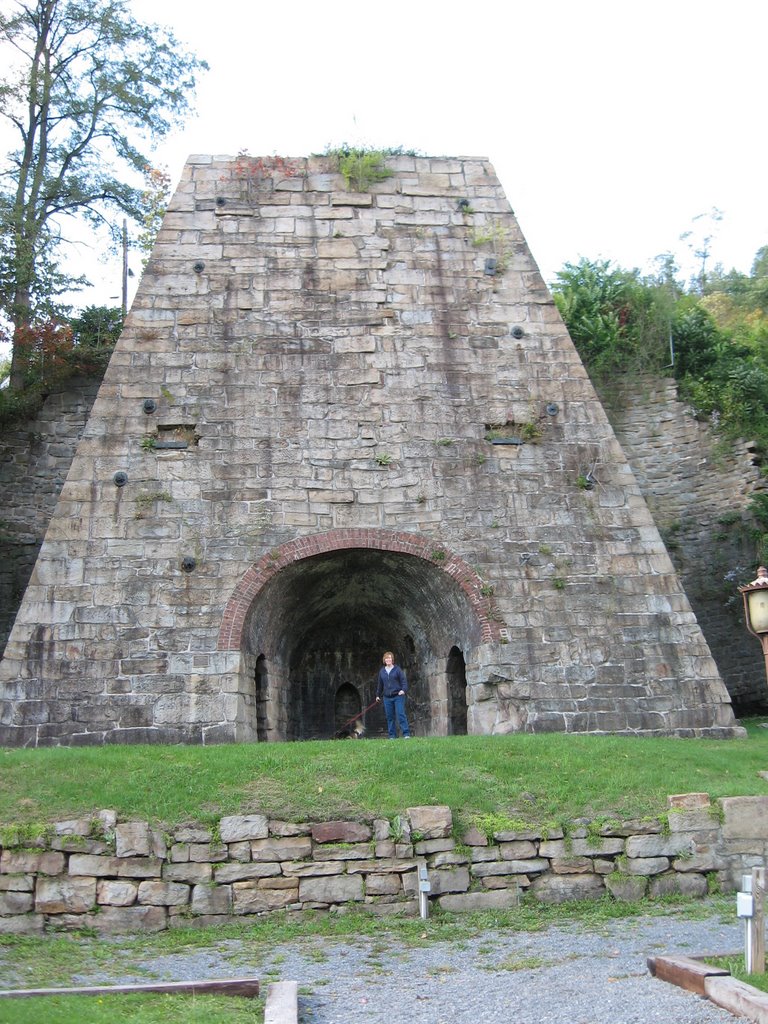
These photos don't really convey how massive the thing is, and how startling it is to unsuspecting passers-by on Route 36. Commonly heard from the passenger seat: "WHAT in the world was THAT? Turn around!" Here's a shot of Sydney and Lily in front of the furnace mouth this summer.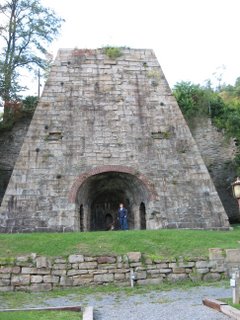 And here's a shot of Sydney "hiding" in the furnace mouth.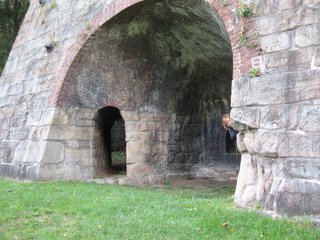
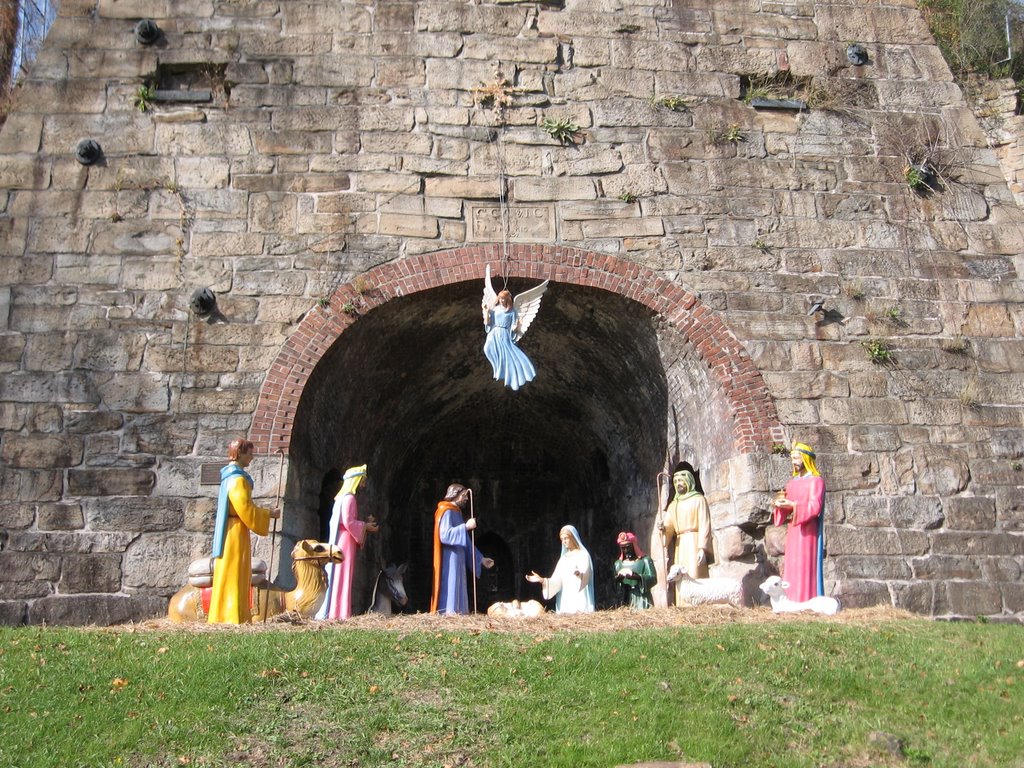 George's Creek Coal and Iron Co. Furnace No. 1 is the town's most striking landmark, a legacy of pre-Civil War industry. The town dates its founding from the year the furnace opened. The furnace produced pig iron from 1839 until 1856 and was the first iron furnace in the United States to successfully use not charcoal but coal and coke, both abundant in Allegany County. The George's Creek company soon, in fact, dropped the iron business to concentrate solely on the coal.
These photos don't really convey how massive the thing is, and how startling it is to unsuspecting passers-by on Route 36. Commonly heard from the passenger seat: "WHAT in the world was THAT? Turn around!" Here's a shot of Sydney and Lily in front of the furnace mouth this summer.
 And here's a shot of Sydney "hiding" in the furnace mouth.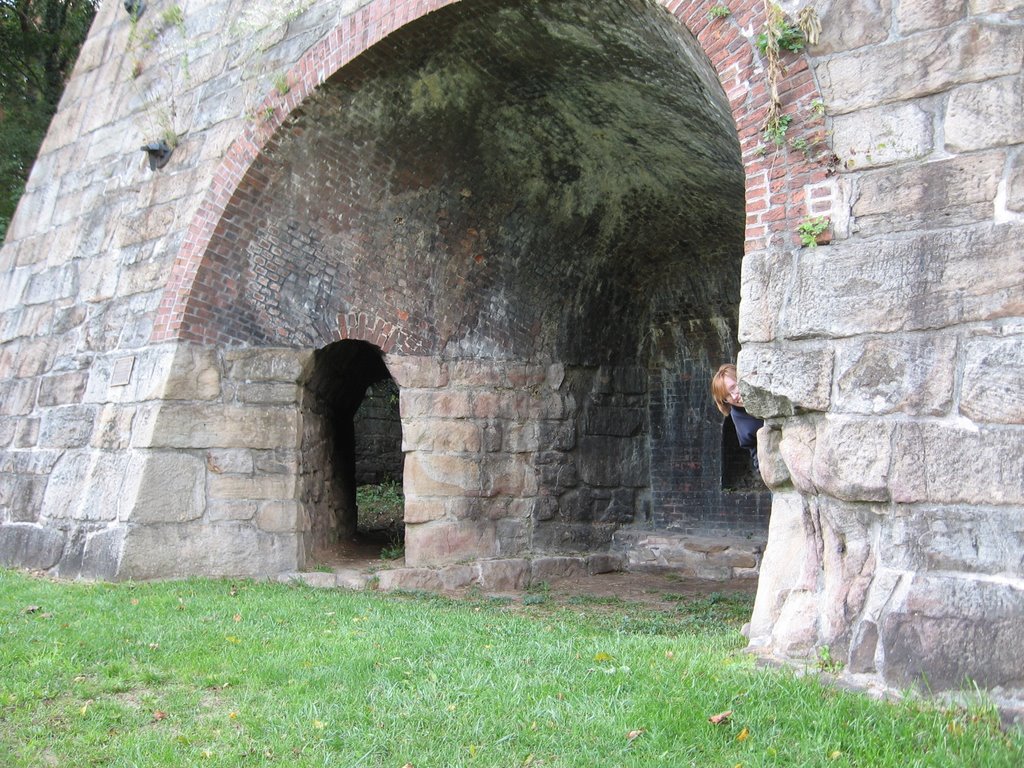
Saturday, November 04, 2006
The trail of Lefty Grove
The great pitcher Lefty Grove, a member of the Baseball Hall of Fame, was from the coal town of Lonaconing, Md., just a few miles south of here. Because the World Series is over, and because the Baseball Forever conference at Frostburg State University hasn’t started yet, I filled the void this morning with a miniature Lefty Grove pilgrimage.
My first stop (of two) was the George’s Creek Regional Library in downtown Lonaconing, where Grove’s MVP trophy is on display.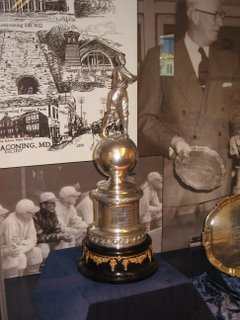 It reads:
That Robert Moses Grove (1900-1975) would be known as Lefty was inevitable. In baseball, it was an era of nicknames. Lefty’s 1931 World Series teammates included Doc, Mule, Bing, Rube and Dib; their Series opponents that year included Sparky, Ripper, Chick, Pepper and Flint.
Lefty’s story is told by Jim Kaplan in his book Lefty Grove: American Original and by Sarah Moses in the November 2006 issue of Allegany Magazine. Lefty’s dad made $50 a month in the mines, hauling “sixteen tons” a day, as in the (much later) Merle Travis song. Lefty worked briefly alongside his dad and brother in the mines before deciding to do something else with his life. He announced, “I didn’t put that coal in the ground, I ain’t gonna take it out.”
In 1920, at age 20, he was hired to play Class C pro ball for the Blue Ridge League team in Martinsburg, W.Va., for $125 a month. Later that year, the Martinsburg owner sold Lefty to the Baltimore Orioles, then a top-paying minor-league team, for the cost of a new fence. For the rest of his life, Lefty proudly claimed he was the only player ever traded for a fence.
During an exhibition game as an Oriole, Lefty struck out Babe Ruth nine times. That sort of thing gets you noticed. In 1925, the Philadelphia Athletics bought his contract for a then-record $100,600 -- you have to wonder how the $600 was negotiated – and Lefty was a major leaguer at last. Ruth soon learned that exhibition game was no fluke; Lefty would hold the Babe to nine homers in 10 years.
In his 17 major-league seasons (nine with Philadelphia and eight with the Boston Red Sox), Lefty had a lifetime winning percentage of .680, with 300 career wins. His niece, Betty Holshey, told Allegany Magazine that “Uncle Bob” sent the family a case of Wheaties whenever he won a game. “For the longest time,” she said, “we didn’t know there was any other cereal but Wheaties.”
Prematurely gray, Lefty presented to batters a severe and intimidating figure. A bad loser, he was known to berate teammates, rend uniforms, trash locker rooms in frustration. His United Press International obit would say he had “an explosive fast ball and temper to match.” Betty Holshey’s dad warned her, “You don’t want to cross your Uncle Bob.”
Batters didn’t cross him often. Lefty was a six-time All-Star, pitched in three World Series (four wins, two losses and two saves) and was on two world championship teams (the 1929 and 1930 Philadelphia A’s). He led the American League in strikeouts for seven seasons and in ERA for nine.
In his major-league career, he pitched 3,940 innings in 616 games, including 35 shutouts, for a lifetime ERA of 3.06.
In retirement, he came home to Lonaconing, ran a bowling alley, and taught lots of youngsters the finer points of baseball. The Baseball Hall of Fame in Cooperstown, N.Y., wanted his MVP trophy, the first awarded in the American League, but Grove said no, no one from “Coney” would be able to see it there, so he presented it instead to the local high school.
The school is long gone, and the trophy was in a bank vault for a while, before the library gave it a home in a $25,000, climate-controlled, high-security case alongside other Grove artifacts, including an autographed baseball and one of the great man’s golf clubs. Elsewhere in the History Room, a three-ring binder of Grove-related newspaper clippings is worth leafing through. His niece, I’m told, still has one of Uncle Bob’s Philadelphia uniforms; the library would love to have that in the case, too.
In his last years, Grove lived with his son and daughter-in-law in Norwalk, Ohio, and he died there the night of Thursday, May 22, 1975, apparently while watching television. (One wonders what was playing: The Waltons, Ironside, Movin’ On?) He’s buried not in Lonaconing but in Frostburg, a few miles up the road from his hometown; his grave was my second and last stop of the day.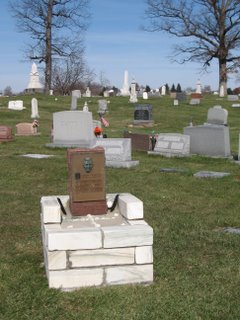 LONACONING DIRECTIONS: The George’s Creek Regional Library is easy to find on Lonaconing’s Main Street, a.k.a. Route 36. Take Exit 34 from I-68 at Frostburg and head south. As you enter the library, the History Room is straight ahead. A few blocks north along Main Street is Furnace Park, where a plaque commemorates Grove on the grounds of the old high school.
FROSTBURG DIRECTIONS: To reach the main entrance of Frostburg Memorial Park, take Grant Street south from U.S. 40, a.k.a. Main Street. The cemetery gate is at Grant and Green. Drive through the main entrance and up the hill past the flagpole, then turn right. At the intersection ahead is a plaque identical to the Lonaconing plaque; Grove’s tombstone is just up the hill behind it.
My first stop (of two) was the George’s Creek Regional Library in downtown Lonaconing, where Grove’s MVP trophy is on display.
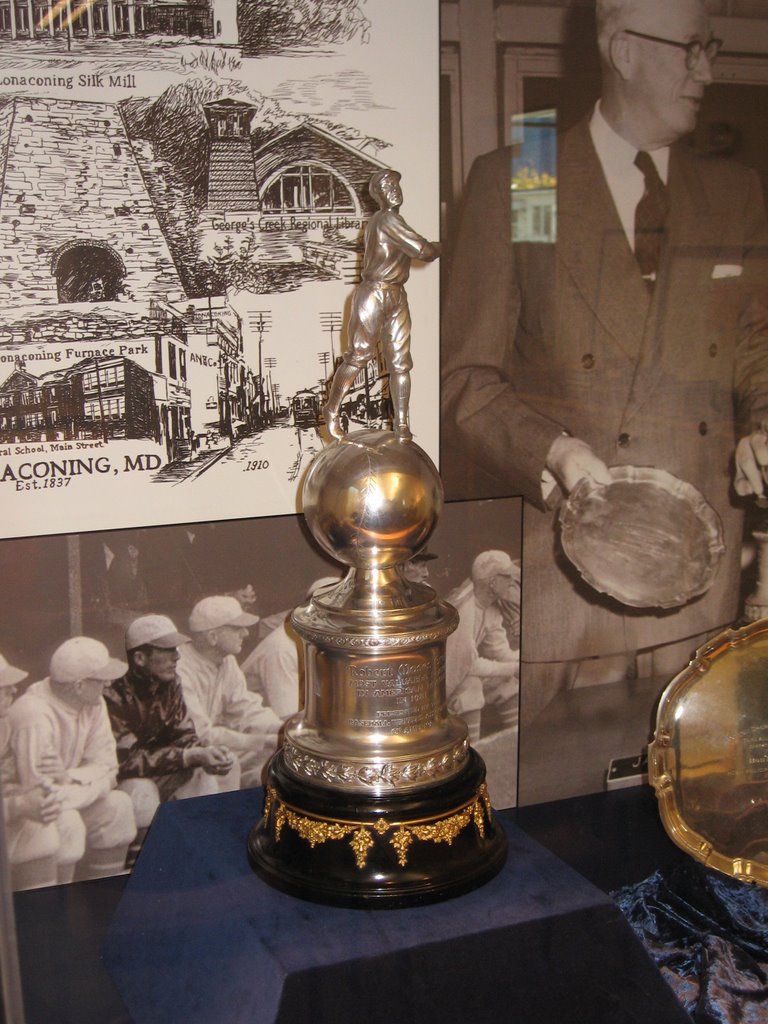 It reads:
Robert Moses GroveThe figure on the trophy seems to be throwing with his right, but never mind; 1931 was the great left-hander’s best year. He went 31-4 for Connie Mack’s Philadelphia Athletics, including a 16-game winning streak, with an ERA of 2.06.
MOST VALUABLE PLAYER
IN AMERICAN LEAGUE
IN 1931
PRESENTED BY THE
BASEBALL WRITERS ASSOCIATION
OF AMERICA
That Robert Moses Grove (1900-1975) would be known as Lefty was inevitable. In baseball, it was an era of nicknames. Lefty’s 1931 World Series teammates included Doc, Mule, Bing, Rube and Dib; their Series opponents that year included Sparky, Ripper, Chick, Pepper and Flint.
Lefty’s story is told by Jim Kaplan in his book Lefty Grove: American Original and by Sarah Moses in the November 2006 issue of Allegany Magazine. Lefty’s dad made $50 a month in the mines, hauling “sixteen tons” a day, as in the (much later) Merle Travis song. Lefty worked briefly alongside his dad and brother in the mines before deciding to do something else with his life. He announced, “I didn’t put that coal in the ground, I ain’t gonna take it out.”
In 1920, at age 20, he was hired to play Class C pro ball for the Blue Ridge League team in Martinsburg, W.Va., for $125 a month. Later that year, the Martinsburg owner sold Lefty to the Baltimore Orioles, then a top-paying minor-league team, for the cost of a new fence. For the rest of his life, Lefty proudly claimed he was the only player ever traded for a fence.
During an exhibition game as an Oriole, Lefty struck out Babe Ruth nine times. That sort of thing gets you noticed. In 1925, the Philadelphia Athletics bought his contract for a then-record $100,600 -- you have to wonder how the $600 was negotiated – and Lefty was a major leaguer at last. Ruth soon learned that exhibition game was no fluke; Lefty would hold the Babe to nine homers in 10 years.
In his 17 major-league seasons (nine with Philadelphia and eight with the Boston Red Sox), Lefty had a lifetime winning percentage of .680, with 300 career wins. His niece, Betty Holshey, told Allegany Magazine that “Uncle Bob” sent the family a case of Wheaties whenever he won a game. “For the longest time,” she said, “we didn’t know there was any other cereal but Wheaties.”
Prematurely gray, Lefty presented to batters a severe and intimidating figure. A bad loser, he was known to berate teammates, rend uniforms, trash locker rooms in frustration. His United Press International obit would say he had “an explosive fast ball and temper to match.” Betty Holshey’s dad warned her, “You don’t want to cross your Uncle Bob.”
Batters didn’t cross him often. Lefty was a six-time All-Star, pitched in three World Series (four wins, two losses and two saves) and was on two world championship teams (the 1929 and 1930 Philadelphia A’s). He led the American League in strikeouts for seven seasons and in ERA for nine.
In his major-league career, he pitched 3,940 innings in 616 games, including 35 shutouts, for a lifetime ERA of 3.06.
In retirement, he came home to Lonaconing, ran a bowling alley, and taught lots of youngsters the finer points of baseball. The Baseball Hall of Fame in Cooperstown, N.Y., wanted his MVP trophy, the first awarded in the American League, but Grove said no, no one from “Coney” would be able to see it there, so he presented it instead to the local high school.
The school is long gone, and the trophy was in a bank vault for a while, before the library gave it a home in a $25,000, climate-controlled, high-security case alongside other Grove artifacts, including an autographed baseball and one of the great man’s golf clubs. Elsewhere in the History Room, a three-ring binder of Grove-related newspaper clippings is worth leafing through. His niece, I’m told, still has one of Uncle Bob’s Philadelphia uniforms; the library would love to have that in the case, too.
In his last years, Grove lived with his son and daughter-in-law in Norwalk, Ohio, and he died there the night of Thursday, May 22, 1975, apparently while watching television. (One wonders what was playing: The Waltons, Ironside, Movin’ On?) He’s buried not in Lonaconing but in Frostburg, a few miles up the road from his hometown; his grave was my second and last stop of the day.
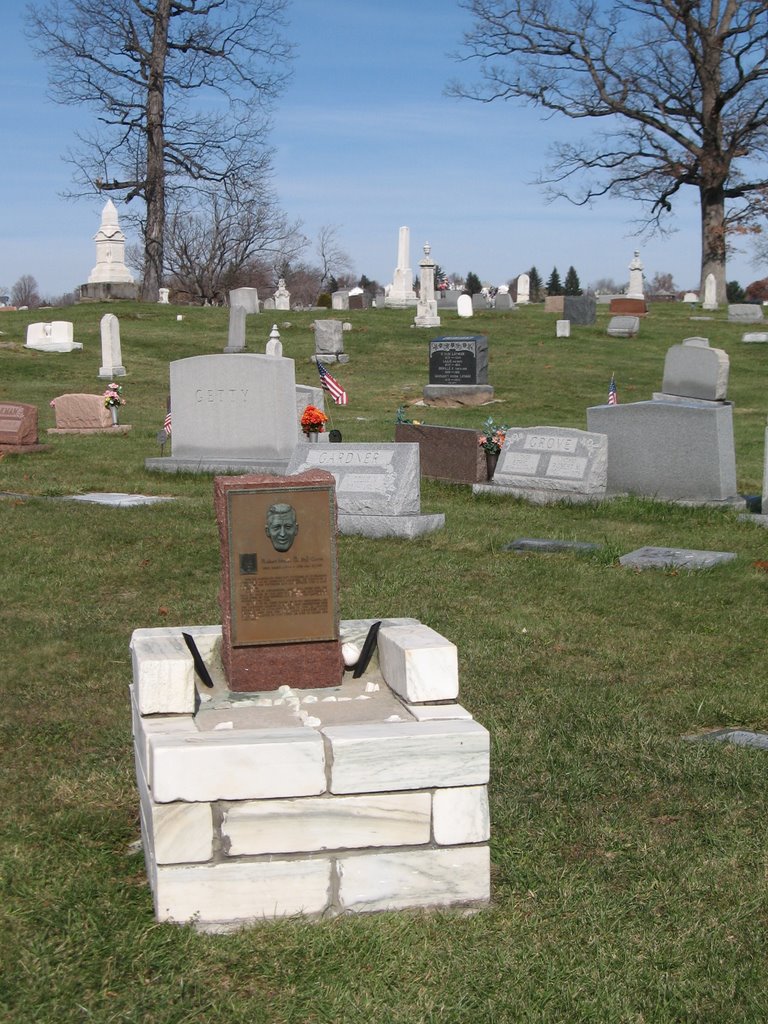 LONACONING DIRECTIONS: The George’s Creek Regional Library is easy to find on Lonaconing’s Main Street, a.k.a. Route 36. Take Exit 34 from I-68 at Frostburg and head south. As you enter the library, the History Room is straight ahead. A few blocks north along Main Street is Furnace Park, where a plaque commemorates Grove on the grounds of the old high school.
FROSTBURG DIRECTIONS: To reach the main entrance of Frostburg Memorial Park, take Grant Street south from U.S. 40, a.k.a. Main Street. The cemetery gate is at Grant and Green. Drive through the main entrance and up the hill past the flagpole, then turn right. At the intersection ahead is a plaque identical to the Lonaconing plaque; Grove’s tombstone is just up the hill behind it.
Tuesday, October 31, 2006
Lights Out -- really
There was an old episode of the radio horror series Lights Out titled "A Day at the Dentist's," written by Arch Oboler. Stephen King remembered it fondly (if fondly is the word), and devoted several pages to it in his non-fiction book Danse Macabre, 25 years ago. It's the one about the hapless guy with the toothache who picks the wrong dentist. Turns out that even though he doesn't know this dentist from Adam, the dentist knows him very well indeed, and has been nursing a grudge against him for years ... and years ... and years ... all the while fantasizing about what he would do, if one fine day, this guy were to walk in, unsuspecting, and climb into that dental chair.
You can guess the rest (the sound effect of a drill was prominent). You've probably read, or seen, countless other catchpenny horror stories involving acts of revenge just that fortuitous, and just that unlikely. But now The Associated Press reminds me that terribly unlikely things do happen, occasionally. According to the police in Charlotte, N.C., a woman who went in for a routine facelift just happened to pick the wrong plastic surgeon's office -- where a nurse anesthetist was one of her high-school classmates, one who believed the patient had stolen her boyfriend 30 years before, and who had been nursing a grudge against the patient for years ... and years ... and years ...
The patient never woke up from that routine procedure, and now the nurse anesthetist, Sally Jordan Hill, is charged with first-degree murder.
It's just like the Lights Out episode!
You can guess the rest (the sound effect of a drill was prominent). You've probably read, or seen, countless other catchpenny horror stories involving acts of revenge just that fortuitous, and just that unlikely. But now The Associated Press reminds me that terribly unlikely things do happen, occasionally. According to the police in Charlotte, N.C., a woman who went in for a routine facelift just happened to pick the wrong plastic surgeon's office -- where a nurse anesthetist was one of her high-school classmates, one who believed the patient had stolen her boyfriend 30 years before, and who had been nursing a grudge against the patient for years ... and years ... and years ...
The patient never woke up from that routine procedure, and now the nurse anesthetist, Sally Jordan Hill, is charged with first-degree murder.
It's just like the Lights Out episode!
Two quotes of the season
"It was my hand that took those precious lights out of this ole dark world."
-- From the confession handwritten by serial killer Danny Rolling shortly before his execution Oct. 25 in Florida
"Halloween is a night for amateurs."
-- Marilyn Manson, quoted in a recent issue of People
-- From the confession handwritten by serial killer Danny Rolling shortly before his execution Oct. 25 in Florida
"Halloween is a night for amateurs."
-- Marilyn Manson, quoted in a recent issue of People
The Molotov cocktail
A recent headline in the Cumberland (Md.) Times-News: "Teenagers found with Molotov cocktails."
My surprise is not, alas, that two 13-year-olds were fooling around with homemade incendiary devices -- I was 13 myself once -- but that the term "Molotov cocktail" still has any currency, even among newspaper copy editors. Surely these 13-year-olds, asked to name the things they just made, would have said "firebombs" or some more current slang term.
The late Vyacheslav Mikhailovich Molotov, one of Stalin's most devoted henchmen, was also apparently one of the smartest, as he lived to age 96 -- perhaps a record among Stalin's henchmen! During Stalin's ill-advised invasion of Finland in 1939, Molotov, then serving as Stalin's foreign minister, infamously told the world that those Soviet planes weren't dropping bombs on the Finns; no, the Finns were hungry, and the kindly Soviets were coming to their rescue, by dropping packages of food. The Finns promptly dubbed the Soviet bombs "Molotov breadbaskets" or "Molotov picnic baskets," and dubbed the homemade incendiaries they lobbed at Soviet tanks "Molotov cocktails."
The forgotten Finn who coined that mordant term more than 65 years ago has had the last laugh over the old Stalinist, I guess. Who other than historians would remember Molotov today, if not for the Molotov cocktail?
My surprise is not, alas, that two 13-year-olds were fooling around with homemade incendiary devices -- I was 13 myself once -- but that the term "Molotov cocktail" still has any currency, even among newspaper copy editors. Surely these 13-year-olds, asked to name the things they just made, would have said "firebombs" or some more current slang term.
The late Vyacheslav Mikhailovich Molotov, one of Stalin's most devoted henchmen, was also apparently one of the smartest, as he lived to age 96 -- perhaps a record among Stalin's henchmen! During Stalin's ill-advised invasion of Finland in 1939, Molotov, then serving as Stalin's foreign minister, infamously told the world that those Soviet planes weren't dropping bombs on the Finns; no, the Finns were hungry, and the kindly Soviets were coming to their rescue, by dropping packages of food. The Finns promptly dubbed the Soviet bombs "Molotov breadbaskets" or "Molotov picnic baskets," and dubbed the homemade incendiaries they lobbed at Soviet tanks "Molotov cocktails."
The forgotten Finn who coined that mordant term more than 65 years ago has had the last laugh over the old Stalinist, I guess. Who other than historians would remember Molotov today, if not for the Molotov cocktail?
Happy Halloween
Tonight we had 104 trick-or-treaters, a personal best for the Duncan household. (Trick-or-treaters are among the things I obsessively count, but it doesn't stop there.) We nearly ran out of candy bars, which is unusual. Normally we stock up for the sake of "the little children," then get to eat most of the candy ourselves, after we turn off the porch light. This afternoon, as Sydney was headed to Food Lion, I carefully instructed her: "Remember, the little children love Milky Ways best, followed by Snickers and Three Musketeers; the little children are also partial to Reese's cups." That dodge didn't work this year. The older I get, the fewer dodges I have.
Our favorite costume this year was a honeybee, worn by the tiniest child of the evening -- male or female, we don't know -- who toddled alone up the long dark walk to our porch and stood there, openmouthed and wide-eyed, as he/she looked up, up, up at me through the glass door, clearly expecting to be gobbled up at any moment, then gamely tapped on the glass anyway, as softly as a leaf lands.
Between goblins, Sydney graded papers, and I watched a nifty Peter Lorre double feature on Turner Classic Movies: Mad Love and The Beast with Five Fingers.
As I type this, neighbor kids on a sugar high, with their masks shoved onto the tops of their heads, are asking each other: "What was up with that creepy guy with the legal pad, counting out loud and trying to take back the Milky Ways?"
Our favorite costume this year was a honeybee, worn by the tiniest child of the evening -- male or female, we don't know -- who toddled alone up the long dark walk to our porch and stood there, openmouthed and wide-eyed, as he/she looked up, up, up at me through the glass door, clearly expecting to be gobbled up at any moment, then gamely tapped on the glass anyway, as softly as a leaf lands.
Between goblins, Sydney graded papers, and I watched a nifty Peter Lorre double feature on Turner Classic Movies: Mad Love and The Beast with Five Fingers.
As I type this, neighbor kids on a sugar high, with their masks shoved onto the tops of their heads, are asking each other: "What was up with that creepy guy with the legal pad, counting out loud and trying to take back the Milky Ways?"
Monday, October 30, 2006
The cognac on Poe's grave
It’s good, on the eve of Halloween, to reflect that I now live in the state where Edgar Allan Poe is buried -- in the old Westminster Hall cemetery at Fayette and Greene streets in Baltimore.
I visited Poe’s grave once, as we all do, and took the tour, but I had forgotten about the famed annual bottle of brandy until Ed Hendricks, the Catholic chaplain at Frostburg State University, reminded us of it last week during our book-club meeting. (I don't remember how the subject came up, but it wasn't because we were being served brandy, worse luck.) According to the Edgar Allan Poe Society of Baltimore:
Thinking about Poe is appropriate this time of year not just because of Halloween but also because of the longstanding (if unprovable) theory that Poe died as the result of abuse by political gangs on Election Day in Baltimore. More on that here.
I visited Poe’s grave once, as we all do, and took the tour, but I had forgotten about the famed annual bottle of brandy until Ed Hendricks, the Catholic chaplain at Frostburg State University, reminded us of it last week during our book-club meeting. (I don't remember how the subject came up, but it wasn't because we were being served brandy, worse luck.) According to the Edgar Allan Poe Society of Baltimore:
Since 1949, on the night of the anniversary of Poe's birth [Jan. 19], a mysterious stranger has entered this cemetery and left as tribute a partial bottle of cognac and three roses on Poe's grave. The identity of the stranger, referred to affectionately as the Poe Toaster, is unknown. The significance of cognac is uncertain as it does not feature in Poe's works as would, for example, amontillado. The presumption for the three roses is that it represents the three persons whose remains are beneath the monument: Poe, his mother-in-law (Maria Clemm) and his wife Virginia. Out of respect, no attempt is made to stop or hinder him.Or her, or them. Surely the 57-year tradition is kept going by a number of people, for tourism purposes if nothing else. Why did it start in 1949? Presumably because that year marked the centennial of Poe’s death in 1849.
Thinking about Poe is appropriate this time of year not just because of Halloween but also because of the longstanding (if unprovable) theory that Poe died as the result of abuse by political gangs on Election Day in Baltimore. More on that here.
Saturday, October 28, 2006
Welcome to Nikep/Pekin
On Route 36 south of Lonaconing, Md., on George’s Creek, sits the old mining community of Nikep. Or is it Pekin?
How this community came to have two names, each the reverse of the other, was explained by Washington Post reporter John Kelly in two “Answer Man” columns in 2004. Here’s the first one; here’s the second.
Pekin, pronounced PEE-kin, was the original name, supposedly because it was on approximately the same latitude as ancient Pekin, the capital of China. At some point, the Post Office got tired of mail addressed to Pekin, Md., getting sent by mistake to Pekin, Ind. – one of the several other U.S. Pekins at that same latitude.
The Post Office fixed the problem by arbitrarily reversing the name of Maryland’s Pekin to form Nikep, which most locals pronounce as if it rhymes with “hiccup.” But many Pekin residents and businesses, including the railroad, refused to observe the new name, so confusion has reigned ever since – even though Nikep/Pekin long since lost its ZIP Code and its post office, the reason for the change in the first place. Its residents’ postal address is now Lonaconing.
China’s Pekin, meanwhile, became Peking and now Beijing.
Lots of place names in the United States are formed by reversed spellings. Dan Tilque has an interesting article on the subject, with addenda.
How this community came to have two names, each the reverse of the other, was explained by Washington Post reporter John Kelly in two “Answer Man” columns in 2004. Here’s the first one; here’s the second.
Pekin, pronounced PEE-kin, was the original name, supposedly because it was on approximately the same latitude as ancient Pekin, the capital of China. At some point, the Post Office got tired of mail addressed to Pekin, Md., getting sent by mistake to Pekin, Ind. – one of the several other U.S. Pekins at that same latitude.
The Post Office fixed the problem by arbitrarily reversing the name of Maryland’s Pekin to form Nikep, which most locals pronounce as if it rhymes with “hiccup.” But many Pekin residents and businesses, including the railroad, refused to observe the new name, so confusion has reigned ever since – even though Nikep/Pekin long since lost its ZIP Code and its post office, the reason for the change in the first place. Its residents’ postal address is now Lonaconing.
China’s Pekin, meanwhile, became Peking and now Beijing.
Lots of place names in the United States are formed by reversed spellings. Dan Tilque has an interesting article on the subject, with addenda.
Thursday, October 26, 2006
The Old Stone House

Soon after Sydney and I moved to western Maryland this summer, we discovered scenic U.S. 40 through Garrett County – not the U.S. 40 that shares four lanes with I-68, but Alternate U.S. 40 just north of the interstate, the old National Pike. By far the most striking building on U.S. 40 is this large stone house overlooking Little Meadows, the valley named by George Washington during the 1754 campaign. When we first laid eyes on it, we assumed that it was very old and that it once had been an inn.
Months later, in the marvelous souvenir shop at the Penn Alps restaurant in Grantsville, we picked up a copy of Strange and Unusual True Stories of Garrett County, published by the Garrett County Historical Society. Lo, there was a photo of "the Old Stone House,” built as an inn in 1818 by Jesse Tomlinson, who chose Little Meadows not only for its scenic beauty but for its opportune location on the National Pike about a day’s ride from Cumberland.
Tomlinson’s inn was built to last, of blocks of stone 2 feet and 3 feet square, with chimneys 30 feet wide at the base and 2-foot-deep windowsills. A community center, the inn housed a general store and the county’s first post office. Stagecoach passengers feasted on mutton, venison, turkey, pheasant and brook trout for 50 cents per person; the wagoners, whose trade was essential, got a discount, plus corn whiskey at 3 cents a shot. During their nights of revelry, someone surely sang “The Wagoner’s Lad”:
Your parents don't like me because I am poorAccording to the historical society, celebrated 19th-century guests at the inn included Henry Clay, Jenny Lind, P.T. Barnum and four U.S. presidents: Jackson, Taylor, Polk and President-elect Harrison. But which Harrison? All the other notables named being pre-Civil War, I’m guessing William Henry Harrison – en route from Ohio to his fatal inauguration, maybe?
They say I'm not worthy of entering your door
I work for my living, my money's my own
And if they don't like me, they can leave me alone
Of course, there are ghost stories. One of the bedrooms is said to have a perpetually bloodstained floor. The historical society passes along an even better legend, as it was retold in a 1951 article in Garrett County’s newspaper, The Republican:
The most intriguing story is about a beautiful, heavily veiled woman with quantities of expensive luggage bearing foreign labels, who got off the stage to spend the night at Stone House. She had her supper brought to her room and did not once set foot outside of her door. The next morning one of the little servant boys brought her hot water. But she had disappeared. All of her baggage remained, but there was no trace of her. The woods were searched as thoroughly as possible, but she was never found; and to this day no one knows who she was.From the outside, the building seems to be in good shape. It’s clearly a private residence now, so do respect the residents’ privacy, but if you’d like to drive past this marvelous old building, leave I-68 at Exit 22 and take U.S. 219 north to U.S. 40, then turn right, down the hill toward Frostburg. The Old Stone House is just ahead on your left.
The Republican again, in 1951:
The Old Stone House can still tell many a good tale, but we are too hurried to listen. It sits foursquare in solid strength by the highway and will still be there when we have gone on, clear out of the picture. There is something very sad about its position, still so close to the road it served, but so remote from the present life of that road.

Monday, October 16, 2006
Sand Spring Run
The stream is Sand Spring Run, which courses through the arboretum on the Frostburg State University campus. The upstream and downstream photos were taken from the bridge in the bottom photo.

Whenever I cross this unnamed bridge, especially this time of year, I think of the church-bridge in Washington Irving's "The Legend of Sleepy Hollow," beyond which travelers were safe from the Headless Horseman. Most of campus, I reckon, lies on the Horseman's side of the bridge.



Whenever I cross this unnamed bridge, especially this time of year, I think of the church-bridge in Washington Irving's "The Legend of Sleepy Hollow," beyond which travelers were safe from the Headless Horseman. Most of campus, I reckon, lies on the Horseman's side of the bridge.

Subscribe to:
Posts (Atom)
