Friday, November 10, 2006
The wreck of the Edmund Fitzgerald
On this date in 1975, the freighter Edmund Fitzgerald was lost with all hands during a storm on Lake Superior. I was 11 years old, and while I was a faithful newspaper reader even then, and read every back issue of Newsweek that my Aunt Willa May passed me, I don't recall the wreck itself making much of an impression. The Newsweek writeup did, however, make a deep impression on Canadian singer-songwriter Gordon Lightfoot, and the song he was inspired to write and perform, "The Wreck of the Edmund Fitzgerald," left me thunderstruck the next year, 1976, whenever I heard it on the radio. I got plenty of opportunity to hear it; the song went to No. 2 on the pop charts. Since then, Lightfoot's bone-chilling six-and-a-half-minute epic has cropped up occasionally on lists of most-hated songs; its critics claim that it's too long, too slow and too maudlin, down there in the depths with "Seasons in the Sun." But I loved the song then, and I love it now, without the slightest irony or distance. I hear the opening, and I'm immediately cold, as if "twas the witch of November come stealin'." And without that song, what are the odds that I would remember the Edmund Fitzgerald at all? This is one of the only examples in my lifetime of a disaster that immediately gets set to music and sung into myth, like the Baltimore fire or the wreck of the Old 97. It's downright bardic, what Lightfoot did in that song.


Wednesday, November 08, 2006
How the Rolling Stone "10 Worst" fared
The day after the Democrats came back, I re-read Matt Taibbi's cover story in the Nov. 2 Rolling Stone, headlined "The Worst Congress Ever." It's full of eyebrow-scorching Mencken-style invective, for example the description of James Sensenbrenner Jr., R-Wis., as "an ever-sweating, fat-fingered beast who wields his gavel in a way that makes you think he might have used one before in some other arena, perhaps to beat prostitutes to death."
Sensenbrenner was listed as one of the magazine's "10 Worst Congressmen," all but one of them Republicans. Before the election, my assumption was that all 10 would sail through the election unscathed, in spite of -- or because of -- Rolling Stone's dudgeon. But it didn't work out that way: Two were voted out of office, one was forced into a runoff, and four others, while re-elected by the loyalists back home, will lose their positions of national power, namely their chairmanships, to Democrats. Here's the Rolling Stone "10 Worst" list, with the nicknames the magazine assigned them and their fate in Tuesday's election.
Dennis "The Highway Robber" Hastert, R-Ill., re-elected with 60 percent of the vote but lost his position as speaker of the House.
James "The Dictator" Sensenbrenner Jr., R-Wis., re-elected with 62 percent of the vote but lost his chairmanship of the Judiciary Committee.
Don "Mr. Pork" Young, R-Alaska, re-elected with 57 percent of the vote but lost his chairmanship of the Transportation Committee.
William "The Bribe Taker" Jefferson, D-La., led a crowded field with 30 percent of the vote but now faces a Dec. 9 runoff with the No. 2 candidate, a fellow Democrat (more on that below).
Jerry "The King of Payoffs" Lewis, R-Calif., re-elected with 66 percent of the vote but lost his chairmanship of the Appropriations Committee.
Tom "Mr. Bigotry" Tancredo, R-Colo., re-elected with 59 percent of the vote.
Dick "Enemy of the Earth" Pombo, R-Calif., chair of the Resources Committee, lost with 47 percent of the vote to his Democratic challenger's 53 percent.
Curt "The Conspiracy Nut" Weldon, R-Pa., lost with 44 percent of the vote to his Democratic challenger's 56 percent.
Hal "Homeland Security Hog" Rogers, R-Ky., won with 74 percent of the vote -- the biggest winning margin on this list.
Marilyn "The Queen of Gay Bashing" Musgrave, R-Colo., won with 46 percent of the vote -- the smallest winning margin on this list. (Her Democratic opponent got 43 percent.)
Jefferson was running against eight Democrats, three Republicans and a Libertarian. The three runner-up Democrats got 52 percent of the vote among them. Had all those rivals within his own party drawn straws, played rock-paper-scissors, etc., and put all their resources behind a single non-Jefferson Democrat, Jefferson would have lost this race outright, and Rolling Stone's batting average would be even higher.
But as it stands, at least 20 percent of the magazine's list was ousted, and another 40 percent of the list was demoted -- which still looks pretty prescient, in hindsight. I'll be interested to read Rolling Stone's "10 Worst" list in 2006.
(Thanks to Bob for pointing out my error in the original version of this post.)
Sensenbrenner was listed as one of the magazine's "10 Worst Congressmen," all but one of them Republicans. Before the election, my assumption was that all 10 would sail through the election unscathed, in spite of -- or because of -- Rolling Stone's dudgeon. But it didn't work out that way: Two were voted out of office, one was forced into a runoff, and four others, while re-elected by the loyalists back home, will lose their positions of national power, namely their chairmanships, to Democrats. Here's the Rolling Stone "10 Worst" list, with the nicknames the magazine assigned them and their fate in Tuesday's election.
Jefferson was running against eight Democrats, three Republicans and a Libertarian. The three runner-up Democrats got 52 percent of the vote among them. Had all those rivals within his own party drawn straws, played rock-paper-scissors, etc., and put all their resources behind a single non-Jefferson Democrat, Jefferson would have lost this race outright, and Rolling Stone's batting average would be even higher.
But as it stands, at least 20 percent of the magazine's list was ousted, and another 40 percent of the list was demoted -- which still looks pretty prescient, in hindsight. I'll be interested to read Rolling Stone's "10 Worst" list in 2006.
(Thanks to Bob for pointing out my error in the original version of this post.)
Tuesday, November 07, 2006
Black as the Pit from pole to pole
 This man-made canyon is a surface coal mine just south of Frostburg, viewed from the east rim along Route 36. For scale, note the house-sized earth-moving machines on the far horizon.

Sharpe and "Seanbean"
I am pleased to see on Dan's Slapinions blog that he read aloud to one of his children, when she was an infant, one of Bernard Cornwell's Sharpe novels.
Cornwell has written 21 of these Napleonic military adventures so far (the most recent being Sharpe's Fury), and 15 Sharpe movies (if I count correctly) have been filmed by the BBC, with Sean Bean in the title role. We watched the most recent, Sharpe's Challenge, earlier this year on BBC America; we even watched the making-of documentary. Sydney has no interest in making-of documentaries, the novels of Bernard Cornwell or the Napoleonic Wars, but her interest in Sean Bean approaches totality. She likes to pronounce "Sean" with a long E, to rhyme with "Bean," and say them quickly: "Seanbean."
The rest of the cast was good, too: Daragh O'Malley as Sharpe's burly sidekick Patrick Harper, Peter Hugo-Daly as the loathsome and toothy Sgt. Bickerstaff, Michael Cochrane as the pompous dimwit Gen. Simmerson. The villains were especially high-caliber: Toby Stephens and Padma Lakshmi, a.k.a. Maggie Smith's son and Salman Rushdie's wife. All worked hard, but Sydney paid them no heed, with Sean Bean around.
Have you voted?
Besides having the best first name in Frostburg, Avalon Ledong has an excellent letter to the editor in today's Election Day edition of the Cumberland Times-News. A Malaysian-American who just got his U.S. citizenship this year, Ledong explains why he's voting today. He concludes:
America still has great promise and great potential. Not all of her dreams are yet realized. The best of the dream can still be yet to come. I want to be a part of making that happen.Here's an earlier Times-News profile of Ledong, who works in personnel at Frostburg State University.
So today I will vote in my first general election. It will be a proud moment for me and for my family. It will be a moment of faith in this country.
Sunday, November 05, 2006
Christ in the mouth of Moloch
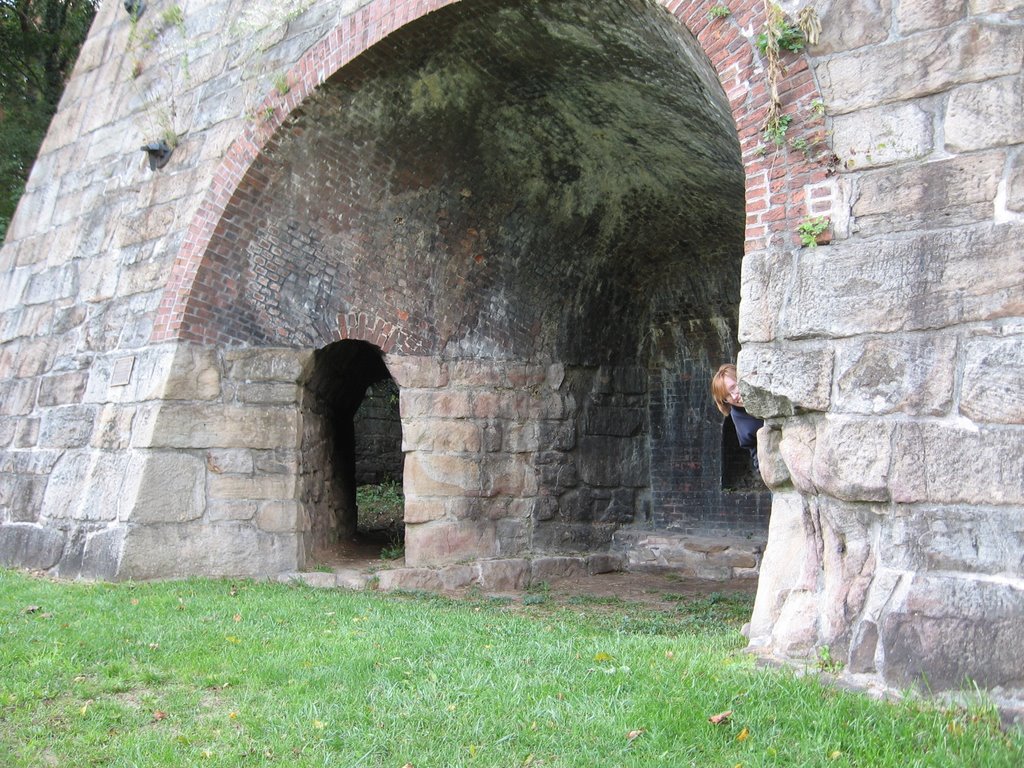
While driving through Lonaconing, Md., yesterday, I happened upon a nativity scene in the mouth of the furnace.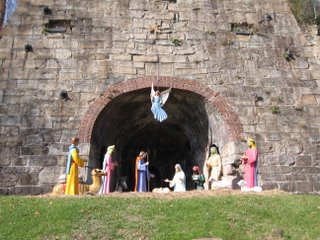 George's Creek Coal and Iron Co. Furnace No. 1 is the town's most striking landmark, a legacy of pre-Civil War industry. The town dates its founding from the year the furnace opened. The furnace produced pig iron from 1839 until 1856 and was the first iron furnace in the United States to successfully use not charcoal but coal and coke, both abundant in Allegany County. The George's Creek company soon, in fact, dropped the iron business to concentrate solely on the coal.
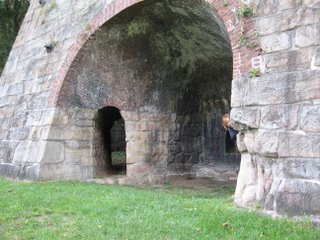
These photos don't really convey how massive the thing is, and how startling it is to unsuspecting passers-by on Route 36. Commonly heard from the passenger seat: "WHAT in the world was THAT? Turn around!" Here's a shot of Sydney and Lily in front of the furnace mouth this summer.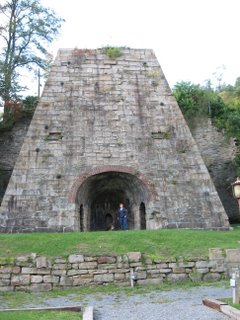 And here's a shot of Sydney "hiding" in the furnace mouth.
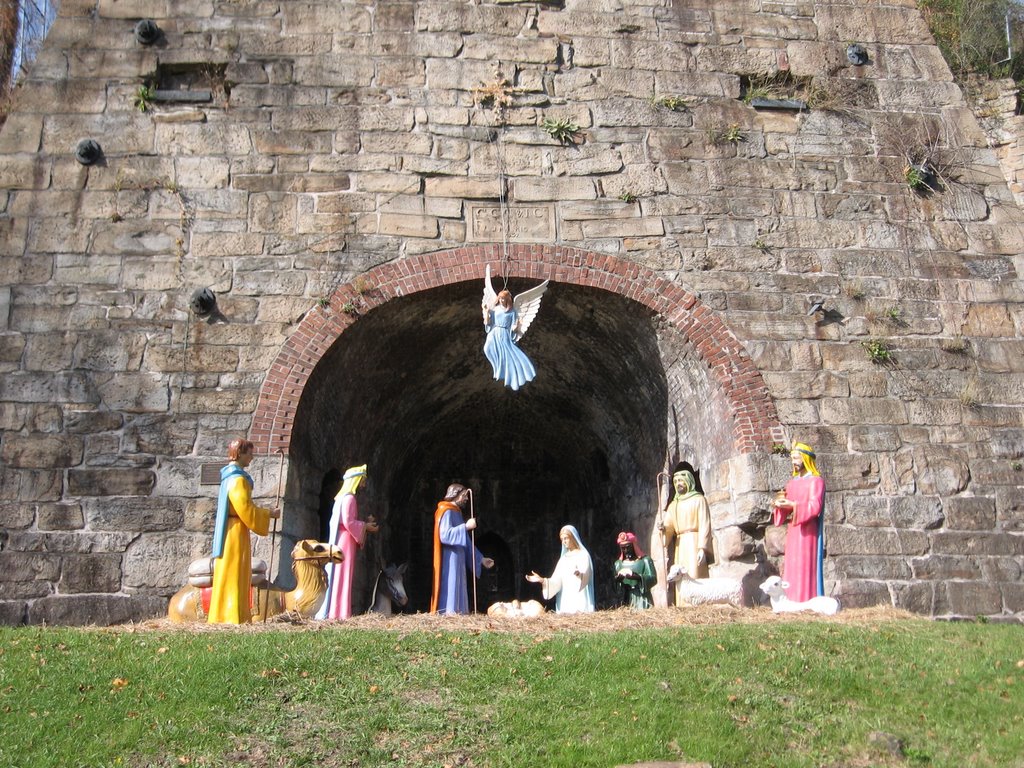 George's Creek Coal and Iron Co. Furnace No. 1 is the town's most striking landmark, a legacy of pre-Civil War industry. The town dates its founding from the year the furnace opened. The furnace produced pig iron from 1839 until 1856 and was the first iron furnace in the United States to successfully use not charcoal but coal and coke, both abundant in Allegany County. The George's Creek company soon, in fact, dropped the iron business to concentrate solely on the coal.
These photos don't really convey how massive the thing is, and how startling it is to unsuspecting passers-by on Route 36. Commonly heard from the passenger seat: "WHAT in the world was THAT? Turn around!" Here's a shot of Sydney and Lily in front of the furnace mouth this summer.
 And here's a shot of Sydney "hiding" in the furnace mouth.
Saturday, November 04, 2006
The trail of Lefty Grove
The great pitcher Lefty Grove, a member of the Baseball Hall of Fame, was from the coal town of Lonaconing, Md., just a few miles south of here. Because the World Series is over, and because the Baseball Forever conference at Frostburg State University hasn’t started yet, I filled the void this morning with a miniature Lefty Grove pilgrimage.
My first stop (of two) was the George’s Creek Regional Library in downtown Lonaconing, where Grove’s MVP trophy is on display.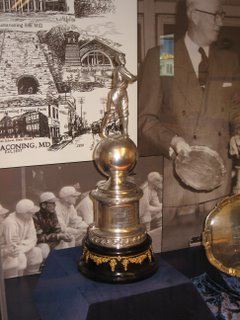 It reads:
That Robert Moses Grove (1900-1975) would be known as Lefty was inevitable. In baseball, it was an era of nicknames. Lefty’s 1931 World Series teammates included Doc, Mule, Bing, Rube and Dib; their Series opponents that year included Sparky, Ripper, Chick, Pepper and Flint.
Lefty’s story is told by Jim Kaplan in his book Lefty Grove: American Original and by Sarah Moses in the November 2006 issue of Allegany Magazine. Lefty’s dad made $50 a month in the mines, hauling “sixteen tons” a day, as in the (much later) Merle Travis song. Lefty worked briefly alongside his dad and brother in the mines before deciding to do something else with his life. He announced, “I didn’t put that coal in the ground, I ain’t gonna take it out.”
In 1920, at age 20, he was hired to play Class C pro ball for the Blue Ridge League team in Martinsburg, W.Va., for $125 a month. Later that year, the Martinsburg owner sold Lefty to the Baltimore Orioles, then a top-paying minor-league team, for the cost of a new fence. For the rest of his life, Lefty proudly claimed he was the only player ever traded for a fence.
During an exhibition game as an Oriole, Lefty struck out Babe Ruth nine times. That sort of thing gets you noticed. In 1925, the Philadelphia Athletics bought his contract for a then-record $100,600 -- you have to wonder how the $600 was negotiated – and Lefty was a major leaguer at last. Ruth soon learned that exhibition game was no fluke; Lefty would hold the Babe to nine homers in 10 years.
In his 17 major-league seasons (nine with Philadelphia and eight with the Boston Red Sox), Lefty had a lifetime winning percentage of .680, with 300 career wins. His niece, Betty Holshey, told Allegany Magazine that “Uncle Bob” sent the family a case of Wheaties whenever he won a game. “For the longest time,” she said, “we didn’t know there was any other cereal but Wheaties.”
Prematurely gray, Lefty presented to batters a severe and intimidating figure. A bad loser, he was known to berate teammates, rend uniforms, trash locker rooms in frustration. His United Press International obit would say he had “an explosive fast ball and temper to match.” Betty Holshey’s dad warned her, “You don’t want to cross your Uncle Bob.”
Batters didn’t cross him often. Lefty was a six-time All-Star, pitched in three World Series (four wins, two losses and two saves) and was on two world championship teams (the 1929 and 1930 Philadelphia A’s). He led the American League in strikeouts for seven seasons and in ERA for nine.
In his major-league career, he pitched 3,940 innings in 616 games, including 35 shutouts, for a lifetime ERA of 3.06.
In retirement, he came home to Lonaconing, ran a bowling alley, and taught lots of youngsters the finer points of baseball. The Baseball Hall of Fame in Cooperstown, N.Y., wanted his MVP trophy, the first awarded in the American League, but Grove said no, no one from “Coney” would be able to see it there, so he presented it instead to the local high school.
The school is long gone, and the trophy was in a bank vault for a while, before the library gave it a home in a $25,000, climate-controlled, high-security case alongside other Grove artifacts, including an autographed baseball and one of the great man’s golf clubs. Elsewhere in the History Room, a three-ring binder of Grove-related newspaper clippings is worth leafing through. His niece, I’m told, still has one of Uncle Bob’s Philadelphia uniforms; the library would love to have that in the case, too.
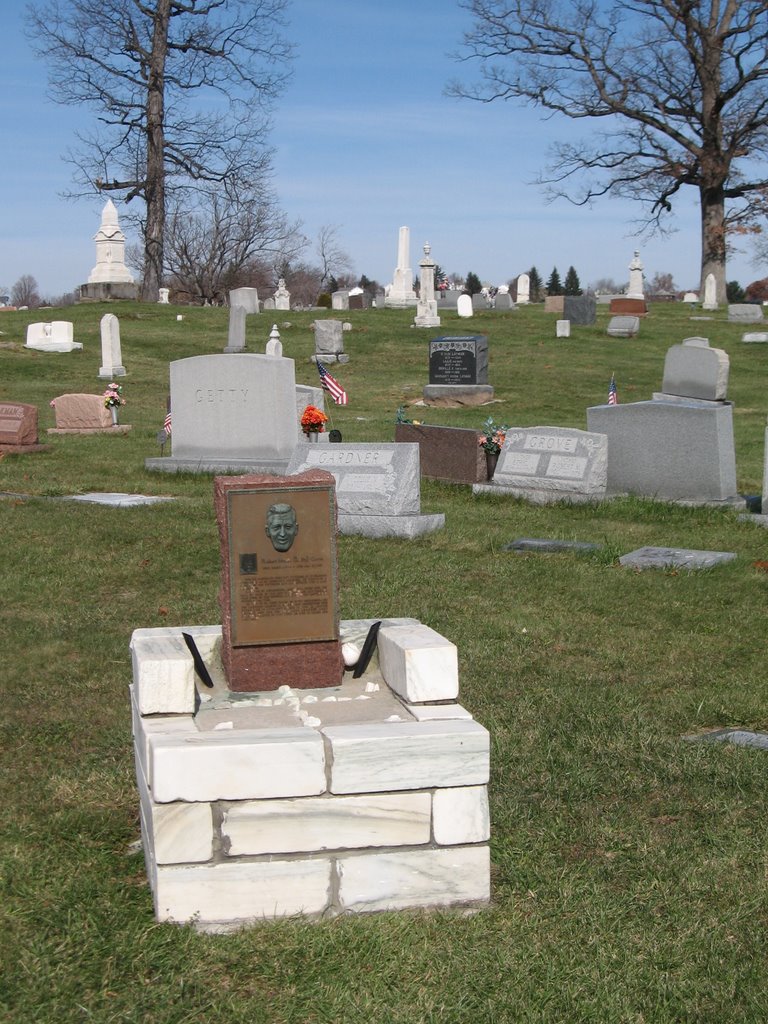
In his last years, Grove lived with his son and daughter-in-law in Norwalk, Ohio, and he died there the night of Thursday, May 22, 1975, apparently while watching television. (One wonders what was playing: The Waltons, Ironside, Movin’ On?) He’s buried not in Lonaconing but in Frostburg, a few miles up the road from his hometown; his grave was my second and last stop of the day.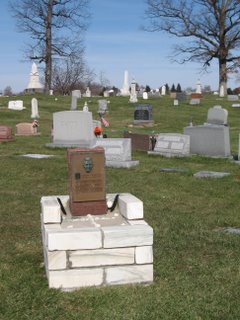 LONACONING DIRECTIONS: The George’s Creek Regional Library is easy to find on Lonaconing’s Main Street, a.k.a. Route 36. Take Exit 34 from I-68 at Frostburg and head south. As you enter the library, the History Room is straight ahead. A few blocks north along Main Street is Furnace Park, where a plaque commemorates Grove on the grounds of the old high school.
FROSTBURG DIRECTIONS: To reach the main entrance of Frostburg Memorial Park, take Grant Street south from U.S. 40, a.k.a. Main Street. The cemetery gate is at Grant and Green. Drive through the main entrance and up the hill past the flagpole, then turn right. At the intersection ahead is a plaque identical to the Lonaconing plaque; Grove’s tombstone is just up the hill behind it.
My first stop (of two) was the George’s Creek Regional Library in downtown Lonaconing, where Grove’s MVP trophy is on display.
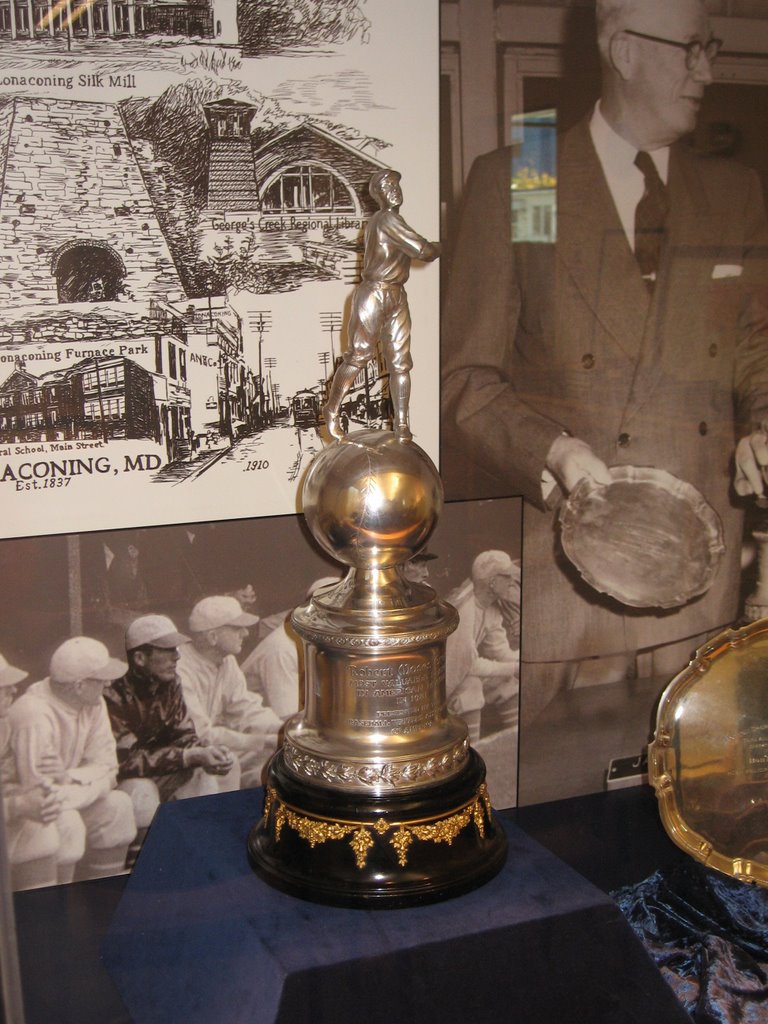 It reads:
Robert Moses GroveThe figure on the trophy seems to be throwing with his right, but never mind; 1931 was the great left-hander’s best year. He went 31-4 for Connie Mack’s Philadelphia Athletics, including a 16-game winning streak, with an ERA of 2.06.
MOST VALUABLE PLAYER
IN AMERICAN LEAGUE
IN 1931
PRESENTED BY THE
BASEBALL WRITERS ASSOCIATION
OF AMERICA
That Robert Moses Grove (1900-1975) would be known as Lefty was inevitable. In baseball, it was an era of nicknames. Lefty’s 1931 World Series teammates included Doc, Mule, Bing, Rube and Dib; their Series opponents that year included Sparky, Ripper, Chick, Pepper and Flint.
Lefty’s story is told by Jim Kaplan in his book Lefty Grove: American Original and by Sarah Moses in the November 2006 issue of Allegany Magazine. Lefty’s dad made $50 a month in the mines, hauling “sixteen tons” a day, as in the (much later) Merle Travis song. Lefty worked briefly alongside his dad and brother in the mines before deciding to do something else with his life. He announced, “I didn’t put that coal in the ground, I ain’t gonna take it out.”
In 1920, at age 20, he was hired to play Class C pro ball for the Blue Ridge League team in Martinsburg, W.Va., for $125 a month. Later that year, the Martinsburg owner sold Lefty to the Baltimore Orioles, then a top-paying minor-league team, for the cost of a new fence. For the rest of his life, Lefty proudly claimed he was the only player ever traded for a fence.
During an exhibition game as an Oriole, Lefty struck out Babe Ruth nine times. That sort of thing gets you noticed. In 1925, the Philadelphia Athletics bought his contract for a then-record $100,600 -- you have to wonder how the $600 was negotiated – and Lefty was a major leaguer at last. Ruth soon learned that exhibition game was no fluke; Lefty would hold the Babe to nine homers in 10 years.
In his 17 major-league seasons (nine with Philadelphia and eight with the Boston Red Sox), Lefty had a lifetime winning percentage of .680, with 300 career wins. His niece, Betty Holshey, told Allegany Magazine that “Uncle Bob” sent the family a case of Wheaties whenever he won a game. “For the longest time,” she said, “we didn’t know there was any other cereal but Wheaties.”
Prematurely gray, Lefty presented to batters a severe and intimidating figure. A bad loser, he was known to berate teammates, rend uniforms, trash locker rooms in frustration. His United Press International obit would say he had “an explosive fast ball and temper to match.” Betty Holshey’s dad warned her, “You don’t want to cross your Uncle Bob.”
Batters didn’t cross him often. Lefty was a six-time All-Star, pitched in three World Series (four wins, two losses and two saves) and was on two world championship teams (the 1929 and 1930 Philadelphia A’s). He led the American League in strikeouts for seven seasons and in ERA for nine.
In his major-league career, he pitched 3,940 innings in 616 games, including 35 shutouts, for a lifetime ERA of 3.06.
In retirement, he came home to Lonaconing, ran a bowling alley, and taught lots of youngsters the finer points of baseball. The Baseball Hall of Fame in Cooperstown, N.Y., wanted his MVP trophy, the first awarded in the American League, but Grove said no, no one from “Coney” would be able to see it there, so he presented it instead to the local high school.
The school is long gone, and the trophy was in a bank vault for a while, before the library gave it a home in a $25,000, climate-controlled, high-security case alongside other Grove artifacts, including an autographed baseball and one of the great man’s golf clubs. Elsewhere in the History Room, a three-ring binder of Grove-related newspaper clippings is worth leafing through. His niece, I’m told, still has one of Uncle Bob’s Philadelphia uniforms; the library would love to have that in the case, too.
In his last years, Grove lived with his son and daughter-in-law in Norwalk, Ohio, and he died there the night of Thursday, May 22, 1975, apparently while watching television. (One wonders what was playing: The Waltons, Ironside, Movin’ On?) He’s buried not in Lonaconing but in Frostburg, a few miles up the road from his hometown; his grave was my second and last stop of the day.
 LONACONING DIRECTIONS: The George’s Creek Regional Library is easy to find on Lonaconing’s Main Street, a.k.a. Route 36. Take Exit 34 from I-68 at Frostburg and head south. As you enter the library, the History Room is straight ahead. A few blocks north along Main Street is Furnace Park, where a plaque commemorates Grove on the grounds of the old high school.
FROSTBURG DIRECTIONS: To reach the main entrance of Frostburg Memorial Park, take Grant Street south from U.S. 40, a.k.a. Main Street. The cemetery gate is at Grant and Green. Drive through the main entrance and up the hill past the flagpole, then turn right. At the intersection ahead is a plaque identical to the Lonaconing plaque; Grove’s tombstone is just up the hill behind it.
Tuesday, October 31, 2006
Lights Out -- really
There was an old episode of the radio horror series Lights Out titled "A Day at the Dentist's," written by Arch Oboler. Stephen King remembered it fondly (if fondly is the word), and devoted several pages to it in his non-fiction book Danse Macabre, 25 years ago. It's the one about the hapless guy with the toothache who picks the wrong dentist. Turns out that even though he doesn't know this dentist from Adam, the dentist knows him very well indeed, and has been nursing a grudge against him for years ... and years ... and years ... all the while fantasizing about what he would do, if one fine day, this guy were to walk in, unsuspecting, and climb into that dental chair.
You can guess the rest (the sound effect of a drill was prominent). You've probably read, or seen, countless other catchpenny horror stories involving acts of revenge just that fortuitous, and just that unlikely. But now The Associated Press reminds me that terribly unlikely things do happen, occasionally. According to the police in Charlotte, N.C., a woman who went in for a routine facelift just happened to pick the wrong plastic surgeon's office -- where a nurse anesthetist was one of her high-school classmates, one who believed the patient had stolen her boyfriend 30 years before, and who had been nursing a grudge against the patient for years ... and years ... and years ...
The patient never woke up from that routine procedure, and now the nurse anesthetist, Sally Jordan Hill, is charged with first-degree murder.
It's just like the Lights Out episode!
Two quotes of the season
"It was my hand that took those precious lights out of this ole dark world."
-- From the confession handwritten by serial killer Danny Rolling shortly before his execution Oct. 25 in Florida
"Halloween is a night for amateurs."
-- Marilyn Manson, quoted in a recent issue of People
-- From the confession handwritten by serial killer Danny Rolling shortly before his execution Oct. 25 in Florida
"Halloween is a night for amateurs."
-- Marilyn Manson, quoted in a recent issue of People
The Molotov cocktail
A recent headline in the Cumberland (Md.) Times-News: "Teenagers found with Molotov cocktails."
My surprise is not, alas, that two 13-year-olds were fooling around with homemade incendiary devices -- I was 13 myself once -- but that the term "Molotov cocktail" still has any currency, even among newspaper copy editors. Surely these 13-year-olds, asked to name the things they just made, would have said "firebombs" or some more current slang term.
The late Vyacheslav Mikhailovich Molotov, one of Stalin's most devoted henchmen, was also apparently one of the smartest, as he lived to age 96 -- perhaps a record among Stalin's henchmen! During Stalin's ill-advised invasion of Finland in 1939, Molotov, then serving as Stalin's foreign minister, infamously told the world that those Soviet planes weren't dropping bombs on the Finns; no, the Finns were hungry, and the kindly Soviets were coming to their rescue, by dropping packages of food. The Finns promptly dubbed the Soviet bombs "Molotov breadbaskets" or "Molotov picnic baskets," and dubbed the homemade incendiaries they lobbed at Soviet tanks "Molotov cocktails."
The forgotten Finn who coined that mordant term more than 65 years ago has had the last laugh over the old Stalinist, I guess. Who other than historians would remember Molotov today, if not for the Molotov cocktail?
Happy Halloween
Tonight we had 104 trick-or-treaters, a personal best for the Duncan household. (Trick-or-treaters are among the things I obsessively count, but it doesn't stop there.) We nearly ran out of candy bars, which is unusual. Normally we stock up for the sake of "the little children," then get to eat most of the candy ourselves, after we turn off the porch light. This afternoon, as Sydney was headed to Food Lion, I carefully instructed her: "Remember, the little children love Milky Ways best, followed by Snickers and Three Musketeers; the little children are also partial to Reese's cups." That dodge didn't work this year. The older I get, the fewer dodges I have.
Our favorite costume this year was a honeybee, worn by the tiniest child of the evening -- male or female, we don't know -- who toddled alone up the long dark walk to our porch and stood there, openmouthed and wide-eyed, as he/she looked up, up, up at me through the glass door, clearly expecting to be gobbled up at any moment, then gamely tapped on the glass anyway, as softly as a leaf lands.
Between goblins, Sydney graded papers, and I watched a nifty Peter Lorre double feature on Turner Classic Movies: Mad Love and The Beast with Five Fingers.
As I type this, neighbor kids on a sugar high, with their masks shoved onto the tops of their heads, are asking each other: "What was up with that creepy guy with the legal pad, counting out loud and trying to take back the Milky Ways?"
Monday, October 30, 2006
The cognac on Poe's grave
It’s good, on the eve of Halloween, to reflect that I now live in the state where Edgar Allan Poe is buried -- in the old Westminster Hall cemetery at Fayette and Greene streets in Baltimore.
I visited Poe’s grave once, as we all do, and took the tour, but I had forgotten about the famed annual bottle of brandy until Ed Hendricks, the Catholic chaplain at Frostburg State University, reminded us of it last week during our book-club meeting. (I don't remember how the subject came up, but it wasn't because we were being served brandy, worse luck.) According to the Edgar Allan Poe Society of Baltimore:
Thinking about Poe is appropriate this time of year not just because of Halloween but also because of the longstanding (if unprovable) theory that Poe died as the result of abuse by political gangs on Election Day in Baltimore. More on that here.
I visited Poe’s grave once, as we all do, and took the tour, but I had forgotten about the famed annual bottle of brandy until Ed Hendricks, the Catholic chaplain at Frostburg State University, reminded us of it last week during our book-club meeting. (I don't remember how the subject came up, but it wasn't because we were being served brandy, worse luck.) According to the Edgar Allan Poe Society of Baltimore:
Since 1949, on the night of the anniversary of Poe's birth [Jan. 19], a mysterious stranger has entered this cemetery and left as tribute a partial bottle of cognac and three roses on Poe's grave. The identity of the stranger, referred to affectionately as the Poe Toaster, is unknown. The significance of cognac is uncertain as it does not feature in Poe's works as would, for example, amontillado. The presumption for the three roses is that it represents the three persons whose remains are beneath the monument: Poe, his mother-in-law (Maria Clemm) and his wife Virginia. Out of respect, no attempt is made to stop or hinder him.Or her, or them. Surely the 57-year tradition is kept going by a number of people, for tourism purposes if nothing else. Why did it start in 1949? Presumably because that year marked the centennial of Poe’s death in 1849.
Thinking about Poe is appropriate this time of year not just because of Halloween but also because of the longstanding (if unprovable) theory that Poe died as the result of abuse by political gangs on Election Day in Baltimore. More on that here.
Saturday, October 28, 2006
Welcome to Nikep/Pekin
On Route 36 south of Lonaconing, Md., on George’s Creek, sits the old mining community of Nikep. Or is it Pekin?
How this community came to have two names, each the reverse of the other, was explained by Washington Post reporter John Kelly in two “Answer Man” columns in 2004. Here’s the first one; here’s the second.
Pekin, pronounced PEE-kin, was the original name, supposedly because it was on approximately the same latitude as ancient Pekin, the capital of China. At some point, the Post Office got tired of mail addressed to Pekin, Md., getting sent by mistake to Pekin, Ind. – one of the several other U.S. Pekins at that same latitude.
The Post Office fixed the problem by arbitrarily reversing the name of Maryland’s Pekin to form Nikep, which most locals pronounce as if it rhymes with “hiccup.” But many Pekin residents and businesses, including the railroad, refused to observe the new name, so confusion has reigned ever since – even though Nikep/Pekin long since lost its ZIP Code and its post office, the reason for the change in the first place. Its residents’ postal address is now Lonaconing.
China’s Pekin, meanwhile, became Peking and now Beijing.
Lots of place names in the United States are formed by reversed spellings. Dan Tilque has an interesting article on the subject, with addenda.
Thursday, October 26, 2006
The Old Stone House

Soon after Sydney and I moved to western Maryland this summer, we discovered scenic U.S. 40 through Garrett County – not the U.S. 40 that shares four lanes with I-68, but Alternate U.S. 40 just north of the interstate, the old National Pike. By far the most striking building on U.S. 40 is this large stone house overlooking Little Meadows, the valley named by George Washington during the 1754 campaign. When we first laid eyes on it, we assumed that it was very old and that it once had been an inn.
Months later, in the marvelous souvenir shop at the Penn Alps restaurant in Grantsville, we picked up a copy of Strange and Unusual True Stories of Garrett County, published by the Garrett County Historical Society. Lo, there was a photo of "the Old Stone House,” built as an inn in 1818 by Jesse Tomlinson, who chose Little Meadows not only for its scenic beauty but for its opportune location on the National Pike about a day’s ride from Cumberland.
Tomlinson’s inn was built to last, of blocks of stone 2 feet and 3 feet square, with chimneys 30 feet wide at the base and 2-foot-deep windowsills. A community center, the inn housed a general store and the county’s first post office. Stagecoach passengers feasted on mutton, venison, turkey, pheasant and brook trout for 50 cents per person; the wagoners, whose trade was essential, got a discount, plus corn whiskey at 3 cents a shot. During their nights of revelry, someone surely sang “The Wagoner’s Lad”:
Your parents don't like me because I am poorAccording to the historical society, celebrated 19th-century guests at the inn included Henry Clay, Jenny Lind, P.T. Barnum and four U.S. presidents: Jackson, Taylor, Polk and President-elect Harrison. But which Harrison? All the other notables named being pre-Civil War, I’m guessing William Henry Harrison – en route from Ohio to his fatal inauguration, maybe?
They say I'm not worthy of entering your door
I work for my living, my money's my own
And if they don't like me, they can leave me alone
Of course, there are ghost stories. One of the bedrooms is said to have a perpetually bloodstained floor. The historical society passes along an even better legend, as it was retold in a 1951 article in Garrett County’s newspaper, The Republican:
The most intriguing story is about a beautiful, heavily veiled woman with quantities of expensive luggage bearing foreign labels, who got off the stage to spend the night at Stone House. She had her supper brought to her room and did not once set foot outside of her door. The next morning one of the little servant boys brought her hot water. But she had disappeared. All of her baggage remained, but there was no trace of her. The woods were searched as thoroughly as possible, but she was never found; and to this day no one knows who she was.From the outside, the building seems to be in good shape. It’s clearly a private residence now, so do respect the residents’ privacy, but if you’d like to drive past this marvelous old building, leave I-68 at Exit 22 and take U.S. 219 north to U.S. 40, then turn right, down the hill toward Frostburg. The Old Stone House is just ahead on your left.
The Republican again, in 1951:
The Old Stone House can still tell many a good tale, but we are too hurried to listen. It sits foursquare in solid strength by the highway and will still be there when we have gone on, clear out of the picture. There is something very sad about its position, still so close to the road it served, but so remote from the present life of that road.

Monday, October 16, 2006
Sand Spring Run
The stream is Sand Spring Run, which courses through the arboretum on the Frostburg State University campus. The upstream and downstream photos were taken from the bridge in the bottom photo.

Whenever I cross this unnamed bridge, especially this time of year, I think of the church-bridge in Washington Irving's "The Legend of Sleepy Hollow," beyond which travelers were safe from the Headless Horseman. Most of campus, I reckon, lies on the Horseman's side of the bridge.



Whenever I cross this unnamed bridge, especially this time of year, I think of the church-bridge in Washington Irving's "The Legend of Sleepy Hollow," beyond which travelers were safe from the Headless Horseman. Most of campus, I reckon, lies on the Horseman's side of the bridge.





Way, Bear
 Our daily walk to campus involves a wooded shortcut that we call the Bear Path, because bears occasionally forage through these woods in season. Sydney's ritual on this stretch is to keep murmuring, "Way, Bear. Way, Bear." This photo of Sydney and Lily on the Bear Path makes it look much more remote than it really is. It's essentially the meeting place of three wooded backyards, and the three houses are just out of camera range.
Sunday, October 15, 2006

Lunk
We're still unpacking, of course, as we just moved in June, and the most recent box I unearthed demonstrates that the more boxes Sydney packed, the more tired and absentminded she became -- and the less sympathetic toward our valuables. Sydney retorts: "You try writing upside down and backward!"
 Sydney retorts: "You try writing upside down and backward!"
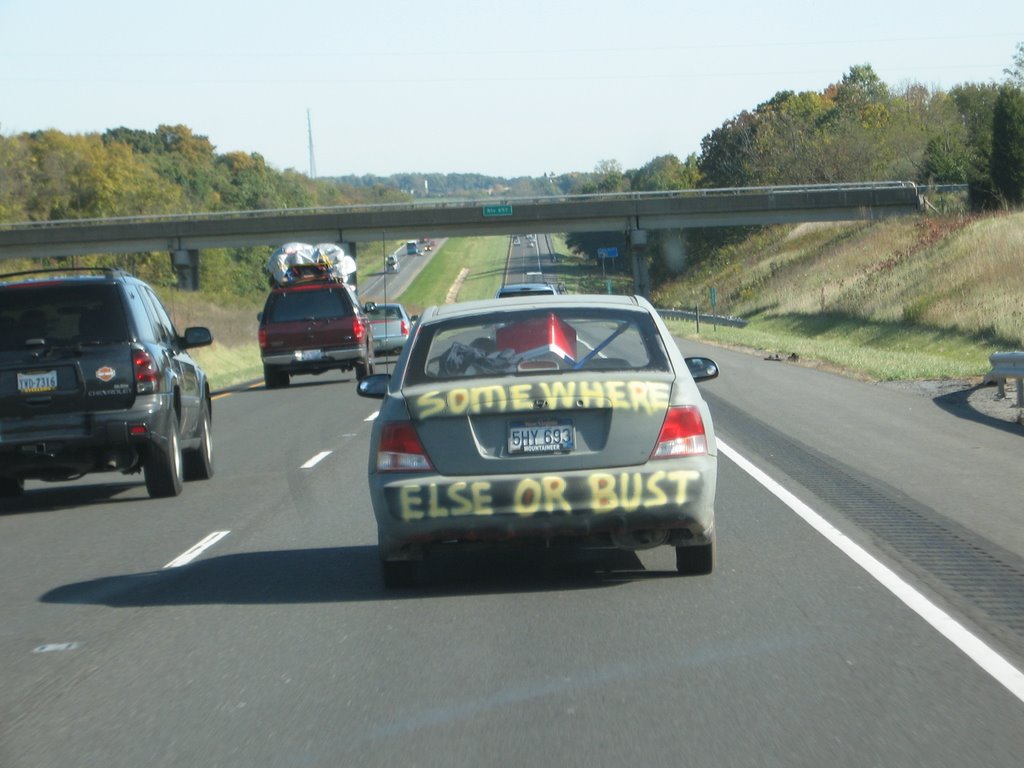


Two headed redneck zombies from outer space, in the woods
According to a flier we picked up in an I-81 convenience store today, this year's big Halloween attraction at Professor Cline's Haunted Monster Museum at Natural Bridge, Va., can be summarized as "Two Headed Redneck Zombies from Outer Space -- in the Woods."
Sunday, October 08, 2006
Everyday movie quotes
In our daily conversation, Sydney and I often fall back on lines from movies -- usually for a laugh, sometimes just because they're so handy. Here are some examples. Can you identify the movie each line comes from?
This first one invariably (and unhelpfully) gets said whenever one of us asks, "Have you seen my keys?"
This first one invariably (and unhelpfully) gets said whenever one of us asks, "Have you seen my keys?"
The Devil thought he had the keys.This next invariably is said whenever one of us, headed to a bank or an ATM, asks, "Do you need money?"
Everybody needs money. That’s why they call it money.The following call-and-response is recited whenever we eat beans, which is shockingly often.
"How ‘bout more beans, Mr. Taggart?"These others just seem to come up naturally.
"I’d say you had enough."
And just what is it that you do ... do?Actually, those last two came not from movies but from a novel and a TV series, respectively. Though the novel line also wound up in a made-for-TV movie, come to think of it.
I am shocked, shocked.
Is correct.
It’s very nice. (Said in a bad French accent.)
Oh, deary dear.
Pull the string! (Said in an Eastern European accent.)
So much time and so little to do. Wait a minute. Strike that. Reverse it. Thank you.
Superstitious, perhaps. Baloney, perhaps not. (Said in that same Eastern European accent.)
What has it got in its pocketses?
Wrapped in plastic.
Wednesday, September 27, 2006
Little Toot
Just as Sydney pressed Rabbit Hill into my hands when she found out I never read it, so I pressed Little Toot into her hands when she said she never heard of it. What she actually did was laugh out loud when I innocently mentioned the title, but I've forgiven her. She now says she enjoyed the book, but she still thinks Little Toot is a dumb title -- and, indeed, the other tugboats on the river do laugh at Little Toot, though not at his father, who is named, uh, Big Toot.
Don't laugh! This was one of my favorite books as a kid, one I frequently checked out of the public library in Batesburg, S.C. Published in 1939, it was the first children's book by Hardie Gramatky (1907-1979), who had been a comic-strip artist, a Disney animator and a magazine illustrator. He was best known as a watercolorist, with exhibitions at the Whitney, the Metropolitan, the Art Institute of Chicago, etc. It's interesting to compare the brushwork of the Little Toot illustrations with that in Gramatky's waterfront paintings, like this one.
Gramatky's New York studio overlooked the East River, and he got the idea for Little Toot while watching the tugboats. While Little Toot's river is unnamed in the book, it seems to be not the East River but the Hudson, as at one point Little Toot gets in the way of a big tug "bound down stream to pick up a string of coal barges from Hoboken."
Throughout, I note as an adult, Little Toot is lauded for the amount of pollution he emits: "What he couldn't create in sound, Little Toot made up for in smoke. From his chubby smokestack he would send up a volley of smoke balls which bubbled over his wake like balloons." At the climax, Little Toot's "S.O.S." smoke signal helps save the day. Environmental qualms aside, I still love Little Toot.
Sunday, September 24, 2006
The Frostburg Arion Band
The next time a music buff mentions the Rolling Stones' remarkable 44-year history as a band, say, "Ah, that's nothing. How about the Frostburg Arion Band?"
I took this photo of the band in performance Saturday in the Upper Quad at Frostburg State University's first Appalachian Festival. Guess how many years this band has been performing. The answer: 129 years. A group of German-Americans in Frostburg, Md., founded the German Arion Band in 1877. I believe that's Ronald Horner of Frostburg State's music faculty, a veteran of the Israel Philharmonic and the Pittsburgh Symphony, leading the current incarnation in Sousa's "Liberty Bell March," a.k.a. the theme from Monty Python's Flying Circus.
In the late 19th and early 20th century, just about every U.S. town of any size had at least one community brass band, peopled by shopkeepers and farmers and kids; it was the era saluted in Meredith Willson's musical The Music Man. In towns with substantial immigrant populations, it wasn't unusual to have one German-American band, one Italian-American band, etc. Most community bands disappeared as the 20th century ground on, but not this one.
There have been a few changes, of course. During the anti-German hysteria of World War II (discussed upstream on this blog), the band changed its name from the German Arion Band to the Frostburg Arion Band.
The band long since stopped relying exclusively on German-Americans, though that ethnicity still abounds in these hills. Today the band is mostly young people, including several members of the Frostburg State University marching band. The musicians in the red uniforms had just run up the hill from the halftime show; this was their second of three gigs on Saturday. Let's see Keith Richards manage that.
Today's band, alas, is in financial distress. Its little revenue from local gigs doesn't come close to meeting expenses, and the 106-year-old band hall on Uhl Street sorely needs repairs and restoration.
The band's namesake, the legendary Corinthian musician Arion, was the "Jolly Mon" of ancient Greece; he was rescued by dolphins after pirates threw him overboard. But who will rescue the Frostburg Arion Band?
I took this photo of the band in performance Saturday in the Upper Quad at Frostburg State University's first Appalachian Festival. Guess how many years this band has been performing.
 The answer: 129 years. A group of German-Americans in Frostburg, Md., founded the German Arion Band in 1877. I believe that's Ronald Horner of Frostburg State's music faculty, a veteran of the Israel Philharmonic and the Pittsburgh Symphony, leading the current incarnation in Sousa's "Liberty Bell March," a.k.a. the theme from Monty Python's Flying Circus.
In the late 19th and early 20th century, just about every U.S. town of any size had at least one community brass band, peopled by shopkeepers and farmers and kids; it was the era saluted in Meredith Willson's musical The Music Man. In towns with substantial immigrant populations, it wasn't unusual to have one German-American band, one Italian-American band, etc. Most community bands disappeared as the 20th century ground on, but not this one.
There have been a few changes, of course. During the anti-German hysteria of World War II (discussed upstream on this blog), the band changed its name from the German Arion Band to the Frostburg Arion Band.
The band long since stopped relying exclusively on German-Americans, though that ethnicity still abounds in these hills. Today the band is mostly young people, including several members of the Frostburg State University marching band. The musicians in the red uniforms had just run up the hill from the halftime show; this was their second of three gigs on Saturday. Let's see Keith Richards manage that.
Today's band, alas, is in financial distress. Its little revenue from local gigs doesn't come close to meeting expenses, and the 106-year-old band hall on Uhl Street sorely needs repairs and restoration.
The band's namesake, the legendary Corinthian musician Arion, was the "Jolly Mon" of ancient Greece; he was rescued by dolphins after pirates threw him overboard. But who will rescue the Frostburg Arion Band?
Foucault's pendulum and Foucault's Pendulum
Saturday, Sydney and I attended -- and much enjoyed -- the first Appalachian Festival at Frostburg State University. As much of it took place in the science building, I took the opportunity to photograph my favorite object on campus, this fine Foucault's pendulum that hangs in the three-story atrium, demonstrating the Earth's rotation by day and night to anyone who passes by. During my first trip to Paris, in 1991, I visited Leon Foucault's original pendulum in the Musée des Arts et Métiers. I went there on a sort of pilgrimage because the climax of Umberto Eco's 1988 novel Foucault's Pendulum takes place in the museum, at the pendulum. So long before tourists were tracing the steps of Robert Langdon in The Da Vinci Code, I was tracing Casaubon's steps in Foucault's Pendulum.
The two novels have a lot in common, as both are obsessed with outlandish conspiracy theories involving the Knights Templar, but Eco's novel is much longer, much harder to read, and much more snarky. As a lark, its scholar-heroes invent the mother of all conspiracy theories (after considering, then dismissing, the Mary Magdalene conspiracy theory as old hat), with disastrous consequences. Eco's novel has not yet been turned into a summer blockbuster starring Tom Hanks, but I'm sure Eco is doing pretty well for himself nevertheless.
The novel Foucault's Pendulum was recommended to me by my then-News & Record colleague Dave Stroble, who waved it at me one day and exulted, "You have to read this! I'm only a hundred pages into it, but it must have been written just for you!" I ran right out and bought a copy, read it with delight over the next couple of weeks, then returned to Dave's desk and said, "OK, I'm ready to talk about Foucault's Pendulum now." Dave went ashen and cried, "Don't tell me you actually finished that thing!" He had made it through 150 pages or so before giving up.
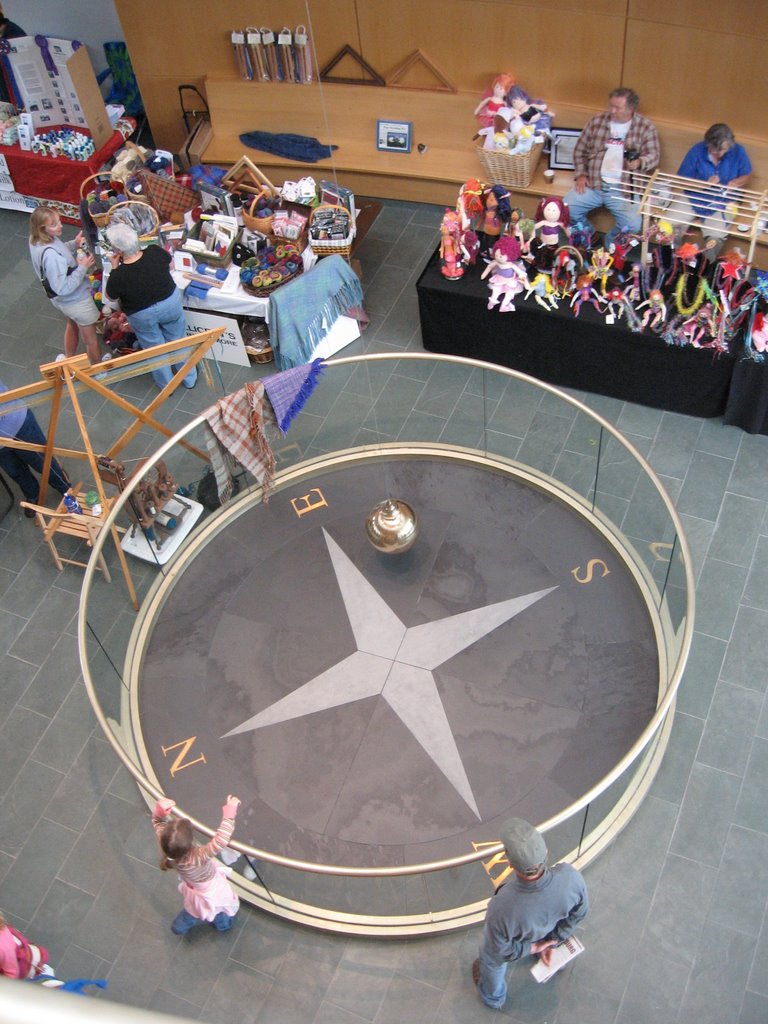 During my first trip to Paris, in 1991, I visited Leon Foucault's original pendulum in the Musée des Arts et Métiers. I went there on a sort of pilgrimage because the climax of Umberto Eco's 1988 novel Foucault's Pendulum takes place in the museum, at the pendulum. So long before tourists were tracing the steps of Robert Langdon in The Da Vinci Code, I was tracing Casaubon's steps in Foucault's Pendulum.
The two novels have a lot in common, as both are obsessed with outlandish conspiracy theories involving the Knights Templar, but Eco's novel is much longer, much harder to read, and much more snarky. As a lark, its scholar-heroes invent the mother of all conspiracy theories (after considering, then dismissing, the Mary Magdalene conspiracy theory as old hat), with disastrous consequences. Eco's novel has not yet been turned into a summer blockbuster starring Tom Hanks, but I'm sure Eco is doing pretty well for himself nevertheless.
The novel Foucault's Pendulum was recommended to me by my then-News & Record colleague Dave Stroble, who waved it at me one day and exulted, "You have to read this! I'm only a hundred pages into it, but it must have been written just for you!" I ran right out and bought a copy, read it with delight over the next couple of weeks, then returned to Dave's desk and said, "OK, I'm ready to talk about Foucault's Pendulum now." Dave went ashen and cried, "Don't tell me you actually finished that thing!" He had made it through 150 pages or so before giving up.
Thursday, September 21, 2006

A new monarch
Sydney's mother, Fran Bowling, and Sydney's Aunt Charlotte Sartin both raise monarch butterfies, a good habit they acquired in the classroom during years of teaching school. They collect larvae or cocoons, tend them in jars, then release the adult monarchs when they're ready to spread their wings. Sydney and I didn't arrive in Roanoke, Va., this past weekend in time to see this monarch climb out of its cocoon, but we were present to see Fran release it. These photos were taken in its first moments out of the jar. 
 If you love monarchs as we do, please learn to love milkweed, too; it's the only plant on which monarchs will lay eggs, and the only plant on which monarch caterpillars feed. Too often, flourishing stands of roadside milkweed get needlessly mowed down or destroyed by herbicides, thus destroying the monarchs' only habitat. Learn to recognize milkweed, and plant it and protect it wherever you can.

 If you love monarchs as we do, please learn to love milkweed, too; it's the only plant on which monarchs will lay eggs, and the only plant on which monarch caterpillars feed. Too often, flourishing stands of roadside milkweed get needlessly mowed down or destroyed by herbicides, thus destroying the monarchs' only habitat. Learn to recognize milkweed, and plant it and protect it wherever you can.
The toad at rest
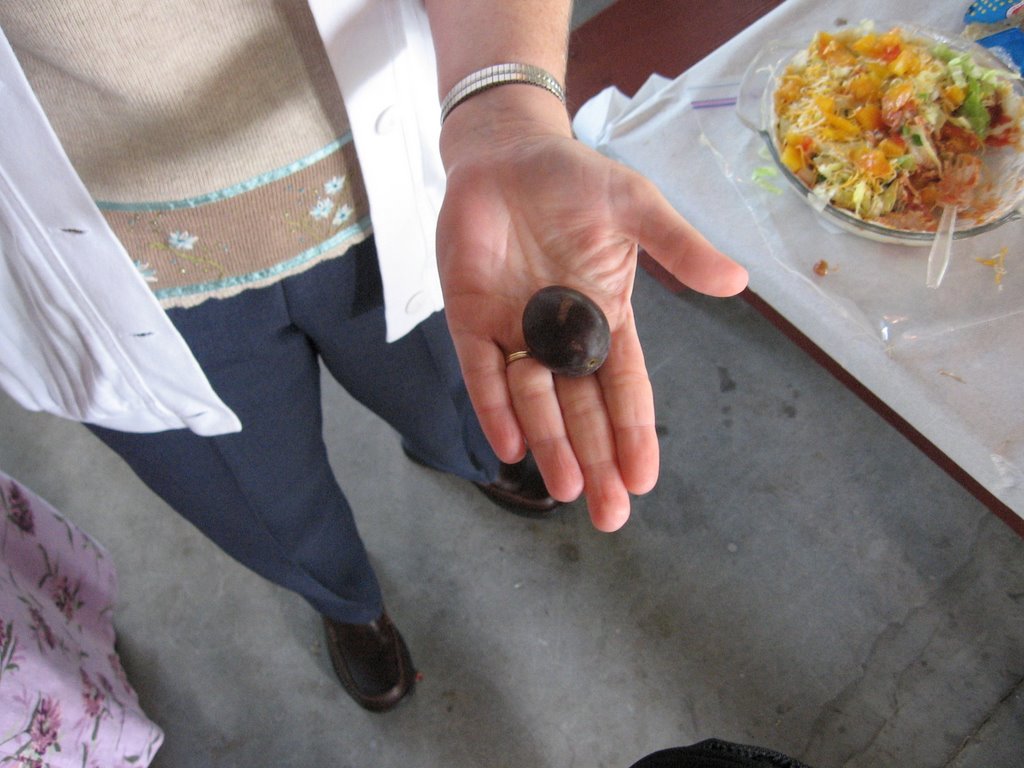
This last shot wouldn't fit in the previous post, but I wanted to show everyone that when we left it, the toad was safe and resting up from all the attention. And just to show all you engineers that I do understand the concept of scale, here's another reunion photo, in which Sydney demonstrates the impressive size of a Damson plum.

 And just to show all you engineers that I do understand the concept of scale, here's another reunion photo, in which Sydney demonstrates the impressive size of a Damson plum.
Toad herding: A photo narrative
Sunday we went to Sydney's family reunion on her mother's side, the Staffords and Stafford descendants, which is held in the Town Park pavilion in Rich Creek, Va. While setting up, Sydney's relatives found one of the picnic tables already occupied by a large toad. By the time we arrived, the toad had been moved out of the way, hidden in the corner behind a trash can, where I took this photo of it. The photo, alas, gives no sense of scale, but this was a big toad.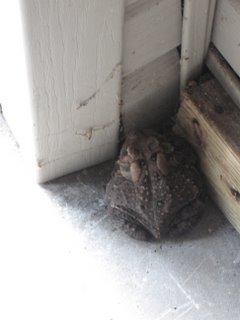 Because we worried the toad would get stepped on or otherwise injured, we decided it needed to be carried across the park, toward the woods. Sydney's mother, Fran Bowling, is a retired elementary-school teacher and therefore a veteran wrangler of wildlife, so she matter-of-factly scooped the toad onto a paper plate. The toad was too big for the plate, though, so Fran wound up herding the reluctant toad toward the woods, away from the pavilion.

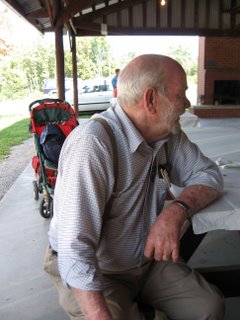
 Impatient, Sydney's Uncle Pat Sartin finally snatched up the toad bare-handed and carried it a reasonable distance out of harm's way. So lightning-quick were his actions that no camera could record them, but I later got this photo of Pat, triumphant.
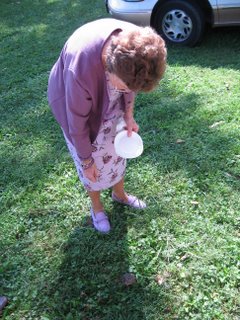
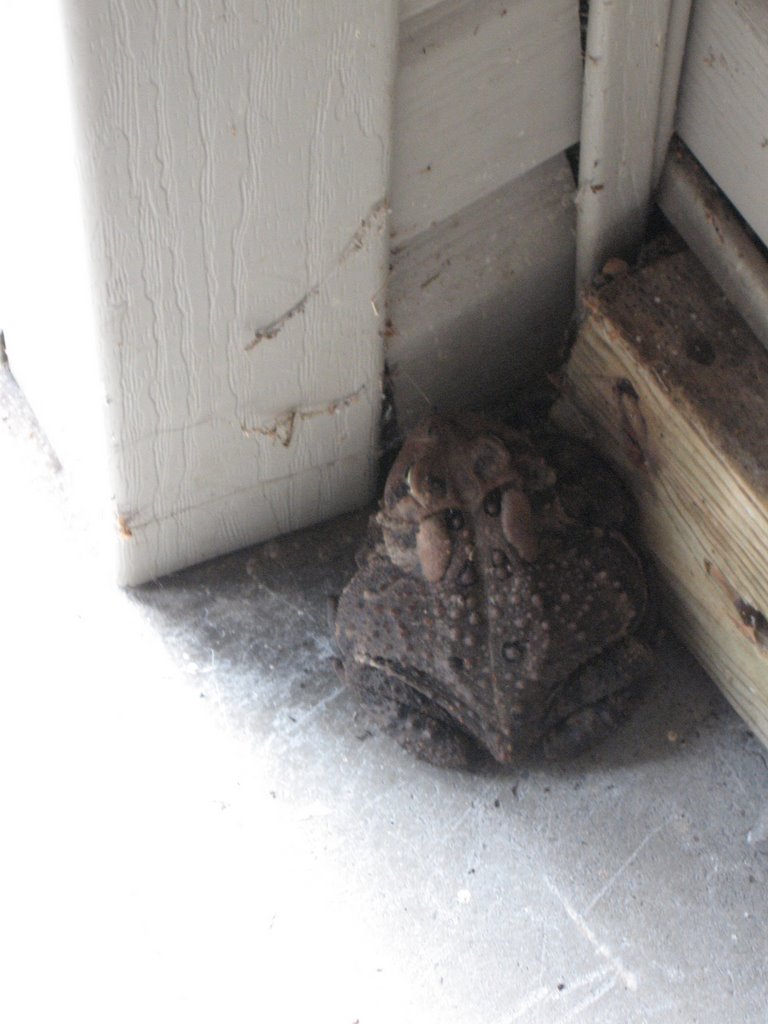 Because we worried the toad would get stepped on or otherwise injured, we decided it needed to be carried across the park, toward the woods. Sydney's mother, Fran Bowling, is a retired elementary-school teacher and therefore a veteran wrangler of wildlife, so she matter-of-factly scooped the toad onto a paper plate. The toad was too big for the plate, though, so Fran wound up herding the reluctant toad toward the woods, away from the pavilion.


 Impatient, Sydney's Uncle Pat Sartin finally snatched up the toad bare-handed and carried it a reasonable distance out of harm's way. So lightning-quick were his actions that no camera could record them, but I later got this photo of Pat, triumphant.

My modeling career
Normally only my byline appears at eTrucker.com, but now I'm a photo illustration. Sydney was behind the camera. I was so "in character" that I nearly fell asleep during the shoot!
Monday, September 11, 2006
Five years later
Sunday night, in my room at the Hampton Inn nearest the Baltimore airport, I reached inside my toiletries bag and found that my shampoo had leaked, that the cap hadn't been screwed on tightly.
That's odd, I thought. I distinctly remember checking the cap for tightness while I packed this morning.
My next thought was: The security guard who opened and searched my suitcase after I checked it must have opened the shampoo bottle to make sure it was shampoo and not an explosive.
There was no polite card in my suitcase like the ones I occasionally found in 2002 and 2003, cards saying, in effect, "So sorry we had to search your suitcase, we trust we didn't disturb anything too badly, thanks for understanding." I don't really expect those cards anymore.
Earlier Sunday, at the Charlotte, N.C., airport, the polite federal officer who tested my CPAP machine -- which never was pulled at a security checkpoint before 2006, but which invariably gets pulled now -- told me some airports now ban CPAP machines as carry-ons, requiring them to go into the hold as checked luggage instead.
Such a reassuring sound "checked luggage" now has in the mouths of security experts. We'll all be OK, they imply, if we just get the dicey stuff out of the cabin and into "checked luggage." Never mind that checked luggage brought down Pan Am Flight 103.
I didn't say any of this to the security guard, of course. He doesn't make the policy. I'm not sure anyone does.
Here's a quiz. Was my assumption that my suitcase and shampoo had been searched
A) Likely correct, given our current search-and-surveillance society; or
B) Likely incorrect, possibly even paranoid, but understandable given our current search-and-surveillance society.
Whatever my answer, it must be A or B. I can imagine no C.
All this went through my mind as I stood in my hotel room, staring at my suitcase. I shook my head and thought: Enough. I secured my shampoo and went to bed.
That's odd, I thought. I distinctly remember checking the cap for tightness while I packed this morning.
My next thought was: The security guard who opened and searched my suitcase after I checked it must have opened the shampoo bottle to make sure it was shampoo and not an explosive.
There was no polite card in my suitcase like the ones I occasionally found in 2002 and 2003, cards saying, in effect, "So sorry we had to search your suitcase, we trust we didn't disturb anything too badly, thanks for understanding." I don't really expect those cards anymore.
Earlier Sunday, at the Charlotte, N.C., airport, the polite federal officer who tested my CPAP machine -- which never was pulled at a security checkpoint before 2006, but which invariably gets pulled now -- told me some airports now ban CPAP machines as carry-ons, requiring them to go into the hold as checked luggage instead.
Such a reassuring sound "checked luggage" now has in the mouths of security experts. We'll all be OK, they imply, if we just get the dicey stuff out of the cabin and into "checked luggage." Never mind that checked luggage brought down Pan Am Flight 103.
I didn't say any of this to the security guard, of course. He doesn't make the policy. I'm not sure anyone does.
Here's a quiz. Was my assumption that my suitcase and shampoo had been searched
Whatever my answer, it must be A or B. I can imagine no C.
All this went through my mind as I stood in my hotel room, staring at my suitcase. I shook my head and thought: Enough. I secured my shampoo and went to bed.
Wednesday, September 06, 2006
I am the Wig Man! Goo goo goo joob!
I'm unusual among Marylanders in that I am not running for the U.S. Senate this year. According to the sample primary ballots in today's paper, 10 Republicans and 18 Democrats are running, plus who knows how many third-party candidates. I guess that's what happens when a five-term incumbent decides to retire.
In a crowded field, Republican candidate Daniel Vovak stands out, as these photos demonstrate. Wherever he goes, Vovak wears a George Washington-esque white wig. Asked why, he explains: "It evokes the Whig roots of the Republican Party and its reliance on the founders' version of the United States Constitution." Besides, he says, it's great publicity.
Vovak's campaign website seems to be down, just like R.J. Reynolds', but Wikipedia is meeting the needs of the Republic by giving him comprehensive coverage.
I deeply admire Vovak's opposition to the Maryland state flag, which he rightly calls "the ugliest flag in America." He adds: "In fact, after further study, I have concluded Maryland has the ugliest flag in the world."
I also deeply admire Vovak's announcement that he has hired a psychic to direct negative energies toward the GOP front-runner in the Senate race, Lt. Gov. Michael Steele. "My volunteer campaign staff deduced it was less expensive to hire a psychic campaign manager who would curse Michael Steele than to spend a half million dollars on consultants," Vovak says. "Nancy Reagan used a psychic, and I admire her. We got a good deal on a great psychic."
I disagree, alas, with Vovak's position on Pluto, which he says should be declared a planet by Congress. I fear this would be a slippery slope. Next thing you know, Congress would declare that H20 is the symbol not for water but gold, or that the value of pi is officially 12 because that was Roger Staubach's number with the Dallas Cowboys.
On the other hand, I deeply admire that Vovak has a position on Pluto.
Most of all, I deeply admire Vovak's crusade to have himself listed on the ballot as Daniel "The Wig Man" Vovak and not Daniel "Wig Man" Vovak, which is how he is indeed listed. Apparently the state of Maryland drew the line at "The," because one must draw lines somewhere, lest chaos reign. In his statement denouncing the loss of his "The," Vovik omitted every occurrence of "the." Brilliant tactic should be emulated by other campaigns at first opportunity, as most routine announcements gain great interest by absence of common word, and think of savings on paper alone!
Some scoff at the Wig Man's chances in the Sept. 12 primary. No way the GOP will go for that, you say. I say: You never know.
Blundering into Berlin
In a recent interview with the Florida Baptist Witness ("Publishing Good News since 1884"), U.S. Rep. Katherine Harris, R-Fla., said she opposes secular government and supports a theocracy instead. The separation of church and state is a lie, the U.S. Senate candidate said:
Her congressional staff also has been remarkable for turnover. Since Harris took office in 2003, she's been through four chiefs of staff and four press secretaries.
The first ex-Harris for Senate campaign manager, Dornan, told The Palm Beach Post, "I have never in my life worked for somebody like her, ever, and hopefully I'll never have to again. ... She was an equal opportunity abuser." He told The Associated Press the Harris campaign is "one of the most disastrous ever run in the United States."
I reminisce about all this because Katherine Harris, "disastrous" campaign and all, easily won this week's primary and now is the GOP candidate for U.S. Senate in Florida. Ain't politics grand?
I am reminded, as so often, of the movie Casablanca. Conrad Veidt calls Humphrey Bogart "just another blundering American," and Claude Rains replies: "We musn't underestimate American blundering. I was with them when they blundered into Berlin in 1918."
All those Florida Republicans who have been backing Anyone But Harris now have to decide: Vote Harris, or vote Democrat? If they close ranks and back the party, as party members used to do, the laughingstock could have the last laugh, and blunder her way straight to the U.S. Senate.
... We have to have the faithful in government, and over time, that lie we have been told, the separation of church and state, people have internalized, thinking that they needed to avoid politics, and that is so wrong because God is the one who chooses our rulers. And if we are the ones not actively involved in electing those godly men and women, and if people aren’t involved in helping godly men in getting elected, than we’re going to have a nation of secular laws. That’s not what our founding fathers intended, and that certainly isn’t what God intended. ... If you’re not electing Christians, then in essence you are going to legislate sin.Amid the ensuing furor, the Harris campaign released a statement saying, in effect, "Jews are OK, too," but letting the church-state comments stand. The statement included a quote from Harris' current campaign manager:
As the grandson of Holocaust survivors, I know that she encourages people of all faiths to engage in government so that our country can continue to thrive on the principles set forth by our Founding Fathers, without malice towards anyone.To clarify, this was Harris campaign manager Bryan Rudnick speaking, not Harris campaign manager Jim Dornan, who quit in November 2005; or Harris campaign manager Jamie Miller, who quit in April 2006; or Harris campaign manager Glen Hodas, who quit in July 2006.
Her congressional staff also has been remarkable for turnover. Since Harris took office in 2003, she's been through four chiefs of staff and four press secretaries.
The first ex-Harris for Senate campaign manager, Dornan, told The Palm Beach Post, "I have never in my life worked for somebody like her, ever, and hopefully I'll never have to again. ... She was an equal opportunity abuser." He told The Associated Press the Harris campaign is "one of the most disastrous ever run in the United States."
I reminisce about all this because Katherine Harris, "disastrous" campaign and all, easily won this week's primary and now is the GOP candidate for U.S. Senate in Florida. Ain't politics grand?
I am reminded, as so often, of the movie Casablanca. Conrad Veidt calls Humphrey Bogart "just another blundering American," and Claude Rains replies: "We musn't underestimate American blundering. I was with them when they blundered into Berlin in 1918."
All those Florida Republicans who have been backing Anyone But Harris now have to decide: Vote Harris, or vote Democrat? If they close ranks and back the party, as party members used to do, the laughingstock could have the last laugh, and blunder her way straight to the U.S. Senate.
Monday, September 04, 2006
Cranesville Swamp
Sydney and I had a wonderful time Sunday afternoon tramping around Cranesville Swamp in neighboring Garrett County, in far western Maryland along the West Virginia border.
This remarkable subarctic swamp formed during the last Ice Age and has been preserved intact the past 15,000 years in a quirky "frost pocket" that keeps the place colder and wetter than normal, and a haven for animal and plant species normally found nowhere south of Canada, including the southernmost tamarack forest in the United States.
We heard about this place before we moved to the neighborhood this summer, but we figured we'd better go see it quick, while it's still there. Like every other spot in North America, the Alleghenies are getting warmer, frost pockets and all.
Sydney and I especially enjoyed the 1,500-foot boardwalk over the peat bog, which is 3 feet deep in spots. That's impressive, since peat is formed by sphagnum moss growing and flourishing in the same spot for thousands of years. This is the least invasive boardwalk I ever saw, set at bog level and barely two people wide. In many places, the vegetation is reaching up through the planks to claim it.
The bog's surface is a thicket of shrubs and ground plants that teems in summer with bees and butterflies and, alas, flies, which ignored Sydney in order to feast on that lumbering buffet just behind her, namely me.
Other colorful inhabitants of the swamp and its woods of red spruce and hemlock include the tiny saw-whet owl, which could fit in the palm of the hand, and the sundew, a carnivorous plant that lacks the Venus' flytrap's press agent.
No, I didn't take any photos. The camera is in the shop, though it should be back Any Day Now.
More than 1,500 acres of the swamp and environs has been bought by the Nature Conservancy, which has planted thousands of red spruce and white pines since 2002, to replace trees unwisely logged at mid-century. The Conservancy also maintains the boardwalk, a network of single-file walking trails and a muddy parking lot that holds maybe a half-dozen cars. Big crowds of people aren't really wanted there, as the ecosystem is too delicate. Fortunately, the place is an hour off the interstate and impossible to find without close attention to the excellent directions on the Nature Conservancy's website.
That the Nature Conservancy needs all the help it can get probably goes without saying, but I'll say it anyway. Here's the website again.
Slithering away from Snakes
In reply to Mr. Cavin's comment below, I'll happily shake on Snakes on a Plane being a flop but not a bomb, a distinction I admire. Clearly Mr. Cavin and I are brothers, as we both care so much about such things.
I confess that I haven't seen the movie, and don't intend to; it never interested me as a movie, only as a business phenomenon. Keith "Reel Fanatic" Demko has seen it, and he comments:
I confess that I haven't seen the movie, and don't intend to; it never interested me as a movie, only as a business phenomenon. Keith "Reel Fanatic" Demko has seen it, and he comments:
To me, the flick delivered exactly what it promised, just a big ball of B-movie fun.'Nuff said!
Thursday, August 31, 2006
More Snakes than bucks
Mr. Cavin writes:
According to the Internet Movie Database, here are movies that did better on opening weekend this summer than Snakes on a Plane, which did $15 million. First I list the title, then the opening-weekend gross.
Pirates of the Caribbean: Dead Man's Chest $135 million
X-Men: The Last Stand $122 million
The Da Vinci Code $77 million
Ice Age: The Meltdown $68 million
Cars $60 million
Superman Returns $52 million
Mission: Impossible 3 $47 million
Talladega Nights $47 million
Click $40 million
Scary Movie 4 $40 million
The Break-Up $39 million
Over the Hedge $38 million
Nacho Libre $28 million
The Devil Wears Prada $27 million
Miami Vice $25 million
The Fast and the Furious: Tokyo Drift $23 million
Monster House $22 million
Poseidon $22 million
Little Man $21 million
You, Me and Dupree $21 million
Silent Hill $20 million
Step Up $20 million
Lady in the Water $18 million
World Trade Center $18 million
Invincible $17 million
The Omen $16 million
RV $16 million
"Let's make a summer action movie starring Samuel L. Jackson, hype it until its very title becomes a catchphrase on the lips of millions, open it on an August weekend with no competition, and make about half as much money as Nacho Libre" is not a recipe for Hollywood success, however you try to spin it.
Snakes on a Plane wound up making the same opening-weekend box office as Barnyard, made by people so stupid they don't know that bulls do not have udders.
Its first week, Snakes on a Plane grossed $20 million. Its second week, $6 million. At this rate, will it still be theaters a fourth week?
To paraphrase Bette Davis again: What. A. Flop.
(For what it's worth, the only other airliner-in-peril movie this summer, itself overhyped, grossed only $11 million its opening weekend. But United 93 already has grossed more than twice its cost; that seems a forlorn box-office hope for Snakes on a Plane.)
Based on information I read at The New York Times, I was under the impression that Snakes on a Plane was reaping the norm for a late summer horror release, and that any illusion of its poor performance was due to hopes being inflated by the internet hype phenomena (a lesson apparently no one took home after the halfhearted opening weekend of Steven Spielberg's AI). Certainly SOAP isn't bombing, though, just merely normal.This argument reminds me of Joan Crawford's in What Ever Happened to Baby Jane?
Joan Crawford: You wouldn't be able to do these awful things to me if I weren't still in this chair.True, Snakes on a Plane wouldn't be a belly flop if it hadn't been the most-hyped Internet phenomenon in Hollywood memory, with 31 million Google hits (as of a minute ago) compared to 8 million for the movie of the summer, Pirates of the Caribbean: Dead Man's Chest. But it WAS, Blanche! It WAS!
Bette Davis: But you ARE, Blanche! You ARE in that chair!
According to the Internet Movie Database, here are movies that did better on opening weekend this summer than Snakes on a Plane, which did $15 million. First I list the title, then the opening-weekend gross.
"Let's make a summer action movie starring Samuel L. Jackson, hype it until its very title becomes a catchphrase on the lips of millions, open it on an August weekend with no competition, and make about half as much money as Nacho Libre" is not a recipe for Hollywood success, however you try to spin it.
Snakes on a Plane wound up making the same opening-weekend box office as Barnyard, made by people so stupid they don't know that bulls do not have udders.
Its first week, Snakes on a Plane grossed $20 million. Its second week, $6 million. At this rate, will it still be theaters a fourth week?
To paraphrase Bette Davis again: What. A. Flop.
(For what it's worth, the only other airliner-in-peril movie this summer, itself overhyped, grossed only $11 million its opening weekend. But United 93 already has grossed more than twice its cost; that seems a forlorn box-office hope for Snakes on a Plane.)
Tuesday, August 29, 2006
Conversation overheard in Frostburg
Two guys in an athletic facility:
"Do you get Martin Luther King Day off?"
"That ain't a real holiday. Now, if we had a James Earl Ray Day ..."
Authentic American voters! There you have 'em, folks.
"Do you get Martin Luther King Day off?"
"That ain't a real holiday. Now, if we had a James Earl Ray Day ..."
Authentic American voters! There you have 'em, folks.
Snakes lacks legs
Before the movie Snakes on a Plane opened, my hero F. Brett Cox wondered aloud:
Amid all the opinion pieces about why the movie tanked (precious few of which concern themselves with whether the movie was any good), has anyone speculated that the recent mid-Atlantic terror scare has put people off airliner-in-peril movies?
It'll be interesting to see how the movie does after all the hype.Well, now we know: It bombed. The opening-weekend gross was $15 million, less than a third of what the virtually hype-free Talladega Nights raked in its first weekend.
Amid all the opinion pieces about why the movie tanked (precious few of which concern themselves with whether the movie was any good), has anyone speculated that the recent mid-Atlantic terror scare has put people off airliner-in-peril movies?
Everyone's talking about Little Georgie
I laughed loudly at this Arthur D. Hlavaty post, and was only mildly ashamed.
Christopher Rowe, meanwhile, is right in remembering that in Robert Lawson's children's book Rabbit Hill, the lyrics of Little Georgie's song come complete with a melody. I can't read music, alas, so it could be sung to the tune of "Happy Birthday" or "To Anacreon in Heaven," for all I know.
Christopher adds:
Kip W., meanwhile, recalls that Lawson was featured years ago in an exhibition of children's book illustrations at the Chrysler Museum of Art in Norfolk, Va. I have visited the Chrysler only once and had not thought about it in years, but it's a fine museum, highly recommended. Kip W. adds:
Christopher Rowe, meanwhile, is right in remembering that in Robert Lawson's children's book Rabbit Hill, the lyrics of Little Georgie's song come complete with a melody. I can't read music, alas, so it could be sung to the tune of "Happy Birthday" or "To Anacreon in Heaven," for all I know.
Christopher adds:
I sing little songs too. In fact, a lot of times I make up a little song for whatever story I'm working on; the one for "The Voluntary State" even made it into the text.Do you mean Tonight we'll remake Tennessee, every night we remake Tennessee? I am delighted to know this. It reminds me of the various creation myths in which the gods sing a world into being.
Kip W., meanwhile, recalls that Lawson was featured years ago in an exhibition of children's book illustrations at the Chrysler Museum of Art in Norfolk, Va. I have visited the Chrysler only once and had not thought about it in years, but it's a fine museum, highly recommended. Kip W. adds:
I remember in 8th grade, snickering because Lawson's drawing of a gangster called "Fish-Eye" looked a lot like one of my teachers.Now I want to see the illustration! What book was it in?
More "German" and "French"
Trent Hergenrader writes, in part:
During the First World War, I wonder, was it renamed "liberty chocolate cake"?
Trent also alerts us to the obscure word "cataglottism," meaning French kissing. He adds:
This is almost on-topic, but German Chocolate Cake gets its name from the type of chocolate (German's Sweet Chocolate) used ...I did not know that. The story is told here at the invaluable Snopes.com.
During the First World War, I wonder, was it renamed "liberty chocolate cake"?
Trent also alerts us to the obscure word "cataglottism," meaning French kissing. He adds:
Had I only known this in high school, so much would be so different today...My knowing that word in high school would have helped me not at all. I knew many terms for acts I was at no risk of actually enjoying. I would, however, have inserted the word into snarky remarks: "What's the matter? Cataglottism got your tongue?"
Sunday, August 27, 2006
Boy: Tales of Childhood
I was taken aback by Roald Dahl’s memoir Boy: Tales of Childhood, but I suppose I shouldn’t have been; this is the author of Switch Bitch, after all. With rare exceptions, all Dahl’s childhood memories are awful: surgeries without anesthetic, a car accident that cut off his nose, and above all, vicious beatings by sadistic schoolmasters, one of whom went on to become Archbishop of Canterbury. Dahl writes:
By now I am sure you will be wondering why I lay so much emphasis upon school beatings in these pages. The answer is that I cannot help it. All through my school life I was appalled by the fact that masters and senior boys were allowed literally to wound other boys, and sometimes quite severely. I couldn't get over it. I never have got over it. It would, of course, be unfair to suggest that all masters were constantly beating the daylights out of all the boys in those days. They weren't. Only a few did so, but that was quite enough to leave a lasting impression of horror upon me. It left another more physical impression upon me as well. Even today, whenever I have to sit for any length of time on a hard bench or chair, I begin to feel my heart beating along the old lines that the cane made on my bottom some fifty-five years ago.On a cheerier note, I was pleased to learn in Boy that young Dahl and all his classmates at Repton were tasters for the new confections being developed by the Cadbury chocolate company:
Cadbury's were using some of the greatest chocolate-bar experts in the world to test out their new inventions. We were of a sensible age, between thirteen and eighteen, and we knew intimately every chocolate bar in existence, from the Milk Flake to the Lemon Marshmallow. Quite obviously our opinions on anything new would be valuable. All of us entered into this game with great gusto, sitting in our studies and nibbling each bar with the air of connoisseurs, giving our marks and making our comments. "Too subtle for the common palate," was one note that I remember writing down.Young Dahl's daydreams about how wonderful it would be to work in the inventing-room at Cadbury's resulted, of course, in his second children's book, Charlie and the Chocolate Factory, 35 years later.
More information german to the measles
Somewhere upstream, I declared that the G in "german measles" ought to be lowercased, since it means german as in "germane," not German the nationality. Beth replies:
Neither the Oxford English Dictionary nor Webster’s New World Dictionary gives the origin of the term "German measles," but both uppercase the G, and the OED goes further by listing the illness under "German" with a capital G, not "german" with a little g. So Beth’s argument is looking pretty good, and Ye Humble Blogsmith is feeling more humble than usual.
Can anyone point us to a definitive origin of "German measles," or is this one of the (countless) terms for which no such definitive origin is known?
As for whether "German measles" might have been a jingoistic way of saying "faux measles," it’s interesting that the earliest appearances of "German measles" cited by the OED are medical journals of the late 19th century, the Bismarck era, when anti-German sentiment may have been at high tide.
Still, the term isn’t as obviously insulting as "Welsh rabbit" or "Dutch courage" or "Irish taxi" (a wheelbarrow). And "French kiss" seems, to modern sensibilities, downright complimentary!
Is your source really sure it's from germanus or is this a folk etymology? I'd wager a guess that it's German measles just because this is a colloquial way of indicating "not true/not standard/from elsewhere" -- like Welsh rabbit or French kissing or Dutch courage.A touch, a touch, I do confess!
Neither the Oxford English Dictionary nor Webster’s New World Dictionary gives the origin of the term "German measles," but both uppercase the G, and the OED goes further by listing the illness under "German" with a capital G, not "german" with a little g. So Beth’s argument is looking pretty good, and Ye Humble Blogsmith is feeling more humble than usual.
Can anyone point us to a definitive origin of "German measles," or is this one of the (countless) terms for which no such definitive origin is known?
As for whether "German measles" might have been a jingoistic way of saying "faux measles," it’s interesting that the earliest appearances of "German measles" cited by the OED are medical journals of the late 19th century, the Bismarck era, when anti-German sentiment may have been at high tide.
Still, the term isn’t as obviously insulting as "Welsh rabbit" or "Dutch courage" or "Irish taxi" (a wheelbarrow). And "French kiss" seems, to modern sensibilities, downright complimentary!
Wendy houses
Saturday a week ago, while reading Roald Dahl’s memoir Boy: Tales of Childhood, I was pleased to stumble across a British phrase new to me: “Wendy house,” meaning a child’s playhouse. I made a mental note but forgot to mention it to Sydney.
The next day, Sydney told me she just had stumbled across an interesting British phrase in Barbara Vine’s novel A Dark-Adapted Eye: “Wendy house,” meaning – well, you know what it means.
Wendy houses get their name from Wendy in J.M. Barrie’s Peter Pan. Upon the publication this year of Alan Moore’s long-awaited novel Lost Girls, about the sexual adventures of the fantasy heroines Wendy, Dorothy and Alice, the phrase “Wendy house” may gain a whole new meaning.
Sunday, August 20, 2006
Little Georgie Sings a Song
We're happy that our new neighborhood has an abundance of small wildlife: groundhogs, chipmunks, squirrels and, especially, rabbits. One of our neighbors spotted seven rabbits under a single tree a few nights ago, but we commonly see five or six during our early-morning or late-evening walks.
Soon after we moved in, Sydney dubbed the area "Rabbit Hill," and whenever a baby rabbit hopped across our path, she cried, "Little Georgie!" She was aghast when I got neither reference. "You mean you never read Rabbit Hill when you were a child?" she asked. When I told her I never even had heard of Rabbit Hill, she tracked down a copy at the library and thrust it into my hands.
So now I personally can attest to Rabbit Hill, written and illustrated by Robert Lawson, being a lovely book. It's about the little animals of the pastures and woods waiting expectantly for the New Folks to move into the Big House, in hopes the New Folks prove to be kind and generous with such things as their garden and their garbage. The moral is "There is enough for all," and so there is. Lawson set this book, first published in 1944, on his own farm in Connecticut; like E.B. White's Charlotte's Web and Walter R. Brooks' novels about Freddy the Pig, it's an enduring children's book about farm life written at mid-century by a publishing-industry veteran long resident in New York City.
Most interesting to me, for personal reasons, was Chapter 3, "Little Georgie Sings a Song," about the youngest member of the rabbit family:
Most people don't know this, but she makes up and sings little songs about things that make her happy. For example, we like to vacation in Kill Devil Hills, on the Outer Banks of North Carolina, and we generally rent the same condo, year after year. As we approach the condo, Sydney sings:
It's our condo!
Our little condo!
Transcribed like that, it doesn't look like much, but it suits both Sydney and me completely, and its melody does indeed go up a little and down a little and end where it began. Sydney doesn't remember when she started habitually singing these little songs, but I'm convinced they come from her reading about Little Georgie when she was a child -- or, even earlier, having her mother read to her about Little Georgie. Little Georgie probably was one of the first writers and musicians of her acquaintance.
(For a very different take on New Folks moving into a neighborhood teeming with rabbits, read Kelly Link's brilliant story "Stone Animals," in her brilliant collection Magic for Beginners.)
Soon after we moved in, Sydney dubbed the area "Rabbit Hill," and whenever a baby rabbit hopped across our path, she cried, "Little Georgie!" She was aghast when I got neither reference. "You mean you never read Rabbit Hill when you were a child?" she asked. When I told her I never even had heard of Rabbit Hill, she tracked down a copy at the library and thrust it into my hands.
So now I personally can attest to Rabbit Hill, written and illustrated by Robert Lawson, being a lovely book. It's about the little animals of the pastures and woods waiting expectantly for the New Folks to move into the Big House, in hopes the New Folks prove to be kind and generous with such things as their garden and their garbage. The moral is "There is enough for all," and so there is. Lawson set this book, first published in 1944, on his own farm in Connecticut; like E.B. White's Charlotte's Web and Walter R. Brooks' novels about Freddy the Pig, it's an enduring children's book about farm life written at mid-century by a publishing-industry veteran long resident in New York City.
Most interesting to me, for personal reasons, was Chapter 3, "Little Georgie Sings a Song," about the youngest member of the rabbit family:
Little Georgie lay back in the warm grass and sang hisHow admirable the word "paean" in a book aimed at 10-year-olds! But I digress. This description of Little Georgie's song perfectly fits Sydney's little songs, too.
song --
New Folks coming, oh my!
New Folks coming, oh my!
New Folks coming, oh my!
Oh my! Oh my!
There weren't many words and there weren't many notes, and the notes just went up a little and down a little and ended where they began. Lots of people might have thought it monotonous, but it suited Little Georgie completely. He sang it loud and he sang it soft, he sang it as a paean of triumph, a saga of perils met and overcome. He sang it over and over again.
Most people don't know this, but she makes up and sings little songs about things that make her happy. For example, we like to vacation in Kill Devil Hills, on the Outer Banks of North Carolina, and we generally rent the same condo, year after year. As we approach the condo, Sydney sings:
It's our condo!
Our little condo!
Transcribed like that, it doesn't look like much, but it suits both Sydney and me completely, and its melody does indeed go up a little and down a little and end where it began. Sydney doesn't remember when she started habitually singing these little songs, but I'm convinced they come from her reading about Little Georgie when she was a child -- or, even earlier, having her mother read to her about Little Georgie. Little Georgie probably was one of the first writers and musicians of her acquaintance.
(For a very different take on New Folks moving into a neighborhood teeming with rabbits, read Kelly Link's brilliant story "Stone Animals," in her brilliant collection Magic for Beginners.)
Thursday, August 17, 2006
Mencken
I just finished reading Marion Elizabeth Rodgers' terrific biography Mencken: The American Iconoclast (Oxford University Press, 2005). The writings of the late H.L. Mencken have enraptured, exasperated and obsessed me since I stumbled across his essay "The Sahara of the Bozart" as a teenager; Rodgers brings the Mencken I knew to vivid life but also reveals many other Menckens as well, Menckens I never dreamed existed.
Rodgers might well have subtitled her book The American Contradiction. Mencken said awful things, publicly and privately, about African-Americans and Jews, things that he genuinely believed; yet he crusaded against the Klan when it was at the peak of its political power, and lobbied on Capitol Hill for an anti-lynching bill when even the Roosevelt administration turned a deaf ear. A thunderous agnostic, he heaped more ridicule upon religion in all its forms than any other public figure in American history; yet he knew more about the Bible than some of his drinking-buddy theologians, and he enjoyed nothing more than a good tent revival, where he sat on the front row and lustily sang every hymn from memory. He prided himself on being, first and foremost, a reporter's reporter, interviewing more people, doing more legwork and churning out more copy than youngsters 40 years his junior; yet he lost all interest in the story of his career, the Scopes "monkey trial," and went home to Baltimore before the verdict even came in. He assailed his fellow Americans as a "timorous mob of goosesteppers" and publicly argued the political and cultural superiority of his ancestral land, Germany, not only during the First World War but during the Second, at serious risk to his career, his freedom and his life; yet the magisterial research project to which he devoted much of that life, The American Language, was a triumphant declaration of independence for his native tongue and a thousand-page tribute to the seething kettle of classes and races that had created it.
Remarkably consistent across his half-century of fame, however, was Mencken's amazing prose style. He idolized Mark Twain and George Bernard Shaw, and it shows, as does the influence of Ambrose Bierce; but no one in the English language ever ranted like Mencken. His screeds are their own subgenre. Harlan Ellison, Hunter S. Thompson and Bruce Sterling, to name but three of Mencken's obvious descendants, are timid souls compared to H.L. at gale force.
On each page, Rodgers cherry-picks three or four glorious Menckenisms, for example his assessment of the dumbing-down of American politics: "We move toward a lofty ideal. On some great and glorious day the plain folks of the land will reach their heart's desire at last, and the White House will be adorned by a downright moron." Mencken may be better served by excerpts than by full reprints; at length, even his most laudable fits of indignation can become exhausting, self-defeating. As I read Rodgers' book, I found myself jotting down the ones that seemed to comment, not on 1916 or 1936 headlines, but on 2006 headlines:
We [Americans] posture as apostles of fair play, as good sportsmen, as professional knights-errant -- and throw beer bottles at the umpire when he refuses to cheat for our side. ... We deafen the world with our whoops for liberty -- and submit to laws that destroy our most sacred rights. ... We play policeman and Sunday-school superintendent to half of Christendom -- and lynch a darky every two days in our own backyard.We need Mencken today more than ever, and not only medicinally; he is marvelously funny, and his torrential vocabulary and thundering rhythms are a mother lode of inspiration for any writer or speaker. He is also an absolutely American creation, essential to any understanding of our often-invoked, often-ignored national heritage, whatever that turns out to be. Yet I get the impression he's not widely read, and that most of his books are out of print. That no Library of America set of Mencken exists is a serious omission; I hope someone is diligently working on that massive task. Mencken, of course, would have jeered at that sentiment, too. "One civilized reader," he wrote, "is worth a thousand boneheads." Reading Mencken, I'm never quite sure in which category the Sage of Baltimore would pigeonhole me: anointed among the civilized, or cast among the boneheads. That he still can cause such unease, more than 50 years after his death, is the best reason to read him.
Europe sees Americanism, in brief, as a sort of Philistine uprising against the free spirit of man -- as a conspiracy of dull and unimaginative men, fortuitously made powerful, against all the ideas and ideals that seem sound to their betters.
Once the world is made safe for democracy, all that will remain will be to make democracy safe for the world.
The kinds of courage I really admire are not whooped up in war, but cried down, and indeed become infamous. No one, in such times ... ever praises the man who stands out against official balderdash, and seeks to restore the national thinking, so called, to a reasonable sanity. On the contrary, he is regarded as a shabby and evil fellow, and there is not much protest when he is punished in a summary and barbaric manner, without any consideration of the evidence against him. It is sufficient that he refuses to sing the hymn currently lined out. That alone is enough to condemn him.
We are, in fact, a nation of evangelists; every third American devotes himself to improving and lifting up his fellow-citizens, usually by force; the messianic delusion is our national disease.
What becomes of the old notion that the United States is a free country, that it is a refuge for the oppressed of other lands?
Sunday, August 13, 2006
Capclave in October
Sydney and I plan to be at Capclave, Oct. 20-22 in Silver Spring, Md. The author guest of honor is Kim Stanley Robinson, and others scheduled to attend include Catherine Asaro, Susan Casper, Dennis Danvers, Gardner Dozois, Laura Anne Gilman, David Hartwell, Peter Heck, Klon Newell, Patrick and Teresa Niesen Hayden, Paul Park, Benjamin Rosenbaum, Darrell Schweitzer, Michael Swanwick, etc. Y'all come!
Saturday, August 12, 2006
More Kevin Smith confessions
In reply to my confession that Sydney and I own a Dimension Collector's Series DVD of Jay and Silent Bob Strike Back, my hero Brett Cox writes:
As for Snakes on a Plane, I suspect that it'll be just you and a few million of your friends.
Come to think of it, though, I wonder whether recent news events will hurt the popularity of that venerable subgenre, the airliner-in-peril movie, as briefly happened after the Sept. 11 attacks.
But will you both be going to see Clerks II? Jeanne's already told me I'm on my own for Snakes on a Plane.Do you know, I haven't even seen the original Clerks yet? That's too bad, considering I have seen Mallrats. Seeing Clerks II before I see Clerks just seems wrong.
As for Snakes on a Plane, I suspect that it'll be just you and a few million of your friends.
Come to think of it, though, I wonder whether recent news events will hurt the popularity of that venerable subgenre, the airliner-in-peril movie, as briefly happened after the Sept. 11 attacks.
A Carter Family hint
On the topic of the Duncans' visit to the Carter Fold in Virginia, Andy Wolverton writes:
I've always thought that you could write a great Carter Family story... (slight, not-so-subtle hint) Maybe for that next collection?Thanks, Andy. Interestingly enough, I already decided to claim the Carter Fold trip as a business expense.
Measles, sort of
My hero Barry Johnson writes:
I guess this means I have to buck the AP Stylebook and its fat ally, Webster's New World Dictionary, and spend the rest of my life lowercasing the G, since "german" is not a geographic reference: hence, "german measles," not "German measles."
This sort of thing buoys my spirits for hours on end.
Hey, Barry, while you were having dinner with that physician, did you ask about that mole on your back and that ache in your toe and that sore place in your mouth, the way I always do? Got to grab the health care where you can.
Here's an interesting bit of fact that I just learned myself last week, over a dinner conversation with a physician. "German measles" aren't really measles. Who knew?I did not know this, either, but I am delighted to learn it, and you inspire me to look it up. "German measles" is another term for rubella, which isn't measles but resembles measles, hence the "German" -- not a reference to Germany but from the Latin "germanus," meaning "similar" (as in the English word "germane"). Those doctors and their Latin!
I guess this means I have to buck the AP Stylebook and its fat ally, Webster's New World Dictionary, and spend the rest of my life lowercasing the G, since "german" is not a geographic reference: hence, "german measles," not "German measles."
This sort of thing buoys my spirits for hours on end.
Hey, Barry, while you were having dinner with that physician, did you ask about that mole on your back and that ache in your toe and that sore place in your mouth, the way I always do? Got to grab the health care where you can.
Wednesday, August 09, 2006
No more "freedom fries"
This should have been bigger news: French fries and French toast are back on the menu in the cafeterias of Capitol Hill, three years after they were renamed "freedom fries" and "freedom toast" by two Republican congressmen indignant over France's opposition to war in Iraq.
Today, 60 percent of Americans are just as opposed to war in Iraq as the French ever were; one of the two "freedom fries" advocates, Bob Ney of Ohio, just bowed out of his re-election campaign amid an ongoing corruption scandal (though you wouldn't know it from his website); and the other, Walter Jones of North Carolina, now favors a pullout of U.S. troops. "I’m more concerned about terrorism south of the border than I am in Iraq," Jones says.
During World War I, amid a wave of anti-German sentiment, patriotic Americans similarly renamed things. Hamburgers became "liberty sandwiches," dachshunds "liberty hounds," sauerkraut "liberty cabbage" and -- my favorite -- German measles "liberty measles." (If they hated Germans so much, why not blame the measles on them?) "Freedom fries" are receding just as rapidly into obscure history. The war will be with us much longer.
The Carter Fold
On Saturday, Sydney and I rode with her family to the Carter Family Memorial Festival at the Carter Fold in Hiltons, Va.
The Carter Fold is an 800-seat music pavilion built into a hillside a few yards from the cabin where A.P. Carter was born and the general store that Carter ran in his later years, long after the original Carter Family musical group had broken up. Old-time, bluegrass and country musicians, mostly local and regional, perform at the Fold every Saturday night, and once a year dozens of them converge on the place for the festival.
Both the Fold and the festival were started in the 1970s by Janette Carter, daughter of A.P. and Sara. It was A.P.'s dying wish that the Carter Family's music, and the music that inspired them, would not be forgotten in the valley the Carters have called home for generations.
This was the first festival without Janette, who died in January at age 82, but her work is being carried on by her children, Dale and Rita. For this year's festival, Rita even made the pinto beans and cornbread, just as her mother did for so many years.
Anyone interested in old-time music should make the pilgrimage to the Fold at least once. Even today, Hiltons is a fair approximation of what my parents used to call the Back of Beyond, i.e. proverbially remote. It's a 40-minute drive from the interstate, along a dauntingly twisty two-lane highway. With the exception of a couple of houses, the Fold pretty much has that part of the Clinch Valley all to itself. How much more isolated the homestead must have been in 1927, when A.P., Sara and Maybelle braved the death-defying, daylong drive to Bristol to audition for Ralph Peer!
This year's festival lineup included the Tennessee Mafia Jug Band, the Old Dominion Cloggers, the Eastern Tennessee State University Bluegrass Band (which boasts a young Japanese woman on fiddle), and my favorite band name in some time, Fescue. The pavilion was packed, and hundreds more people milled around outside, slurping ice cream cones (Pet is still the brand of choice, as it was at A.P.'s store), listening to impromptu jam sessions, and exploring the general store and cabin, both of which are Carter Family museums now.
Some of the most celebrated artifacts are elsewhere -- Sara's autoharp, for example, is in the (excellent) Country Music Hall of Fame museum in Nashville -- but there's plenty of neat stuff to look at in Hiltons. Sydney was most impressed by a couple of June Carter Cash's dresses ("She was so tiny!"), while I gravitated to A.P.'s upright piano and his Underwood typewriter. When no docent was looking, I reached out and lightly depressed the "D" key -- not enough to tap the roller; just enough to feel the key, for a moment, push back. I learned to type on a Royal, myself.
I would post photos, had I remembered to take the camera!
An essential book on the Carters, and on much else besides, is Will You Miss Me When I'm Gone?: The Carter Family and Their Legacy in American Music, by Mark Zwonitzer with Charles Hirshberg. Read it; heed it; and meet us at the Fold sometime, y'hear?
Husbands off the map
Of "You Know They Got a Hell of a Band," the last episode of Nightmares and Dreamscapes, Katy Miller writes:
Come to think of it, that's pretty much the plot of The Shining, isn't it? Have we spotted a motif? (In Stephen King's fiction, I mean. That this is a motif of real life is undebatable.)
Also, may I point out that the WIFE was in NO WAY involved in that couple "driving themselves off the map" as you so sweetly put it.Excellent point, Katy. The same dynamic was at work in "Crouch End," at the other end of the series: The wife spoke good sense from the beginning, but the husband refused to listen and dragged them both into disaster.
Come to think of it, that's pretty much the plot of The Shining, isn't it? Have we spotted a motif? (In Stephen King's fiction, I mean. That this is a motif of real life is undebatable.)
Genius at work

Sydney took this candid photo of me in the home office.
Note the Innsmouth High School Swim Team T-shirt.
Tuesday, August 08, 2006
Nightmares & Dreamscapes, Episodes 7 & 8
My expectations for TNT's Stephen King anthology series steadily diminished through the run, to the point that I was amused by the final two episodes even though neither was precisely what I'd call good. I guess I was applying what John Kessel calls, in reference to genre fiction, "alternate standards of excellence."
Of the two, I preferred "Autopsy Room Four," with Richard Thomas as a paralyzed man who awakens on a gurney to find himself being prepped for autopsy, with no way of communicating that he's still alive. Veteran couch potatoes like me immediately will recognize this as the premise of "Breakdown," an episode from the first season of Alfred Hitchcock Presents -- an episode starring Joseph Cotten and directed by Hitchcock himself.
In King's short story, the protagonist remembers that Hitchcock episode, too, though it doesn't help him any. The Nightmares & Dreamscapes episode likewise acknowledges the original; during a flashback, it's on a TV screen in the background. This sort of footnote absolves the living from charges of plagiarism, but not from charges of unoriginality. To King's credit, his short story is a real page-turner and a tour de force of point of view, as the reader experiences everything poor Howard Cottrell experiences, but nothing more.
Much of this power is frittered away for television, alas, in order to pad the story to an hour's length. Writer April Smith and director Mikael Salomon give us not only lengthy flashbacks involving Cottrell's fiancee (a character not in King's story), but scenes involving the fiancee, the golfing partner, the doctor who makes the hasty diagnosis, the slacker orderlies, etc. -- all of which takes us away from where we ought to be, on the slab in Autopsy Room Four. And the ending is even sillier than King's ending, which I would not have thought possible. Still, whenever my interest threatened to flag, someone picked up a pair of shears or an anal thermometer, and I was right there on the table with John-Boy again.
"Breakdown" was remade, with John Heard, for the ill-considered 1980s revival of Alfred Hitchcock Presents, so "Autopsy Room Four" really is the third go-round for this story on the small screen. The original Hitchcock episode was written by Francis Cockrell and Louis Pollock, and my hat's off to them.
Before I leave "Autopsy Room Four" behind, I must quote King's afterword to the story, in his collection Everything's Eventual. The paralysis in the story is caused by the bite of an exotic snake, a Peruvian boomslang. King writes:
With "You Know They Got a Hell of a Band," Nightmares & Dreamscapes goes out not with a bang, but with a couple of guitar riffs, maybe on air guitar. Kim Delaney and Steven Weber play a vacationing couple who drive themselves right off the map and into a town called Rock and Roll Heaven, where they are menaced by the likes of Roy Orbison, Duane Allman and Otis Redding. The actors playing the dead rock stars look almost nothing like the dead rock stars (Orbison looks more like Phil Harris, who sang "The Bare Necessities" and "The Thing"), and the episode would have been greatly improved had writer-director Mike Robe hired Bruce Campbell to play Mayor Presley, but in a weird way the poor likenesses actually work, since this isn't supposed to be, say, Janis Joplin, but a lip-syncing, maggot-spewing malevolent entity masquerading as Janis Joplin, in a sort of Karaoke Festival of the Damned.
This may be the silliest story King's ever written, but anyone forced to listen to 30 minutes of classic-rock radio will find the episode's view of Hell rather convincing.
Of the two, I preferred "Autopsy Room Four," with Richard Thomas as a paralyzed man who awakens on a gurney to find himself being prepped for autopsy, with no way of communicating that he's still alive. Veteran couch potatoes like me immediately will recognize this as the premise of "Breakdown," an episode from the first season of Alfred Hitchcock Presents -- an episode starring Joseph Cotten and directed by Hitchcock himself.
In King's short story, the protagonist remembers that Hitchcock episode, too, though it doesn't help him any. The Nightmares & Dreamscapes episode likewise acknowledges the original; during a flashback, it's on a TV screen in the background. This sort of footnote absolves the living from charges of plagiarism, but not from charges of unoriginality. To King's credit, his short story is a real page-turner and a tour de force of point of view, as the reader experiences everything poor Howard Cottrell experiences, but nothing more.
Much of this power is frittered away for television, alas, in order to pad the story to an hour's length. Writer April Smith and director Mikael Salomon give us not only lengthy flashbacks involving Cottrell's fiancee (a character not in King's story), but scenes involving the fiancee, the golfing partner, the doctor who makes the hasty diagnosis, the slacker orderlies, etc. -- all of which takes us away from where we ought to be, on the slab in Autopsy Room Four. And the ending is even sillier than King's ending, which I would not have thought possible. Still, whenever my interest threatened to flag, someone picked up a pair of shears or an anal thermometer, and I was right there on the table with John-Boy again.
"Breakdown" was remade, with John Heard, for the ill-considered 1980s revival of Alfred Hitchcock Presents, so "Autopsy Room Four" really is the third go-round for this story on the small screen. The original Hitchcock episode was written by Francis Cockrell and Louis Pollock, and my hat's off to them.
Before I leave "Autopsy Room Four" behind, I must quote King's afterword to the story, in his collection Everything's Eventual. The paralysis in the story is caused by the bite of an exotic snake, a Peruvian boomslang. King writes:
I doubt like hell if there's any such reptile as a Peruvian boomslang, but in one of her Miss Marple capers, Dame Agatha Christie does mention an African boomslang.Ah, research!
With "You Know They Got a Hell of a Band," Nightmares & Dreamscapes goes out not with a bang, but with a couple of guitar riffs, maybe on air guitar. Kim Delaney and Steven Weber play a vacationing couple who drive themselves right off the map and into a town called Rock and Roll Heaven, where they are menaced by the likes of Roy Orbison, Duane Allman and Otis Redding. The actors playing the dead rock stars look almost nothing like the dead rock stars (Orbison looks more like Phil Harris, who sang "The Bare Necessities" and "The Thing"), and the episode would have been greatly improved had writer-director Mike Robe hired Bruce Campbell to play Mayor Presley, but in a weird way the poor likenesses actually work, since this isn't supposed to be, say, Janis Joplin, but a lip-syncing, maggot-spewing malevolent entity masquerading as Janis Joplin, in a sort of Karaoke Festival of the Damned.
This may be the silliest story King's ever written, but anyone forced to listen to 30 minutes of classic-rock radio will find the episode's view of Hell rather convincing.
New letter to the editor
Today the Cumberland Times-News published my second letter to the editor, about a month after it published my first one.
Wednesday, August 02, 2006
Mongo only pawn in game of life
On a July business trip to Indiana, I found myself in the town of Mongo. Here's the evidence.
According to a local business, Trading Post Canoe Rental, the town's name is short for the Indian name Mongoquinong, but as I long ago memorized Blazing Saddles, all I could think, driving through, was: "Mongo straight." And probably it is.

According to a local business, Trading Post Canoe Rental, the town's name is short for the Indian name Mongoquinong, but as I long ago memorized Blazing Saddles, all I could think, driving through, was: "Mongo straight." And probably it is.
Nightmares & Dreamscapes, Episodes 5 & 6
Both these episodes disappointed me, though "The Road Virus Heads North" came very close to being good, and certainly was the only genuinely scary episode of the series thus far. It's basically our old favorite about the haunted painting, with Tom Berenger as a best-selling horror writer who Chooses Poorly at a yard sale and Suffers the Consequences.
I re-read the King short story after I saw the episode; it's in the King collection Everything's Eventual, and it originally appeared in Al Sarrontonio's millennial all-star horror anthology, 999. In some respects, the episode, written by Peter Filardi, improves on the original. In King's story, for example, Kinnell ditches the painting at a rest area, whereas in the episode he takes his aunt's advice and throws it into the river, which is much more visual and dramatic. In the episode, the painting causes a near-fatal moment of driver distraction, which suggests the painting is actively trying to kill Kinnell; this episode is absent from King's story. Kinnell's New Age ex-wife is only mentioned in King's story; in the episode, he actually visits her on the drive northward. (Here occurs the scariest moment in the episode, a moment not in King's story, when the ex-wife innocently asks, "Were they trying to steal your painting?")
In fact, the episode does a good job all around of giving Kinnell a fleshed-in life. Whereas King's story introduces us only to his aunt, the episode also introduces us to his doctor, agent and ex-wife, all likeable and believable, which serves to make Kinnell (well played as a gruff old bear by Tom Berenger) more likeable and believable, too. Much of this, I'm sure, was added just to stretch a rather thin story across a one-hour running time.
Other additions in the episode, however, serve only to confuse things. Most importantly, adding a medical crisis for Kinnell before his fateful drive north forces us to read the "Road Virus" in the painting as a metaphor for Kinnell's own (possible) illness, which would mean the spooky goings-on are entirely in Kinnell's mind -- a horror writer dealing with the bad news in terms he can understand. But the episode also demands that we view Kinnell's pursuer, the ghost of the painting's vengeful artist, as objectively real, a separate entity that murders people; director Sergio Mimica-Gezzan, in fact, is rather more insistent on this point than the original King story, which stays locked into Kinnell's imaginings throughout. (Those imaginings, by the way, include a crucial point of clarification and bonus creepiness, one left out of the episode: The disturbed artist Bobby Hastings destroyed all his paintings, including this one, and was as dismayed as Kinnell to discover this particular painting rather resistant to destruction.)
The implication seems to be that Hastings' rampage is Kinnell's doing, maybe even that Kinnell and Hastings are, on some level, the same person, a point heavy-handedly slammed home by the episode's overblown ending, and I just don't buy that.
Full credit, though, to whoever actually painted the canvas that's the star of the show. On the creepiness scale, it's right up there with the portraits in Lewin's The Picture of Dorian Gray and Corman's House of Usher.
In his introduction to the story in Everything's Eventual, King writes:
Oh, yeah, that other episode. Not much to say about "The Fifth Quarter," a violent, non-supernatural revenge tale about an ex-con who celebrates his parole not with his wife and child but by going after the thugs who iced his buddy. Jeremy Sisto and Samantha Mathis, appealing performers, are wasted here. Sadly, all that most filmmakers seem to have learned from Quentin Tarantino (or vaguely picked up on from watching the trailer to one of his movies once) is that shouted, foul-mouthed conversations between people holding great big loaded guns in one another's faces are inherently cinematic; not true. Much more interesting in "The Fifth Quarter" are the themes of infidelity and sexuality that get mentioned here and there, but the filmmakers (writer Alan Sharp and director Rob Bowman) aren't really interested in that stuff. What they are interested in, is not interesting.
I re-read the King short story after I saw the episode; it's in the King collection Everything's Eventual, and it originally appeared in Al Sarrontonio's millennial all-star horror anthology, 999. In some respects, the episode, written by Peter Filardi, improves on the original. In King's story, for example, Kinnell ditches the painting at a rest area, whereas in the episode he takes his aunt's advice and throws it into the river, which is much more visual and dramatic. In the episode, the painting causes a near-fatal moment of driver distraction, which suggests the painting is actively trying to kill Kinnell; this episode is absent from King's story. Kinnell's New Age ex-wife is only mentioned in King's story; in the episode, he actually visits her on the drive northward. (Here occurs the scariest moment in the episode, a moment not in King's story, when the ex-wife innocently asks, "Were they trying to steal your painting?")
In fact, the episode does a good job all around of giving Kinnell a fleshed-in life. Whereas King's story introduces us only to his aunt, the episode also introduces us to his doctor, agent and ex-wife, all likeable and believable, which serves to make Kinnell (well played as a gruff old bear by Tom Berenger) more likeable and believable, too. Much of this, I'm sure, was added just to stretch a rather thin story across a one-hour running time.
Other additions in the episode, however, serve only to confuse things. Most importantly, adding a medical crisis for Kinnell before his fateful drive north forces us to read the "Road Virus" in the painting as a metaphor for Kinnell's own (possible) illness, which would mean the spooky goings-on are entirely in Kinnell's mind -- a horror writer dealing with the bad news in terms he can understand. But the episode also demands that we view Kinnell's pursuer, the ghost of the painting's vengeful artist, as objectively real, a separate entity that murders people; director Sergio Mimica-Gezzan, in fact, is rather more insistent on this point than the original King story, which stays locked into Kinnell's imaginings throughout. (Those imaginings, by the way, include a crucial point of clarification and bonus creepiness, one left out of the episode: The disturbed artist Bobby Hastings destroyed all his paintings, including this one, and was as dismayed as Kinnell to discover this particular painting rather resistant to destruction.)
The implication seems to be that Hastings' rampage is Kinnell's doing, maybe even that Kinnell and Hastings are, on some level, the same person, a point heavy-handedly slammed home by the episode's overblown ending, and I just don't buy that.
Full credit, though, to whoever actually painted the canvas that's the star of the show. On the creepiness scale, it's right up there with the portraits in Lewin's The Picture of Dorian Gray and Corman's House of Usher.
In his introduction to the story in Everything's Eventual, King writes:
I actually have the picture described in this story, how weird is that? My wife saw it and thought I'd like it (or at least react to it), so she gave it to me as a ... birthday present? Christmas present? I can't remember. What I can remember is that none of my three kids liked it. I hung it in my office, and they claimed the driver's eyes followed them as they crossed the room ...Who painted that original, I wonder?
Oh, yeah, that other episode. Not much to say about "The Fifth Quarter," a violent, non-supernatural revenge tale about an ex-con who celebrates his parole not with his wife and child but by going after the thugs who iced his buddy. Jeremy Sisto and Samantha Mathis, appealing performers, are wasted here. Sadly, all that most filmmakers seem to have learned from Quentin Tarantino (or vaguely picked up on from watching the trailer to one of his movies once) is that shouted, foul-mouthed conversations between people holding great big loaded guns in one another's faces are inherently cinematic; not true. Much more interesting in "The Fifth Quarter" are the themes of infidelity and sexuality that get mentioned here and there, but the filmmakers (writer Alan Sharp and director Rob Bowman) aren't really interested in that stuff. What they are interested in, is not interesting.
Subscribe to:
Posts (Atom)
