Sunday, February 18, 2007

A rainbow cloud

Sydney spotted this rainbow cloud over our house at midday on Feb. 11. I was able to capture two shots of it before it vanished. These two photos were taken nine seconds apart, at 11:42 a.m. Eastern.
By 11:44, the rainbow effect had all but disappeared.

Was our rainbow cloud a circumhorizontal arc, sometimes called the rarest sky phenomenon in nature? (See this National Geographic item.) I'm glad we saw it, whatever it was.

The governor's Gormenghastly green bag

I was mystified to read of Gov. Martin O'Malley's 145 "green bag" appointments to various boards and commissions, but lo, such appointments in Maryland actually are taken to the state Senate in a green bag! Here's the history, courtesy of the Maryland State Archives, official custodians of the green bag.

Like many "historical" and "traditional" customs, this one seems to have been invented within living memory. No one is sure there was an actual green bag before 1951, and the current one dates from 1983, when I was an undergraduate.

I am reminded of the equally useful customs enforced by Sourdust and Barquentine, the father-and-son Masters of Ritual in Mervyn Peake's Gormenghast.

Baby Face

Thanks to Netflix and the Turner Classic Movies Forbidden Hollywood Collection, Vol. 1, we just saw the pre-release, no-holds barred version of Baby Face (1933), with the terrific Barbara Stanwyck as a woman on the make, armed only with her body and a secondhand volume of Nietzsche.

The first half is astonishing, a revelation, basically a series of sex scenes with ever-higher-status men, placed floor by floor up a phallic Art Deco skyscraper. The least interesting of Stanwyck's conquests is played by the 26-year-old John Wayne, then only beginning to make a name for himself in low-budget Westerns. Stanwyck herself was the same age as Wayne, but in their brief scenes together, you sure couldn't tell!

Stanwyck has one quickie in a boxcar, another in a ladies' room. She denounces her brutish (and possibly incestuous) dad for pimping her out from the time she was 14. Upon discovering the bodies of two of the men she's destroyed, Stanwyck's look of satisfied appraisal, on which the camera lingers, is colder even than anything she gave Billy Wilder's camera in Double Indemnity, 11 years later.

The second half of the movie, alas, is downright dull, as Stanwyck's character has an inexplicable change of heart thanks to the never-very-interesting George Brent, the 1926 hit "Baby Face" is played about six times too many (minus the Al Jolson vocals), and a sorta-conventional "happy ending" is trundled in like creaking scenery. But that first half, everything pre-Paris, is something! I was reminded of Nicole Kidman's character in To Die For, or Myrna Loy as the daughter of Fu Manchu.

Alfred E. Green directed Baby Face, but I suspect what credit doesn't go to Stanwyck goes to Kathryn Scola, who co-wrote the screenplay. She specialized, for a time, in tough and sometimes scandalous dames; her other early-1930s credits include The Lady Who Dared, Wicked, Midnight Mary, Lilly Turner, Female and Night After Night -- which was Mae West's movie debut, in a supporting role.

I thought of Baby Face this morning, when I read in Ellen Goodman's column that Anna Nicole Smith "made a name for herself the old-fashioned way, using the only thing she had." Smith was one down on Stanwyck's character; she didn't even have Nietzsche.

Quotes in the news

"You do not want a varmint up in the wiring areas and what-have-you on an airplane."
-- American Airlines spokesman John Hotard, on the stowaway Eastern gray squirrel that forced a trans-Pacific flight to make an unscheduled landing in Honolulu.

"People who celebrate Valentine's Day should be pelted with shoes!"
-- Chanted by Hindu fundamentalists during their annual Feb. 14 protest in India.

"Uh, I, I can only tell you what people on the ground -- It's hard for me, you know, living in this beautiful White House, to give you an assessment, a firsthand assessment."
-- President Bush at his Feb. 14 press conference, in response to ABC's Martha Raddatz, who asked him of Iraq, "Do you believe it's a civil war, sir?"

A coal statistic

According to the cutline beneath this front-page photo in the Cumberland Times-News, a single high school in Cumberland, Md., burns about 700 tons of coal a year.

According to the "Coal Train" chapter of John McPhee's latest book, Uncommon Carriers, a typical rail car holds 115 tons of coal.

That means Allegany High School requires a bit more than six rail cars full of coal per year to keep the pipes (and kids) from freezing. Let's pull a seventh car onto that (imaginary) siding behind the boiler room, in case of a hard winter.

Keep that once-a-year seven-car coal train for a single building in mind, the next time you hear coal touted as America's energy salvation.

Gravita-tas

I enjoy reading the daily celebrity-birthday roundup in the Cumberland Times-News, and Saturday's prompted an interesting breakfast-table discussion: Who is the more talented actor, Jim Brown (age 71) or Denise Richards (age 36)? My opinion, which I unwisely expressed to Sydney, was, "Jim Brown clearly has the edge in gravitas, but Denise Richards clearly has the edge in ta-tas." This will haunt me for some time, I'm sure.

Among my faithful readers ...

... I am pleased to hear from Donovan S. Brain. The quote at the bottom of his/its blog is worth the click.

Wednesday, February 07, 2007

Fuzz bunnies

Phil "Dr. Phil" Kaldon writes:
Were you in Greensboro during the era of the famous Greensboro police department "fuzz bunnies"? They actually made a national ad for the relevant company, Dr. Phil writes coyly. (smirk)
Given your smirk, Phil, I sense another conversation coming on that I will have to distance myself from, but nevertheless -- Tell me about the Greensboro, N.C., "fuzz bunnies." I'm clueless.
Saturday, February 03, 2007

A harsh truth

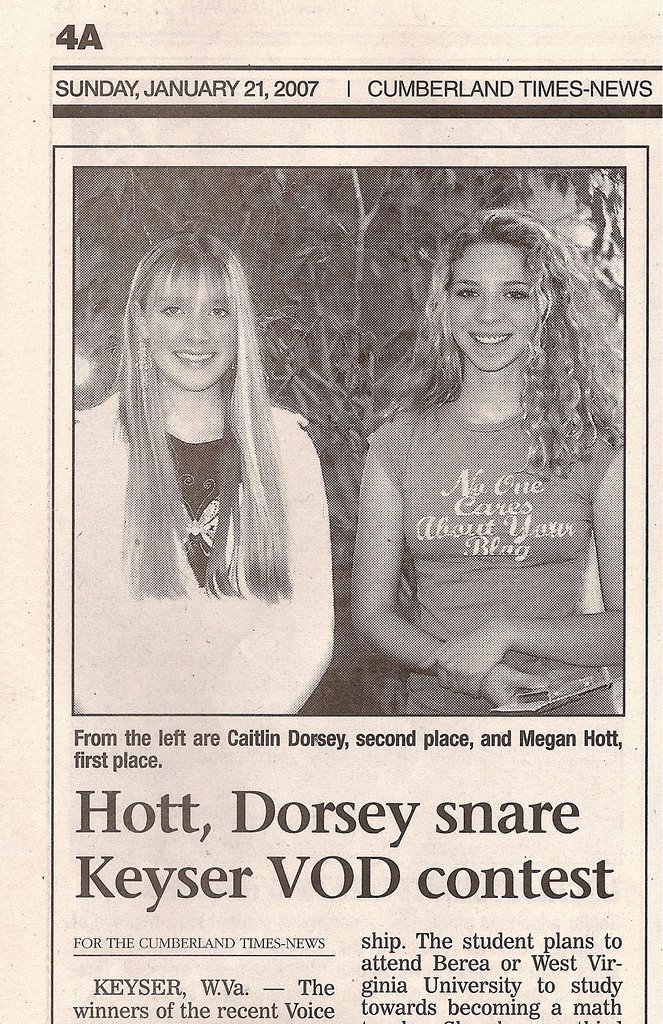
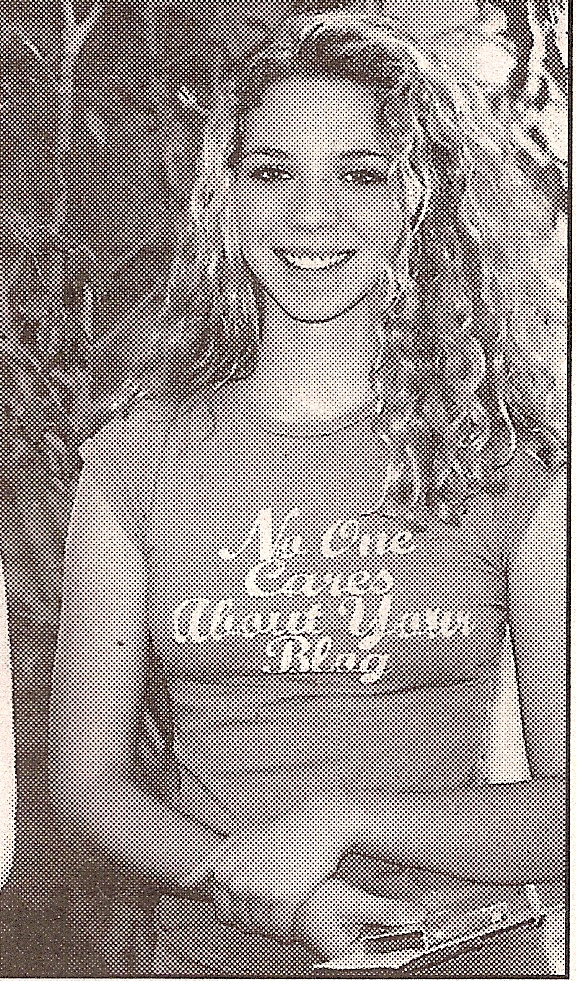
I'm sure the T-shirt worn in this photo by Megan Hott, winner of a high-school Voice of Democracy contest in Keyser, W.Va., speaks for millions.

Friday, February 02, 2007

And such a bargain

Little did I know, when I bought a Handy Can of WD-40, just how handy it was! Look at the grand claim on the back.Shoot, we ought to send cases of it to the White House, to Capitol Hill, to the Pentagon ...
The Southern model

The Taliban say they will open private schools in defiance of their nation's government. That sounds familiar.

Wednesday, January 31, 2007

In the lucky third

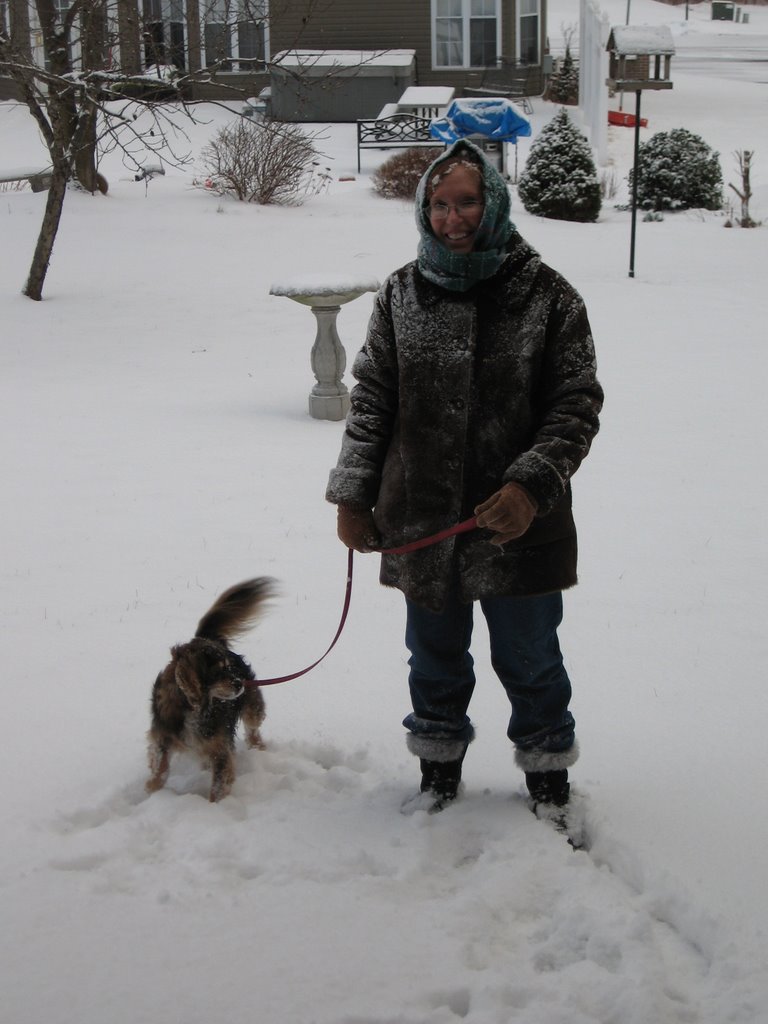
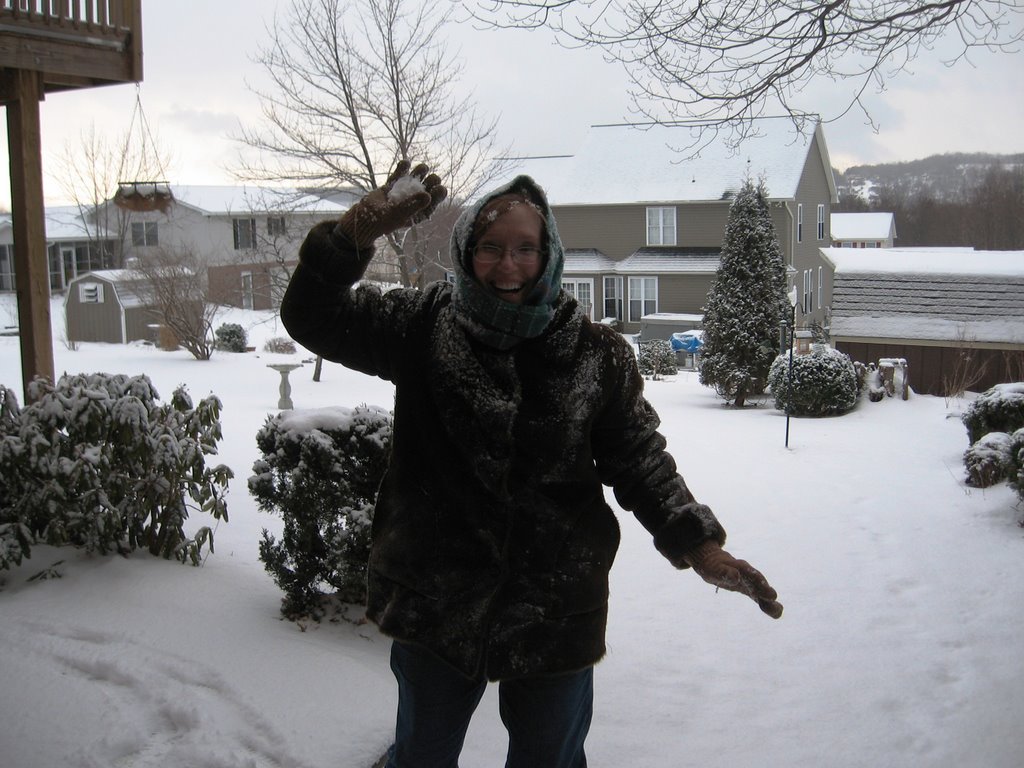
I read in today's paper that in any given year, only a third of the Earth gets any snow. We definitely now live in the lucky third.

Attentive readers will be able to guess where this snowball wound up.
Monday, January 29, 2007

The long road of George Jones

"I would have played for nothing as long as somebody would have fed me."

Sydney's faculty page

I haven't decided what to charge her for the photos.

The Assemblies of Yahweh

Also on my Sunday drive, I passed radio station WMLK in Pethel, Pa., which caught my eye because I wondered whether the call letters stood for Martin Luther King. But no; the billboard said this was the broadcasting arm of the Assemblies of Yahweh, which I looked up when I got home.

Based in Bethel, Pa., this is the largest church in the Sacred Name Movement, a Depression-era outgrowth of the Adventist movement that asserts the authority of the Old Testament, the observance of Jewish festivals and -- you guessed it -- the correct name of the divine. At the Assemblies of Yahweh website, the Statement of Doctrine reads, in part:
We affirm that it is necessary and most important to our salvation that we accept the revealed, personal Name of our Heavenly Father YAHWEH and the Name of His Son, our Savior YAHSHUA the MESSIAH. We affirm also that the most accurate transliteration of these Names from the Hebrew into the English is by the spellings employed above, Exodus 3:14-15; Psalm 68:4; Psalm 83:18; Isaiah 42:8; Isaiah 52:6; Acts 4:12.
The Assemblies of Yahweh was founded in 1969 by Jacob O. Meyer, who was fed up with the other Sacred Name churches; since then, other Sacred Name churches have been created by folks fed up with the Assemblies of Yahweh. Such is the story of Protestantism.

Roadside America

While driving through Shartlesville, Pa., yesterday, intent on getting home before night and snow fell, I passed Roadside America. Next time through, I'll do my best to stop at this venerable attraction, a 6,000-square-foot miniature village that was the life's work of self-taught artist Laurence Gieringer. Here's the writeup at the invaluable (if unrelated) Roadside America website.

For a very different miniature-village experience, I recommend my hero Jeffrey Ford's excellent novella "Botch Town," in his excellent collection The Empire of Ice Cream.

Saturday, January 20, 2007

1 a.m. Feb. 3, 1959, 5 miles northwest of Mason City, Iowa

That's the time, date and place of the Beechcraft Bonanza crash that killed rock stars Buddy Holly, Ritchie Valens and J.P. "The Big Bopper" Richardson, as well as 21-year-old pilot Roger Peterson.

Now Richardson's son Jay, who does tribute shows as "The Big Bopper Jr.," is having his dad's body examined by forensic anthropologist Bill Bass, founder of the University of Tennessee's "Body Farm." The younger Richardson says he hopes to put some longstanding rumors and doubts to rest.

With all due respect to a son who lost his father -- one whose grief is made even more complex by the fact that he wasn't born until after his father died -- it's hard to imagine what more there is to know, after all these years. The Sept. 15, 1959, Civil Aeronautics Board report on the crash concluded, on ample evidence, that the disoriented pilot, flying only on unfamiliar instruments, simply flew the plane into the ground.

In the decades since, conspiracy theorists have made much of the fact that Holly carried his handgun aboard the plane, saying he might have shot the pilot by accident while horsing around, leaving a bullet wound that the local coroner might have overlooked when presented with an obvious plane-crash victim. No evidence whatsoever supports this theory, which moreover contradicts all the evidence of Holly's previous behavior that evening, and on the bus earlier on the tour. Far more likely to assume that Holly boarded the plane and immediately tried to get some sleep.

The younger Richardson says he's also intrigued by the fact that his father's body was found 40 feet from the plane to the northwest (in an adjoining cornfield, actually), while Holly's body and Valens' body were found 17 feet from the plane to the south and southwest. (The full coroner's report is here.) He wonders whether his dad crawled free of the crash. But the plane hit the ground at full speed and tumbled until it came to rest against a barbed-wire fence, and investigators found that most of the seat belts had broken; surely that's explanation enough for the scattering of the bodies.

Sometimes -- indeed, most of the time -- accidents just happen. Even if the victims are famous.

Sunday, January 14, 2007

From the Land of Pleasant Living

This Baltimore Examiner article about the city's beer-brewing heritage introduced me to National Bohemian, a.k.a. Natty Boh, for generations the city's favorite home brew. Its irresistible slogan: "From the Land of Pleasant Living." The beer's mascot, Mr. Boh, looks like a German-American saloonkeeper circa 1885, the year the beer first appeared. He has a handlebar mustache and a single visible eye -- is he winking, perhaps, or did he break up one saloon brawl too many?

Natty Boh is no longer a home brew, alas; it's now brewed in North Carolina and shipped by Pabst to the die-hards in Maryland, Pennsylvania and Delaware, and apparently nowhere else. Here's the official website, with a helpful list of distributors that carry the beer, and here's the Wikipedia entry. Mr. Boh merchandise is on tap at NattyBohGear.com, while a fellow named Shayne has devoted an entire blog, and presumably much of his life, to all the cultural manifestations of Natty Boh.

Brazelton's mom

I was pleased to read on the wires that influential pediatrician T. Berry Brazelton is still going strong, age 88. I met Brazelton and interviewed him for the News & Record of Greensboro, N.C., in the late 1980s, and I liked him a lot. What I did not know before this profile was published was that his mother founded perhaps the first abortion clinic in Texas. A 1996 profile in the alumni publication at Columbia-Presbyterian Medical Center says the year was 1940. It also says Mrs. Brazelton was the first woman elder in the Presbyterian Church. There are two resume items you don't often see side by side!

In her blog at I'mNotSorry.net, Patricia Beninato says that in a talk in Richmond several years ago, Brazelton said:
If a baby isn’t going to be born to parents who will be passionately in love with it, then it has a right to be aborted.
To get to the quote, click here and search for Brazelton's name. I can't find online the write-up of the talk that Beninato is quoting, but I'd be keen to read the whole thing.

Thursday, January 11, 2007

"The Chief Designer" on CD

I was pleased to receive in the mail today two copies of the new audio edition of my story "The Chief Designer," a two-CD set in the Great Science Fiction Stories series from AudioText Inc. The exterior of the package shows the real-life Korolev (pictured); inside, on the CDs themselves, are photos of Korolev, Gagarin and Sunrise One. The copy on the box reads:
This story, an alternate history masterpiece, is told from the viewpoints of Korolev, the 'Chief' who managed the most crucial years of the secret Soviet space program, and his assistant and eventual successor, Aksyonov. The story spans from World War II, when Korolev was released from a prison camp to design rockets, to 1997 and the Mir space station. This endearing story is many tales in one: an historical story that captures the true mood of the period; a science fiction story that resonates on multiple levels with plenty of technology and cosmonaut bravado; and finally, a ghost story as the tale fades away.
This 132-minute "unabridged reading by Jared Doreck" is the first audio edition of any of my stories. On our next car trip, I look forward to popping this into the dash and, in effect, listening to myself.

Friday, January 05, 2007

The woolly bear watch

Dr. Phil Kaldon writes:
We get woolly bears migrating across our driveway here in West Michigan. They tend to look like our cats, some are more orange and some are more black. The greater the number of darker ones you see, the more you know you are about to be screwed by the Gods of Winter.
Phil, did you see mostly dark ones this season, or mostly orange? We've had a mild winter so far, for what it's worth. And I haven't seen woolly bear One, but I haven't gone looking, either ...

In the buttocks, Bob

My hero Bob Devney -- eight-time Hugo Award nominee in the Best Fan Writer category, and author of the best convention reports ever written -- writes:
One of my favorite headlines is a golden oldie (though perhaps a falsie), supposedly from a British paper during World War II:

Eighth Army push bottles up Germans
Ha!

You remind me, Bob, of the marvelous headline all of us at the Greensboro, N.C., paper so enjoyed circa 1990, mainly because it was published by one of our bitter rivals, the High Point, N.C., paper. During a drug bust, as the offenders scrambled to ditch or hide or otherwise distance themselves from their illegal goods, one brave fellow who had been smoking cocaine in its crystalline form shoved the "rocks" up his own rectum. The police, however, had brought along rubber gloves in anticipation of this ploy, and their search of each suspect was thorough indeed, so the contraband ultimately was found. The newspaper headline read:
Police find crack in buttocks
I can't say how the staff of the High Point paper reacted, but at the Greensboro paper this headline occasioned daylong merriment. Just as the newsroom had quieted down, some newcomer would walk in, be handed the headline, and everyone would erupt in laughter again. I'm surprised we got a paper out that day at all. Finally, after we settled down and got back to work, my colleague Stan Swofford stood, hitched up his pants and muttered: "I don't know what we're laughing about. Greensboro police couldn't even find that." And we all howled anew.
Ah, journalism!

Wednesday, January 03, 2007

Fun with headlines


My hero Gwenda Bond had a good response to my confusion over this headline:
I think "mad" here is being used in the sense of wicked cool.
To which Dr. Phil Kaldon replied:
Why... YES!

Dr. Phil

"Everything is Physics"
Sharing my fascination with headlines is Charlie Ewers, who teaches journalism at Frostburg State University; he clips and passes me gems from time to time. For example, this:

It's a Hard Rock life

In reply to my post about the heyday of the Hard Rock Cafe, Jason Lundberg writes:
I was also caught up in the whole Hard Rock furor of the 80s and early 90s. It almost got to be like collecting baseball cards or comics among my friends: "You went to the one in Florida? Cool!" "Aw, man, everyone's got the New York one." "Dude, how did you get one from Bangkok?!"

I went on a marching band trip to Florida when I was in high school, and not only did we stand in line for over an hour just to get into the restaurant, we stood in line for another hour just to get our t-shirts. I think I had five of them at one point; I know that some lucky customers of Goodwill have them now.
While you kids were standing in line for T-shirts, I felt very smug and adult and aloof from the whole thing, being all of 26 -- an inexplicable attitude, since at the time I was spending most of my paycheck on Doctor Who T-shirts. I even referred to my Ford Escort as my "Tardis," as in: "I'll be right back, folks; it's raining, and I need to roll up the windows in my Tardis." My friends should have beaten me to death.

Multiplying rabbits

Regarding our family superstition that "Rabbit rabbit rabbit" must be said as one's first words on the first day of the month, Jeremy Tolbert writes:
In my family, we say "white rabbit" three times when smoke at a campfire is blowing your way to "make it turn away." I wonder if the superstitions are related?
I'm sure they are, like all the other good-luck superstitions involving rabbits, the proverbial "rabbit's foot" being the most famous.

Could the old superstition be one of the reasons that Lewis Carroll has Alice encounter the White Rabbit first, among all the denizens of Wonderland?

Why should rabbits be associated with good fortune, I wonder? Must be their reproductive skills.

For a very different take on rabbits, read Kelly Link's brilliant story "Stone Animals" in Magic for Beginners.

Dick Cavett's "death episode"

On the subject of on-air deaths, my hero Jeffrey Ford writes:
Do you remember the old guy who died while Dick Cavett was interviewing him on TV?
I did not know about that, Jeff, so I looked it up. Thanks! Publisher and organic-farming advocate J.I. Rodale did indeed die on the set of The Dick Cavett Show in 1971. According to the invaluable Snopes website:
While Cavett was discussing politics with journalist Pete Hamill, Rodale's head dropped to his chest and he was heard to let out what sounded like a snore. "Are we boring you, Mr. Rodale?" asked Cavett. There was no response — Rodale was dead. The show was never broadcast.
In the Peter Jackson version of this scene, Cavett's quip would prompt Rodale's ghost to swoop down from the rafters and bellow, "Yes ... bored unto DEATH!"

The Snopes people have a grim but fascinating page devoted to others who died -- or were fatally injured or stricken -- on the air, on camera or onstage. Though several of the deaths involve radio broadcasts, I count only one on-air death of a disc jockey: Jack Spector on WHLI in Garden City, N.Y., in 1994.

FSFS

Of the on-air death of local disc jockey Chazz Offutt, my fellow Frostburg resident Jeremy Bruno writes:
Do we ever get any good news in this area (aside from the foundation of FSFS, that is...)?
By FSFS he means the Frostburg Science Fiction Society, which I declared into existence on New Year's Day. So far there are three members: Jeremy, Sydney and me. There will be others.

I guess "FSFS" would be pronounced "fiss-fiss," but maybe a better short form would be (FS)2, or FS squared.

(Thanks to undergrad math major Tricia Shore and her engineer husband for pointing out my mathematical typo earlier.)

Tuesday, January 02, 2007

Death on the air

Veteran Cumberland, Md., disc jockey Chazz Offutt died on the air, during his morning show, the Tuesday after Christmas. A listener told Michael Sawyers of the Cumberland Times-News:
He had just said the time, 20 minutes after 8, and all of a sudden I heard a noise and then there was just nothing. The mike was open, and I heard somebody say "Chazz," then I heard them say "Call 911."
How many times has this happened in live radio, or live television, I wonder?

Monday, January 01, 2007

Hail, cannons?

California farmers, desperate to ward off hail, are buying hail cannons again.

The best recent newspaper article on hail cannons is by Joe Garner in the July 10, 2006, Rocky Mountain News. Garner writes, in part:
The October 1919 edition of Popular Science magazine had a cover story on "Hail Fighters and Their Strange Devices," complete with an illustration of cannon barrels pointed skyward.

"By 1919, hail cannons had been discredited, but people intent on changing the weather refuse to give them up," the magazine headlined almost 90 years ago.

Today, Mike Eggers Ltd., based in New Zealand, is the principal manufacturer of hail cannons used in the United States for "horticultural protection." The sticker price is $50,000 a unit to provide coverage over a radius of one-third of a mile, would-be purchasers said. Eggers declined to talk price.

Ultimately, Eggers is selling hope, which history has shown is more potent than any cannon ...

Spreading out

The federal government, expecting the worst, is beginning to move out of Washington, D.C. We were talking about this at the 2002 Campbell Conference at the University of Kansas: The less centralized our government, our economy, our electrical grid, our population, etc., the better off we are. Why haven't we been doing more of this, the past five years?

A boy and his sword

You may have read about the lawsuit filed by the high-school senior in Rhode Island who wants his yearbook portrait to depict him wearing chain mail and carrying a sword. (He's a member of the Society for Creative Anachronism.) What you probably haven't read is that the decision not to publish the photo was made not by the principal's office, but by the student staff of the yearbook. Thanks to the invaluable Student Press Law Center for pointing this out.

Had this been a case of the principal overruling the student editor, I'd have sided with the editor. As it's apparently a case of the principal backing the student editor, I still side with the editor.

I can't understand why the American Civil Liberties Union is representing the chain-mailed teen. Going to court to force journalists of any age to publish or not publish anything is downright ... medieval.

Rabbit rabbit rabbit

One of the Giles County, Va., superstitions that Sydney inherited from the Stafford side of the family is the good-luck custom of saying "Rabbit rabbit rabbit" as your first words on the first day of the month. Most months, we forget to do this until we've said several hundred other words, and upon realizing we've forgotten "Rabbit rabbit rabbit" yet again, we get annoyed and say another word.

I'm pleased to say, however, that we did start Jan. 1, 2007, by saying "Rabbit rabbit rabbit" at midnight, before we even said "Happy new year," because Sydney's mother had reminded us earlier in the day. We missed the actual Times Square ball drop on television because we were watching the tail end of the Absolutely Fabulous marathon on BBC America (while snacking on the excellent Gouda cheese made at Our Lady of the Angels Monastery in Crozet, Va.), but remembering "Rabbit rabbit rabbit" is the important thing. And now it's the first thing I've "said" on the blog this month, too.

As for where "Rabbit rabbit rabbit" came from, and why rabbits, who knows? More on the superstition here.

Saturday, December 30, 2006

The most vigilant Sentinel of all

I can't find the item online, but according to the Christmas Eve edition of the Cumberland Times-News, Dave Christopher of Cumberland, Md., has not missed a single Fort Hill High School football game in the past 50 years. For more on Sentinel football, click here -- or just ask Dave.

Tree Christmas O, Tree Christmas O ...

Check out the upside-down Christmas tree in the home of Patty and Joe Hess of Augusta, W.Va. "This is my hardest tree to decorate," Patty Hess told the Cumberland Times-News. "I'm on a step stool most of the time."

Maryland's greatest spy

Are schoolchildren in Maryland taught about the exploits of Allied spy Virginia Hall in occupied France during World War II? I hope so, and not just because she named her wooden leg Cuthbert.

Teddy Roosevelt on the estate tax

From Teddy Roosevelt's message to Congress, Dec. 3, 1906:
I feel that in the near future our national legislators should enact a law providing for a graduated inheritance tax by which a steadily increasing rate of duty should be put upon all moneys or other valuables coming by gift, bequest, or devise to any individual or corporation. ... The prime object should be to put a constantly increasing burden on the inheritance of those swollen fortunes which it is certainly of no benefit to this country to perpetuate.
From Roosevelt's speech on "The New Nationalism," Osawatomie, Kan., Aug. 31, 1910:
No man should receive a dollar unless that dollar has been fairly earned. Every dollar received should represent a dollar's worth of service rendered -- not gambling in stocks, but service rendered. The really big fortune, the swollen fortune, by the mere fact of its size acquires qualities which differentiate it in kind as well as in degree from what is possessed by men of relatively small means. Therefore, I believe in a graduated income tax on big fortunes, and in another tax which is far more easily collected and far more effective -- a graduated inheritance tax on big fortunes, properly safeguarded against evasion and increasing rapidly in amount with the size of the estate.

Well, I swear

That the election of a Muslim to Congress -- a Muslim who, naturally enough, wants to swear his oath on the Quran, not the Bible -- should be controversial is a pretty sad thing in a free country, but the controversy has had a couple of beneficial effects. For one thing, a lot of people have been prompted to read, for the first time, the unequivocal Article VI of the U.S. Constitution:
The Senators and Representatives before mentioned, and the Members of the several State Legislatures, and all executive and judicial Officers, both of the United States and of the several States, shall be bound by Oath or Affirmation, to support this Constitution; but no religious Test shall ever be required as a Qualification to any Office or public Trust under the United States.
For another, we have been usefully reminded that not even all U.S. presidents have sworn their oaths of office on a Bible. John Quincy Adams swore his oath on a law volume, bless his Unitarian, contrarian soul.

Another win for Harry

A year's supply of butterbeer to the Georgia Board of Education, which sided with the Gwinnett County school board against anti-Harry Potter crusader Laura Mallory, a.k.a. the Professor Umbridge of Loganville, Ga.

Humbug!

Another reason to have voted against Maryland Gov. Robert Ehrlich in November: According to The Washington Post, he introduced inflatable Santas and snowmen to the governor's mansion.

Three gargoyles


A fellow tourist snapped this photo of me at Notre Dame in 1991, on my first visit to Paris.

Scary Duncan's Bar & Grill flier

As far as I know, I have no family connection to Duncan's Bar & Grill in Frostburg, so I'm not to blame for this flier, which appeared up and down Main Street before the holiday.

Monday, December 25, 2006

The decline of newspapers is old news

Those who care about newspapers should read this Jack Shafer article in Slate:
A good three decades before the newspaper industry began blaming its declining fortunes on the Web, the iPod, and game machines, it knew it was in huge trouble.
I worked at a good, 100,000-circulation daily newspaper from 1986 to 1993, and throughout that time, my peers and I had endless conversations about all the ways our newspaper, and every newspaper, needed to change: completely overhauling the outdated beats, the arbitrary section divisions, the pointless “personal columns,” the endless grip-and-grin shots, the unreadable and, indeed, unread daily updates from the meetings of the Zoning and Sewerage Maintenance Subcommittee Boards -- all of them still staples of the daily newspaper. Newspaper owners just have been too successful and too complacent to want to change anything. And most of them still are, especially the owners of small and medium-sized newspapers -- which still tend to be cash cows, thanks to local coverage, however piddling, that Fox News and Google can't match. But their day, too, will come, if they keep sitting on their classifieds and legal notices, and doing nothing.

Children of the Atomium

Fans of futures past will love this marvelous website devoted to the Atomium, built as the astonishing centerpiece of the 1958 World's Fair in Brussels, Belgium. The name may not be familiar, but once you've seen it, you'll recognize it.

Sorry; orbs aren't enough

I've always loved ghost stories and the folklore of hauntings, and the parapsychology buffs who lug equipment into old cemeteries and prisons and manor houses for overnight "investigations" amuse me no end -- though I'm generally annoyed by the wholly uncritical coverage given such expeditions by local newspapers and TV and radio stations, and I invariably marvel over the lame "evidence" these folks bring back. To me, extraordinary claims demand extraordinary evidence, and simple photographs of "orbs" -- the anomalies that can be caused in any photograph, especially nighttime photographs, by dust, pollen, precipitation, etc. -- simply don't count, unless you're already a true believer. I was beginning to think I was alone in my anti-orb grumpiness, but now Stephen Wagner, the Paranormal Phenomena editor at About.com (whose news roundups I recommend), states the case very well in a column titled "Enough With the Orbs Already":
So at this point I am willing to dismiss all orb photos as non-paranormal anomalies. There seems to be no compelling reason to consider them as anything but dust and such. ... Let’s not waste any more speculation on orbs. Enough already.

Revisiting Bigfoot

As a kid, I uncritically devoured dozens of books and TV shows on all paranormal topics, especially cryptozoology. My favorite legendary creatures, unsurprisingly, were the Loch Ness Monster and Bigfoot, and I well remember the hairs on the back of my neck prickling whenever I saw the infamous "Patterson film," more accurately known as the Patterson-Gimlin film, which purported to show a Bigfoot ambling through the California woods. It sure convinced me!

Now that I'm older, I'm a lot more skeptical, as are a number of people who have studied the film, and a number of people who claim to have insider knowledge of a hoax perpetrated by -- or, perhaps, ON -- filmmakers Roger Patterson (who died in 1972) and Robert Gimlin (who's still alive, and whose only concession is that someone, perhaps Patterson, conceivably could have played a hoax on him). Here's a fine Wikipedia summary of the claims, counterclaims, counter-counterclaims, etc. While no one has proven the film's Bigfoot is fake, certainly no one has proven the film's Bigfoot is genuine, either.

Far less impressive than the Patterson-Gimlin effort is the latest alleged "Bigfoot photo," taken in the El Dorado National Forest in the High Sierras, notable only because the photographers have helpfully pointed out Bigfoot's "male organ." Bet you'll click the link now!

[NOTE: I revised my above comments on the Patterson-Gimlin film after my favorite cryptozoologist, Loren Coleman -- a regular contributor to the Cryptomundo website, which I highly recommend -- wrote me pointing out severe problems in the claims of the Patterson-Gimlin debunker whose comments I had linked to before. So I substituted the above link to the Wikipedia article as a far more objective (and detailed) guide to this fascinating story. Thanks, Mr. Coleman.]

The online Jap Herron

Here's another reason to love the Web: a 234-page pdf of Jap Herron, the short 1917 novel that Emily Grant Hutchings claimed was dictated to her from the Other Side by the late Mark Twain, via a Ouija board. It has a lengthy introduction by Hutchings, as well it should. Thanks to Jason Offutt's blog, From the Shadows, for the link.

First the effect, then the cause

I enjoyed this Seattle Post-Intelligencer article on physicist John Cramer of the University of Washington, who plans to test whether photon signals can be sent backward in time.
Roughly put, Cramer is talking about the subatomic equivalent of arriving at the train station before you've left home, of winning the lottery before you've bought the ticket, of graduating from high school before you've been born -- or something like that. ... "People tell me it can't work," Cramer says, "but nobody seems to be able to explain why it won't."
Besides being a scientist, Cramer -- whom I met, briefly, when he visited Clarion West 1994 -- is a science-fiction novelist, an Analog columnist, and the father of prominent sf/fantasy editor Kathryn Cramer.

At the end of the article, Cramer says, "If this experiment fails in reality, maybe I'll write a book in which it works." This is the Will Jenkins approach. Jenkins, the lifelong inventor who wrote science fiction as Murray Leinster, used to say that if he decided an idea could work, he patented it; if he decided it couldn't work, he wrote a story about it instead.

After the solstice

My apologies for the long absence. Sydney and I rushed home to South Carolina on Tuesday, Dec. 12, because my mother, age 83, had taken a turn for the worse. My mother hung on longer than anyone expected, but on the ninth day of our bedside vigil, she died -- about 9:20 p.m. Thursday, Dec. 21, the longest night of the year. I am told that after the winter solstice, the days get sunnier, and I trust that this is true. I'm sure I'll write much more about this later, but for now, I'm a bit burnt-out on condolences, and I welcome comments on any other topic. My mother would agree; she always loved to change the subject.

Friday, December 08, 2006

The Seminoles rock

The Seminole Tribe of Florida is buying the Hard Rock Cafe -- all 124 restaurants, plus the Hard Rock hotels, casinos and concert venues, and the world's largest collection of rock 'n' roll memorabila.

I'm impressed. I might even be willing to eat at the Hard Rock Cafe now. Anything Native Americans come up with to take white people's money, I support.

The Associated Press reminds me that the Seminole Tribe was the first tribe to get into the gambling industry, back when I was in high school, with a single bingo hall in Hollywood, Fla. Florida tried to shut 'em down, but Florida learned, not for the first time, that the Seminoles don't take any mess. All the other federally recognized tribes followed suit, and that's why, today, little old ladies all over America can look forward to boarding the tour bus each Saturday morning and playing the slots all day.

Here's my only Hard Rock Cafe story. Back in the 1980s, I went to Washington, D.C., as a chaperone for a vanload of high-school students from Greensboro, N.C., all members of the local Journalism Explorer Post. Beforehand, I made a list of every possible tourist attraction in D.C., and asked everyone to vote on what they most wanted to see in our nation's capital. The overwhelming winner, more popular even than that perennial write-in favorite, "the hookers," was the site of the future Hard Rock Cafe. It was, at the time, a big hole in the ground full of construction equipment, but the savvy owners had rented a narrow storefront next door and already had the shelves stocked with "Hard Rock Cafe Washington DC" merchandise. The line when we arrived, I am not kidding, was the longest tourist line we saw in Washington that spring; hundreds of tourists, mostly teenagers, were lined up in an orderly queue that stretched for blocks, just to buy a Hard Rock Cafe T-shirt. That was the '80s. Dang, I sound like a VH1 special.

The Dunbar Poets

I was started to read that one of the teams competing Saturday for the state 1A football championship is the Poets. The fighting Poets? Laudable, but unusual. So I looked it up and found that the Poets are, naturally enough, the teams from Baltimore's Paul Laurence Dunbar High School, named for the great poet who lived in D.C. toward the end of his too-short life. Go, poets!

God's Politics and the Christian Coalition

In abruptly leaving the Christian Coalition, which he was to have led as president beginning Jan. 1, the Rev. Joel Hunter says he's more interested in fighting poverty and protecting the environment, areas the old guard wants nothing to do with. He tells Time magazine:
The emerging constituency, especially the 20- and 30-year-olds' generation, are not prone to the old categories, they don't care about Republican or Democrat, they don't care about conservative or liberalism, they say let's just do what's right to love our neighbor. I went into the Christian Coalition thinking maybe we can turn one of these traditional narrow organizations and broaden it into these compassion issues. But it didn't work.
One wonders whether Hunter has read Jim Wallis' excellent book God's Politics: Why the Right Gets It Wrong and the Left Doesn't Get It. Someone should get Hunter and Wallis together. Time notes that Hunter is "now floating the idea of a new mobilizing organization to lead the Christian community into the future." That organization -- Wallis' organization -- may already exist.

Battlefield ghosts

Jim Goldsworthy's Dec. 3 column in the Cumberland Times-News is about battlefield ghosts. He cites an unnamed friend, a Civil War re-enactor, who was on a tour at Manassas, Va. The guide asked a group of children whether they knew what a Zouave uniform looked like.
"One little girl said they wore baggy red pants and blue jackets and funny red hats. When the guide asked how she knew that, she pointed to a cannon at the top of a nearby hill and said, 'One of them was standing up there.' We looked, but nobody was there," said my friend. ... My friend described a photograph taken by one of his buddies at a Georgia battlefield. It shows three mounted cavalry troopers that no one saw, and there had been no re-enactors on horseback present that day. He says the photo looks exactly like an old painting he's seen.
As is usual in the field of the paranormal, we move easily from "This happened to a friend of mine" to "This happened to a friend of a friend of mine." Often, too, as here, the related experience is claimed to be just like a previously mediated experience -- a painting or movie or photo we saw, a story someone else told -- which always makes me wonder how much of the related experience is just an unintentional Xerox of the "original."

Goldsworthy contributes an experience of his own:
When I made my so-far only visit to the Antietam battlefield at Sharpsburg 35 years ago, I actually could smell the blood. I know what blood smells like, and it wasn't my imagination.
I've never been to Antietam, though I've never smelled blood at the bloody places I have visitied, such as Gettysburg, and Normandy, and the Tower of London. I can, however, recommend to Goldsworthy and his friend and his friend's friend the American Battlefield Ghost Hunters Society, based in Charlotte Hall, Md., the only such specialty organization I know of.

Not-so-mad scientists

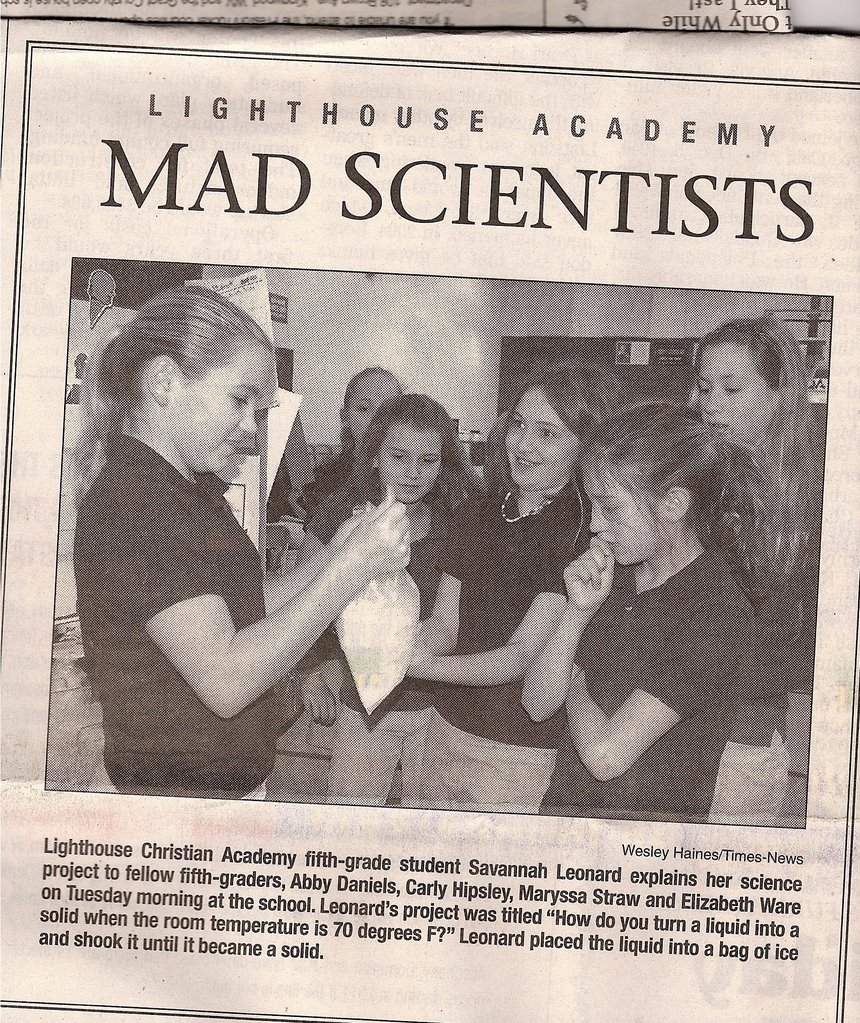
I really like this Wesley Haines photo from the Cumberland Times-News, of fifth-graders doing a science project, but why is the headline "Mad Scientists"?In what sense are these kids mad? Are they mad simply because they're doing science? Because all scientists are mad? Because science itself is mad?

The Martian spring

To the latest hints of water on Mars, Tim Radford in The Guardian applies a necessary, uh, splash of cold water:
Since 1996, orbiters and landers have been crashing down on Mars (in some cases, literally) every 18 months or so and mission scientists have announced the discovery of water on Mars at least half a dozen times in the past seven years. But, in each case, they haven't actually discovered water at all: just indirect evidence, either that it must once have been there, or that it could still be lurking furtively below the arid Martian dust, waiting to sneak out and leave a gully, a wadi or a wash as teasing evidence of its fleeting presence. ... The Martian water torture will continue until somebody actually lands on Mars, drills a borehole, taps into an aquifer and then makes a cup of tea with the stuff.
Holiday, Ollieday

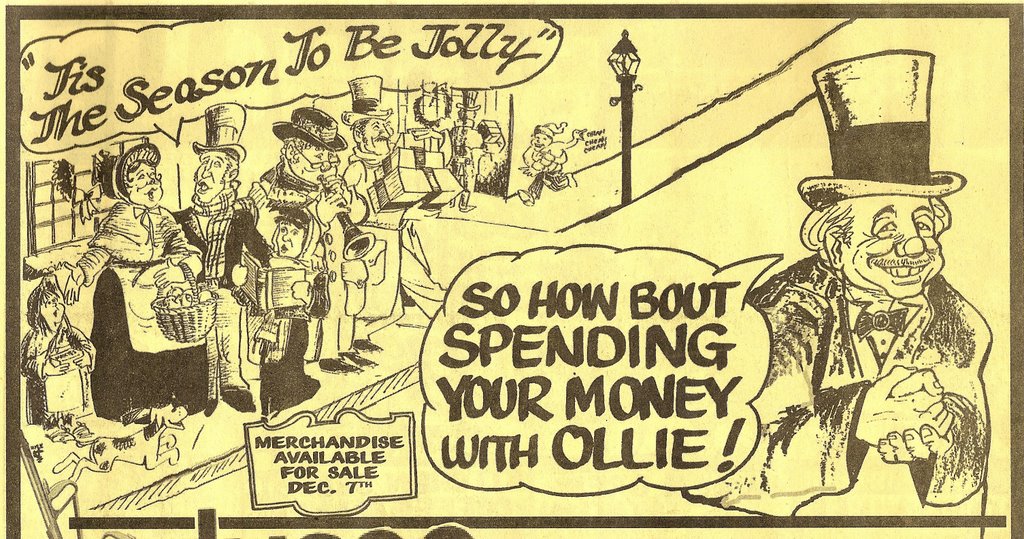
This lead illustration in a newspaper insert encapsulates everything I love about Ollie's Bargain Outlet, a 48-store retail chain based in Harrisburg, Pa., whose advertising approaches South of the Border or Pigman's Bar-Be-Que grandeur. Note the goose (or duck?) in the background crying, "Cheap! Cheap! Cheap!" The late Ollie Rosenberg, a backer of the chain when it started in 1982, was presumably less moth-eaten in real life than his Ollie's avatar. We discovered the Ollie's in LaVale, Md., soon after moving here, and I am in fact a card-carrying member of Ollie's Army. My card:

Must be karma

Seeing this ad in the Cumberland Times-News made me realize that while I wasn't paying attention, both a 1,700-year-old Sanskrit text on the arts of love and a 1980s swimsuit model whose out-of-date calendar image once adorned the closet door of my first apartment in Greensboro, N.C., have become pillars of the U.S. economy.

Friday, December 01, 2006

Could it be ... Satan?

This saga of Lisa Jensen's Christmas wreath is my favorite holiday story of the season so far. In brief: Jensen, who lives in Colorado, put up a Christmas wreath shaped like a peace sign. Her homeowners association -- which deserves to be named: It's the Loma Linda Homeowners Association -- told her to take down the wreath or suffer a $25-per-day fine. The problem with the wreath, they explained, was that it could be viewed as a divisive antiwar protest and, possibly, a symbol of Satan. In response, Jensen did exactly what she should have done: Told the homeowners association to stick it in their yule log, and then spread the word far and wide, so that every English-language news organization on Earth (by my rough estimate) has now covered the story. Countless strangers contacted Jensen, offering to pay her fine throughout the holiday. The nearby town of Pagosa Springs put up an identical wreath to show its solidarity. After a few days of global derision, stunned by their new awareness of this divisive, possibly Satanic device called "The Internet," the Loma Linda Homeowners Association sent Jensen this note:
We had a misunderstanding with your Christmas decoration and for that we apologize. We withdraw any and all previous requests for removal of your decoration.
By "misunderstanding," they mean, of course, "We failed to understand that our pettiness and ignorance would make us the laughingstock of millions." One wonders why they didn't just say that. Oh, and the wires report that two of the three homeowners' board members have had their numbers changed; the third isn't answering calls.
Gruber's Almanack


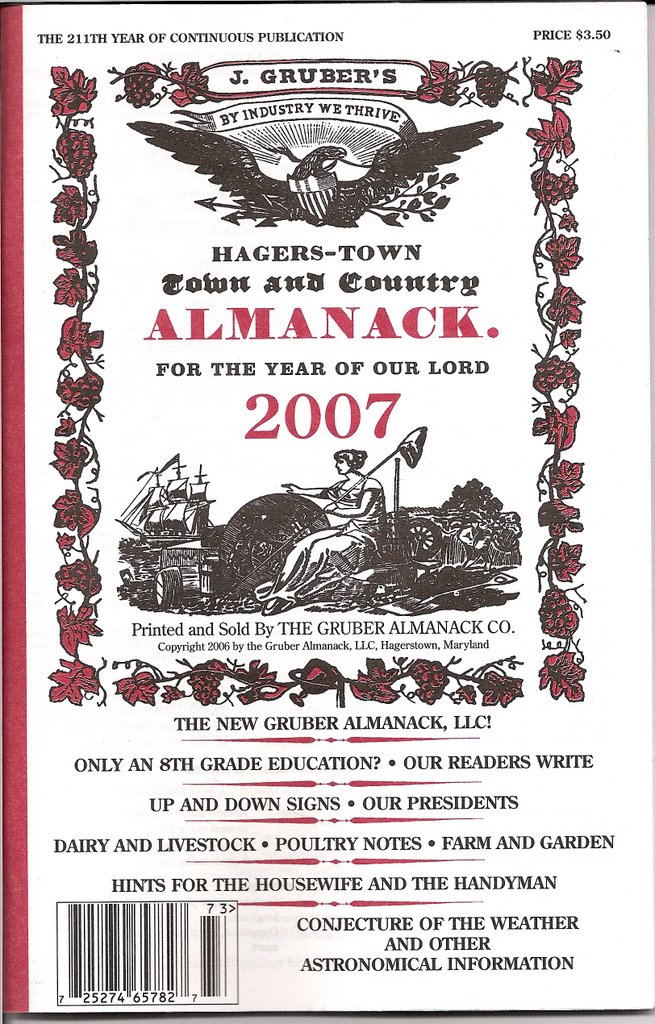
I picked up a copy of J. Gruber's Hagers-Town Town and Country Almanack without realizing this Maryland annual is the second oldest continuously published periodical in the United States. Gruber's almanac first appeared in 1797 -- the year John Adams was inaugurated, Lord Nelson lost his arm, and Mary Shelley was born -- and still is published by the descendants of its founder, the titular John Gruber.

No longer, alas, does Gruber's almanac sponsor its annual Woolly Bear Contest, which once offered a $100 prize for the biggest woolly bear caterpillar. The goal was to examine the width of the black bands on as many woolly bears as possible to determine the severity of the coming winter; according to folk belief, the more black on the woolly bear, the worse the weather will be. In the last years of the contest, the number of woolly-bear entries had dropped off to practically nothing. (After all, when was the last time you went looking for woolly bears? J'accuse!)

I'm pleased to report, however, that the almanac still will predict the sex of your next child for a mere $5. This service is provided using the signs of the Zodiac according to the formula established by Hagerstown's own "Aunt" Lydia Cline, a retired nurse who died in 1973. The editors are careful to point out (on Page 61 of the current edition) that the prognostication works not with a first child, but only with successive children. Send the birthdate and gender of the first child, plus the aforementioned $5 and a self-addressed stamped envelope, to:

"Aunt Lydia"
c/o The Gruber Almanack, LLC.
1120-C Professional Court
Hagerstown, MD 21741-0609

"While we cannot guarantee the accuracy of the predictions," the editors note, "be assured that 'Aunt Lydia' still maintains an accuracy of other 80%!"

Since you asked: The oldest continuously published periodical in the United States is The Old Farmer's Almanac out of Dublin, N.H., which first appeared in 1792. What blog will beat that?

Monday, November 27, 2006

Something no candidate mentioned this election

The comptroller general of the United States -- basically, the federal government's chief accountant -- is traveling the country warning of economic disaster if something isn't done about federal spending, beginning with Medicare:
Realistically, what we hope to accomplish through the Fiscal Wake-Up Tour is ensure that any serious candidate for the presidency in 2008 will be forced to deal with the issue. The best we're going to get in the next couple of years is to slow the bleeding.

O.J. Simpson and the grammar police

Has any recent news story been more dependent on correct verb tenses than the O.J. Simpson flap? Consider this passage from an Associated Press story (emphases mine):
"If I Did It," in which Simpson was to have described how he would have killed his ex-wife, had been scheduled to air as a two-part interview Nov. 27 and Nov. 29 on Fox. The book was to have followed on Nov. 30.
My breath is taken away by this stately procession of properly parsed time elements, without which the news story would make no sense whatsover. Are grammarians using this news coverage in their classrooms?

Astrological prudence

The other day, my horoscope read, in part: "You can entertain others with unusual tidbits of information or lightning-fast reflexes."

After I read that aloud at the breakfast table, Sydney thought for a moment and said: "If I were you, I'd go with the unusual tidbits of information."

The "face" of Jack the Ripper

Much is being made over the composite "police sketch" of Jack the Ripper done for a new Channel Five TV documentary. As always, the invaluable Casebook: Jack the Ripper website does a good job of sifting the facts from the hype. While conceding the sketch's resemblance to Ripper suspect George Chapman, Casebook editor Stephen P. Ryder focuses on the larger point:
There simply isn't enough information in the surviving witness testimony to make such a detailed facial sketch of "Jack the Ripper."

Chick & Ruth's Delly

I was pleased to read in Sunday's paper about Chick & Ruth's Delly in Annapolis, where the Pledge of Allegiance is recited every morning, where the owner (son of the late Chick & Ruth) does magic tricks, and where most of the menu items are named for current Maryland politicians. The sandwich menu, for example, includes the Roscoe G. Bartlett Jr., a veggie burger with lettuce, tomato and provolone cheese on toasted whole wheat. (I mention this only because I live in Maryland's 6th District, which Bartlett represents on Capitol Hill.)

Now that we have a new governor-elect, Baltimore Mayor Martin O'Malley, he's getting his own sandwich on the menu. The ingredients are up to him; so far, all we know is that it'll involve roast beef, of which O'Malley apparently is a fan.

Politicians lower on the pecking order than governors apparently don't always get to pick their signature dish. State Sen. John Astle still is brooding over the menu's original John Astle: a hot dog wrapped in baloney. "What a sandwich for a politician," Astle says.

Not all the sandwiches have Maryland connections; the George W. Bush is grilled Swiss, bacon and tomato on rye, while the Golda Meir is lox, cream cheese, onion and tomato served open face on a bagel.

I read the version picked up on the wires, but here's the original feature in the Annapolis newspaper, The Capital.

Quotes in the news

"We may have lost a dear old friend and teacher."
-- Michael Meyer, lead scientist for NASA's Mars Exploration Program, on the newly silent Mars Global Surveyor, which has been orbiting the red planet for 10 years

"What's really great about this place is you can smoke almost anywhere."
-- Actress Liv Tyler, who's filming a movie in Florence, S.C.

"Remember how Herbie could only be a dentist in the Land of the Misfits? Well, maybe this is the only place in Division I where I could be a head coach."
-- Rich Rodriguez, head football coach, West Virginia University, who is thinking of the Land of Misfit Toys and the elf Hermey, not Herbie; his confusion is common, as Rudolph the Red-Nosed Reindeer expert Rick Goldschmidt notes with frustration:
One thing I should make clear is that the elf who wants to be a dentist is named Hermey. Why everyone is calling him "Herbie" I will never fully understand.

Patenting the genetic alphabet

Michael Crichton's next novel, appropriately titled Next, is about the abuse of gene patents, so Crichton is giving interviews about the subject. "Major hepatitis C and HIV genes and various diabetes genes are all owned," he tells Parade. "Researchers working on those diseases must worry about getting permission and paying high fees. ... It's OK to own a treatment or test for a disease, but no one should own a disease."

In agreement is Lori Andrews, a professor at Chicago-Kent College of Law and an ethics adviser to the Human Genome Project. She tells Parade, "Gene patenting is like someone owning the alphabet and charging you each time you speak."

Here's the brief Parade article, which includes a "Genetic Bill of Rights" that's written, oddly enough, in the second person.

Friday, November 24, 2006

Everyday movie quotes -- identified

Back in October, I posted a partial list of movie quotes that Sydney and I invoke in our everyday conversation. But I never followed up by identifying the movies! So here we go.

"The Devil thought he had the keys."
-- One of the tent-revival preachers in Robert Duvall's The Apostle

"Everybody needs money. That’s why they call it money."
-- Danny DeVito in David Mamet's Heist

"How ‘bout more beans, Mr. Taggart?"
"I’d say you had enough."
-- Burton Gilliam and Slim Pickens in Blazing Saddles

"I am shocked, shocked."
-- Claude Rains in Casablanca

"Is correct."
-- Benicio Del Toro in Traffic

"It’s very nice." (Said in a bad French accent.)
-- John Cleese as the rude French knight in Monty Python and the Holy Grail

"Oh, deary dear."
-- Gene Wilder in Blazing Saddles

"Pull the string!" (Said in an Eastern European accent.)
-- Bela Lugosi in Glen or Glenda and (imitating Bela) Martin Landau in Ed Wood

"So much time and so little to do. Wait a minute. Strike that. Reverse it. Thank you."
-- Gene Wilder (accept no substitutes) in Willy Wonka and the Chocolate Factory

"Superstitious, perhaps. Baloney, perhaps not." (Said in that same Eastern European accent.)
-- Bela Lugosi in The Black Cat
The last two, as I acknowledged earlier, are actually TV quotes.
"What has it got in its pocketses?"
-- Brother Theodore as Gollum in the Rankin-Bass TV movie of The Hobbit

"Wrapped in plastic."
-- Jack Nance in the Twin Peaks pilot

Thursday, November 23, 2006

More on the Edmund Fitzgerald

My post about the wreck of the Edmund Fitzgerald -- the event and the Gordon Lightfoot song -- generated a lot of responses. My friend Katy Miller writes:
Amen, Brother! I LOVE this song. There are a few songs from my childhood that have invaded my psyche, and this is one of them...

My favorite "hair on the back of your neck standing up" lyrics from the song are: Does any one know where the love of God goes when the waves turn the minutes to hours?

Oooooohhh... Love it love it love it.

Let the bell ring 29 times!
My hero F. Brett Cox points out, however, that Mariner's Church in Detroit no longer marks the anniversary by ringing the bell 29 times, once for each crew member who went down with the ship; instead, the AP reports, the bell now rings only eight times, "one toll for each of the Great Lakes and the interconnected waterways," in memory not merely of the Edmund Fitzgerald crew but of all the thousands who have died in Great Lakes shipping through the years. I dunno about this; wasn't the wreck observance always about all the deaths, via the symbolic 29?

Brett also writes:
Anyone who would link "The Wreck of the Edmund Fitzgerald" with meretricious drivel like "Seasons in the Sun" is tone-deaf and tasteless.

Lightfoot also wrote and recorded another long song about a shipwreck: "The Ballad of Yarmouth Castle," which, if memory serves, is about a Caribbean cruise ship that caught fire and sank. Honest.
I haven't heard that one, but I'm glad to know it exists. Here are the lyrics, at the useful Lightfoot! fan site; and here is Wikipedia's extensive account of the disastrous fire, which occurred in 1965 between Miami and Nassau and left 90 people dead.

On the general topic of commemorating news headlines in song, something much more common in earlier centuries, my hero Jeffrey Ford writes:
The only thing similar that I can think of is "Hurricane" by Bob Dylan, although that wasn't an event but the tragedy of a single individual. I really like Gordon Lightfoot's music -- "In the Early Morning Rain," "If You Could Read My Mind," etc. The second of those songs refers to one of my favorite Abbott and Costello movies -- The Time of Their Lives. ... Thanks for helping me remember the Edmund Fitzgerald.
I never before knew there was an Abbott and Costello-Gordon Lightfoot connection, but I'm delighted to know it now!

My Clarion 2004 student Phil ("Dr. Phil") Kaldon writes:
Growing up near the Canadian border, we ran into a young Gordon Lightfoot in Niagara Falls ON while he was filming his first TV special. We asked who this guy we'd ridden on the elevator was, who did take after take of this song about a river flowing by. Our breathless waitress said, "That's Gordon Lightfoot."

Long before "The Wreck of the Edmund Fitzgerald, us GL fans delighted with "The Canadian Railroad Trilogy," a song WAY too long for radio to play. Oddly, I've always loved really long and complicated songs, including the long "American Pie," and long program pieces by Emerson, Lake & Palmer and the group Renaissance (sigh).

Living in the middle of Lake Superior for 7 1/2 years, and in Michigan since 1984, the Edmund Fitzgerald -- boat, story, song and legend -- are a big news resonance every November. Hell, the wreck date is even on my mother's birthday and I teach about the wreck in my first semester physics classes.
What sort of physics lesson do you haul from the wreck, Phil? I'm curious.

I was always fond of long songs, too, even that hippie epic "Alice's Restaurant Massacree" -- infamous during my undergraduate days at the University of South Carolina for being the first song one half-assed student DJ at WUSC (90.5 FM) invariably played each shift, to give himself 18 minutes and 20 seconds of cover while he did his paperwork and the other chores he should have done already.

And speaking of Alice's restaurant: Happy Thanksgiving! Hope you all had another dinner that couldn't be beat.
Walk right in, it's around the back
Just a half a mile from the railroad track
You can get anything you want
At Alice's restaurant.

Ate some more burnt hoss flesh

In reply to my post about James Thurber and "No News, or What Killed the Dog," Rick Bowes writes:
Wow! That's my story with variations. The Thurber Carnival, the classic 1945 compilation which includes the entire My Life And Hard Times, was what my parents read to me at bedtime. At age four and five, stories like "The Night The Ghost Got In" and "The Night The Bed Fell" were funny/scary magic. When I was maybe ten or eleven - this was in the mid '50's when any old family house had '78's and phonographs to play them - a friend on a rainy afternoon played "No News...". It was revelation - The Dead Sea Scrolls - were as nothing. Thanks for reminding me.
"Funny/scary magic" is exactly how I felt about My Life and Hard Times. I've often thought that book, in the right hands, would make a riotous kids' movie, on the order of A Christmas Story. (One shudders, of course, to imagine it in the wrong hands.)
Two afterthoughts on "No News, or What Killed the Dog":

According to a brief bio by professional clown Bruce "Charlie" Johnson, now-forgotten vaudeville and Ziegfeld headliner Nat Wills (1873-1917) performed "No News, or What Killed the Dog" as a one-sided telephone conversation -- so it not only was an early variation of "The Aristocrats," but an ancestor of Bob Newhart's celebrated telephone routines and the brilliant scene of the president's bad-news phone call in Dr. Strangelove.

Archeophone Records plans a 26-track CD of Wills' greatest hits, the first track, of course, being "No News, or What Killed the Dog." I'd pay extra for a bonus track that repeats in the same spot as the recording in the Thurber household.

A Lefty Grove website

After reading my post about the great pitcher Lefty Grove, Bruce Pringle kindly sent a link to his informative Lefty Grove tribute site, which I recommend to all.

Bruce says that when he was about 11 years old, he saw the great man himself, standing outside his Lonaconing, Md., bowling alley. Bruce, where was that bowling alley? Is it still around?

Tuesday, November 21, 2006

More post-election analysis

"The bottom line here is that I think that the majority of folks in Maryland want Martin O'Malley as governor rather than Bob Ehrlich."

-- Maryland Gov. Bob Ehrlich, four days after he was defeated in his re-election bid by Baltimore Mayor Martin O'Malley, 53 percent to 46 percent

My favorite recent "lineup" photo

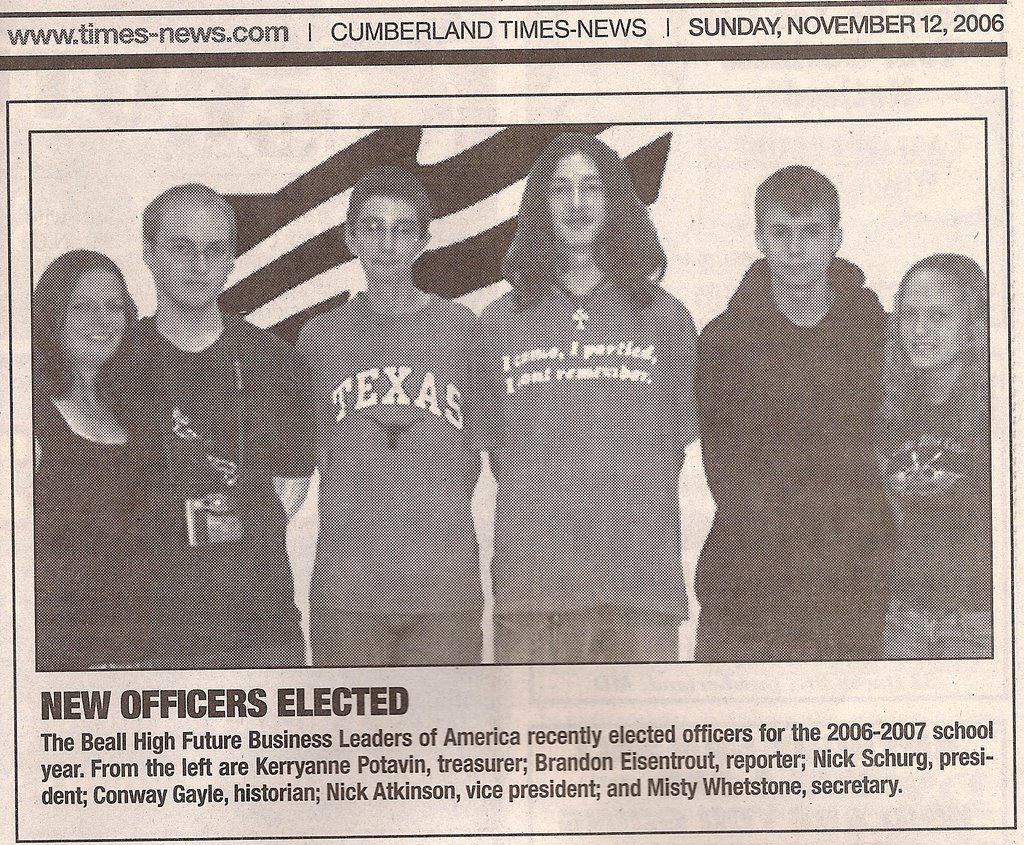
You have to admire a Future Business Leader of America, newly elected as club historian, who wears a T-shirt that says "I came, I partied, I dont [sic] remember."

In all my high-school photos, I'm wearing plaid polyester pants, so the laugh's on me.

Here's the T-shirt in the online Wal-Mart catalog.

HTG PDLS

Hunters who go into the field not with "bird dogs," but with poodles, clearly are self-confident and independent, and I admire them. Check out this feature by Ben Shouse in The Argus Leader of Sioux Falls, S.D. An excerpt:
These hunters are impressed by the bird dogging ability of poodles, but there are serious obstacles to more widespread acceptance.

For one thing, the culture of dogs and hunting is aligned against the breed. The American Kennel Club puts them in the "non-sporting" group. In 2004, the National Rifle Association enlisted them as a symbol of presidential candidate John Kerry's lack of authenticity, using the slogan, "That dog won't hunt."

Note the license plate in the photo: HTG PDLS.

"A Mouth for Bluejohn"

My latest essay, "A Mouth for Bluejohn," is in the fall 2006 issue of NC State, the North Carolina State University alumni magazine. (It's on Page 11.)

The essay is about the words and phrases that I never heard before Sydney uttered them ("bluejohn," "have a mouth," "the mail has run," etc.), and the words and phrases that Sydney never heard before I uttered them ("faunching," "floojens," etc.).

The examples in the essay are far from exhaustive, of course. Sydney reminds me of one I was too demure to include: When I was growing up, my family never used the word "laxative," instead calling Milk of Magnesia an "active medicine," with an un-English emphasis on the adjective -- "ACTIVE medicine." This euphemism was news to her.

Wednesday, November 15, 2006

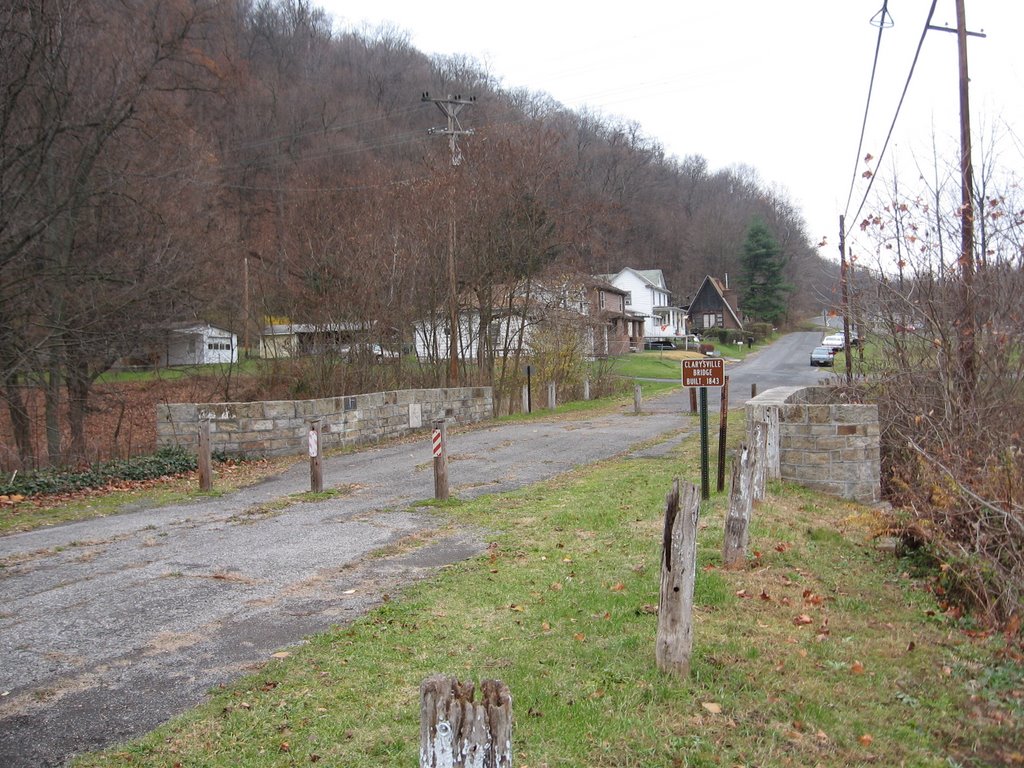
The Clarysville Bridge

To get a good view of the Clarysville Bridge, at U.S. 40 and Route 55 between Frostburg and LaVale, I had to clamber through thorny bushes down to the streambank. The bridge, built in 1843 along the National Road, is a lot less impressive seen from the level of the highway:Unfortunately, the stream itself has the discoloration typical of acid mine drainage.
The Oxymoronic Arms


This sign is on Main Street in Frostburg, Md.

Saturday, November 11, 2006

Ate some burnt hoss flesh

One of my two favorite books (the other being Alice's Adventures in Wonderland) is James Thurber's memoir of his youth in Columbus, Ohio, My Life and Hard Times. I first encountered it when I was about 10, in the pages of The Thurber Carnival, a sort of greatest-hits collection that includes My Life and Hard Times in its entirety (all 115 pages). (I still recommend The Thurber Carnival to any unfortunate who hasn't met Thurber yet.) I picked up The Thurber Carnival at that young age because it was full of cartoons, and I loved cartoons. Enough backstory. My point is that at age 10, I thought the funniest part of this very funny book was this passage from early in Chapter Five, "More Alarms at Night":
Father was usually in bed by nine-thirty and up again by ten-thirty to protest bitterly against a Victrola record we three boys were in the habit of playing over and over, namely, "No News, or What Killed the Dog," a recitation by Nat Wills. The record had been played so many times that its grooves were deeply cut and the needle often kept revolving in the same groove, repeating over and over the same words. Thus: "ate some burnt hoss flesh, ate some burnt hoss flesh, ate some burnt hoss flesh." It was this reiteration that generally got father out of bed.
As a child, I wept with laughter when I first read this passage, whenever I re-read this passage, and whenever I even thought about this passage. In fact, I took to amusing myself, whenever I was bored, by murmuring aloud, "ate some burnt hoss flesh, ate some burnt hoss flesh, ate some burnt hoss flesh," until I dissolved into giggles. (This helps explain why my childhood was interrupted periodically by serious conversations instigated by grave and concerned adults.)

I was sure then, and I am sure now, that while the expectation of Father bursting in -- the suspense of wondering when that would happen -- certainly heightened the entertainment value of the repetition, the repetition was entertaining in and of itself, indeed more entertaining than anything else on the record, and that the boys could have listened to "ate some burnt hoss flesh" for hours, had Father not inevitably burst in to complete his role in the (nightly?) drama. I was sure, too, that whatever "No News, or What Killed the Dog" might have been about, "ate some burnt hoss flesh" had to have been the absolute least fortunate line to repeat ad infinitum, the worst collection of syllables on offer, the record's nadir of taste. All this factored into my merriment, as did my utter mystification over what ELSE could possibly have been on that record, what else it might have been about.

This week, more than 30 years later, I finally found out. "No News, or What Killed the Dog" must have been the 19th-century version of "The Aristocrats," a lengthy, offensive shaggy-dog tale subject to endless variations, all of which lead inevitably to the same anticlimactic -- but, in context, grotesquely hilarious -- punchline. I know this because George G. Carey, in his book Maryland Folklore (Tidewater Publishers, 1989), includes a version told by Eastern Shore waterman Alex Kellam. It begins:
I heard the one about the rich plantation owner whose health went bad and the doctor ordered him away for six months' rest and he was to lose all contact with his friends and family. And so at the end of the six months he came back and his colored servant met him at the depot and took him home in the horse and buggy. On the way in he said to Sam,

"Now I've been gone six months and I haven't heard one thing from home. What's happened since I've been gone?"

He said, "Oh nothing, except one little thing. Since you've been gone your dog died."

He said, "The dog died? Well, what killed the dog?"

"Well, the dog eat some burnt horse flesh."

"Burnt horse flesh? How'd he get that?"

"Well, your barn burnt down and burnt up all the cows and horses, and after the fire the dog eat the burnt horse flesh and that's what killed the dog."

"Oh," he said, "my barn burned?"

He said, "Yessir, the barn burned."

He said, "How did the barn catch fire?"

"Well, it seems a spark flew over from the house ..."

And so on and so on, potentially endlessly, with calamity piling upon calamity, until at the end we reach the punchline: "But other than that, there ain't no news." Carey calls this story "a once widely told American yarn."

So now I finally know the context of "ate some burnt hoss flesh." And it's still funny! As David Letterman would say: For you students of comedy -- now, that's comedy.

Friday, November 10, 2006

The wreck of the Edmund Fitzgerald

On this date in 1975, the freighter Edmund Fitzgerald was lost with all hands during a storm on Lake Superior. I was 11 years old, and while I was a faithful newspaper reader even then, and read every back issue of Newsweek that my Aunt Willa May passed me, I don't recall the wreck itself making much of an impression. The Newsweek writeup did, however, make a deep impression on Canadian singer-songwriter Gordon Lightfoot, and the song he was inspired to write and perform, "The Wreck of the Edmund Fitzgerald," left me thunderstruck the next year, 1976, whenever I heard it on the radio. I got plenty of opportunity to hear it; the song went to No. 2 on the pop charts. Since then, Lightfoot's bone-chilling six-and-a-half-minute epic has cropped up occasionally on lists of most-hated songs; its critics claim that it's too long, too slow and too maudlin, down there in the depths with "Seasons in the Sun." But I loved the song then, and I love it now, without the slightest irony or distance. I hear the opening, and I'm immediately cold, as if "twas the witch of November come stealin'." And without that song, what are the odds that I would remember the Edmund Fitzgerald at all? This is one of the only examples in my lifetime of a disaster that immediately gets set to music and sung into myth, like the Baltimore fire or the wreck of the Old 97. It's downright bardic, what Lightfoot did in that song.

Wednesday, November 08, 2006

How the Rolling Stone "10 Worst" fared

The day after the Democrats came back, I re-read Matt Taibbi's cover story in the Nov. 2 Rolling Stone, headlined "The Worst Congress Ever." It's full of eyebrow-scorching Mencken-style invective, for example the description of James Sensenbrenner Jr., R-Wis., as "an ever-sweating, fat-fingered beast who wields his gavel in a way that makes you think he might have used one before in some other arena, perhaps to beat prostitutes to death."

Sensenbrenner was listed as one of the magazine's "10 Worst Congressmen," all but one of them Republicans. Before the election, my assumption was that all 10 would sail through the election unscathed, in spite of -- or because of -- Rolling Stone's dudgeon. But it didn't work out that way: Two were voted out of office, one was forced into a runoff, and four others, while re-elected by the loyalists back home, will lose their positions of national power, namely their chairmanships, to Democrats. Here's the Rolling Stone "10 Worst" list, with the nicknames the magazine assigned them and their fate in Tuesday's election.

  • Dennis "The Highway Robber" Hastert, R-Ill., re-elected with 60 percent of the vote but lost his position as speaker of the House.
  • James "The Dictator" Sensenbrenner Jr., R-Wis., re-elected with 62 percent of the vote but lost his chairmanship of the Judiciary Committee.
  • Don "Mr. Pork" Young, R-Alaska, re-elected with 57 percent of the vote but lost his chairmanship of the Transportation Committee.
  • William "The Bribe Taker" Jefferson, D-La., led a crowded field with 30 percent of the vote but now faces a Dec. 9 runoff with the No. 2 candidate, a fellow Democrat (more on that below).
  • Jerry "The King of Payoffs" Lewis, R-Calif., re-elected with 66 percent of the vote but lost his chairmanship of the Appropriations Committee.
  • Tom "Mr. Bigotry" Tancredo, R-Colo., re-elected with 59 percent of the vote.
  • Dick "Enemy of the Earth" Pombo, R-Calif., chair of the Resources Committee, lost with 47 percent of the vote to his Democratic challenger's 53 percent.
  • Curt "The Conspiracy Nut" Weldon, R-Pa., lost with 44 percent of the vote to his Democratic challenger's 56 percent.
  • Hal "Homeland Security Hog" Rogers, R-Ky., won with 74 percent of the vote -- the biggest winning margin on this list.
  • Marilyn "The Queen of Gay Bashing" Musgrave, R-Colo., won with 46 percent of the vote -- the smallest winning margin on this list. (Her Democratic opponent got 43 percent.)

    Jefferson was running against eight Democrats, three Republicans and a Libertarian. The three runner-up Democrats got 52 percent of the vote among them. Had all those rivals within his own party drawn straws, played rock-paper-scissors, etc., and put all their resources behind a single non-Jefferson Democrat, Jefferson would have lost this race outright, and Rolling Stone's batting average would be even higher.

    But as it stands, at least 20 percent of the magazine's list was ousted, and another 40 percent of the list was demoted -- which still looks pretty prescient, in hindsight. I'll be interested to read Rolling Stone's "10 Worst" list in 2006.

    (Thanks to Bob for pointing out my error in the original version of this post.)
  • Tuesday, November 07, 2006

    Black as the Pit from pole to pole

    This man-made canyon is a surface coal mine just south of Frostburg, viewed from the east rim along Route 36. For scale, note the house-sized earth-moving machines on the far horizon.

    Sharpe and "Seanbean"

    I am pleased to see on Dan's Slapinions blog that he read aloud to one of his children, when she was an infant, one of Bernard Cornwell's Sharpe novels.

    Cornwell has written 21 of these Napleonic military adventures so far (the most recent being Sharpe's Fury), and 15 Sharpe movies (if I count correctly) have been filmed by the BBC, with Sean Bean in the title role. We watched the most recent, Sharpe's Challenge, earlier this year on BBC America; we even watched the making-of documentary. Sydney has no interest in making-of documentaries, the novels of Bernard Cornwell or the Napoleonic Wars, but her interest in Sean Bean approaches totality. She likes to pronounce "Sean" with a long E, to rhyme with "Bean," and say them quickly: "Seanbean."

    The rest of the cast was good, too: Daragh O'Malley as Sharpe's burly sidekick Patrick Harper, Peter Hugo-Daly as the loathsome and toothy Sgt. Bickerstaff, Michael Cochrane as the pompous dimwit Gen. Simmerson. The villains were especially high-caliber: Toby Stephens and Padma Lakshmi, a.k.a. Maggie Smith's son and Salman Rushdie's wife. All worked hard, but Sydney paid them no heed, with Sean Bean around.

    Have you voted?

    Besides having the best first name in Frostburg, Avalon Ledong has an excellent letter to the editor in today's Election Day edition of the Cumberland Times-News. A Malaysian-American who just got his U.S. citizenship this year, Ledong explains why he's voting today. He concludes:
    America still has great promise and great potential. Not all of her dreams are yet realized. The best of the dream can still be yet to come. I want to be a part of making that happen.

    So today I will vote in my first general election. It will be a proud moment for me and for my family. It will be a moment of faith in this country.
    Here's an earlier Times-News profile of Ledong, who works in personnel at Frostburg State University.

    Sunday, November 05, 2006

    Christ in the mouth of Moloch

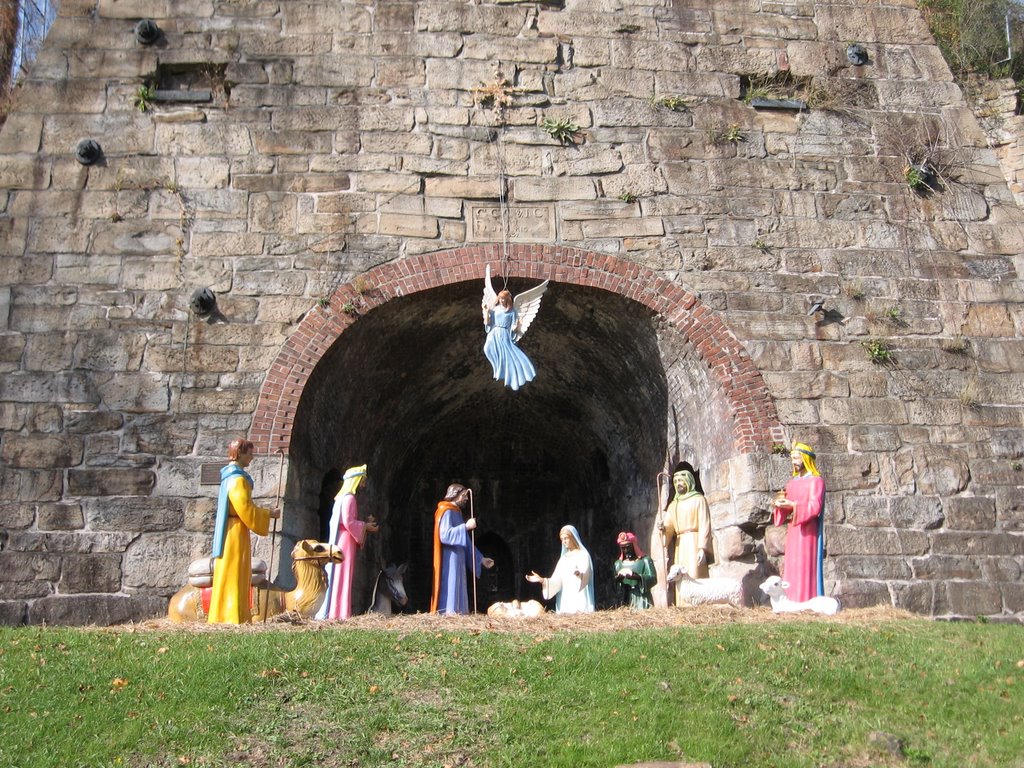
    While driving through Lonaconing, Md., yesterday, I happened upon a nativity scene in the mouth of the furnace.George's Creek Coal and Iron Co. Furnace No. 1 is the town's most striking landmark, a legacy of pre-Civil War industry. The town dates its founding from the year the furnace opened. The furnace produced pig iron from 1839 until 1856 and was the first iron furnace in the United States to successfully use not charcoal but coal and coke, both abundant in Allegany County. The George's Creek company soon, in fact, dropped the iron business to concentrate solely on the coal.

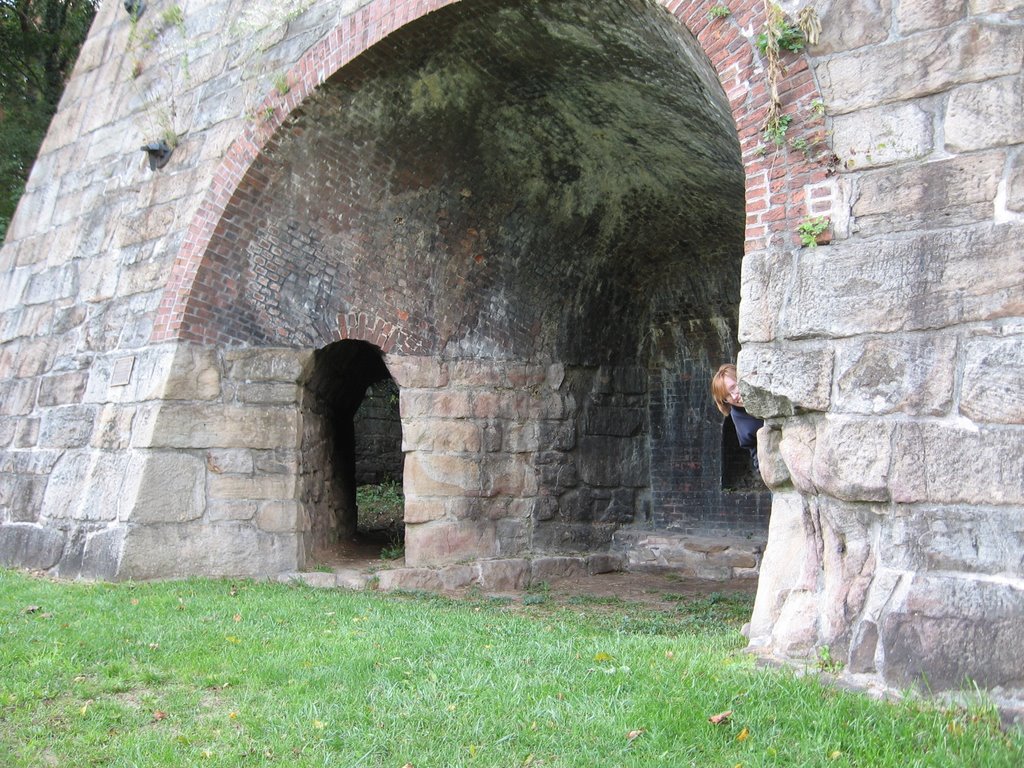
    These photos don't really convey how massive the thing is, and how startling it is to unsuspecting passers-by on Route 36. Commonly heard from the passenger seat: "WHAT in the world was THAT? Turn around!" Here's a shot of Sydney and Lily in front of the furnace mouth this summer.And here's a shot of Sydney "hiding" in the furnace mouth.
    Saturday, November 04, 2006

    The trail of Lefty Grove

    The great pitcher Lefty Grove, a member of the Baseball Hall of Fame, was from the coal town of Lonaconing, Md., just a few miles south of here. Because the World Series is over, and because the Baseball Forever conference at Frostburg State University hasn’t started yet, I filled the void this morning with a miniature Lefty Grove pilgrimage.

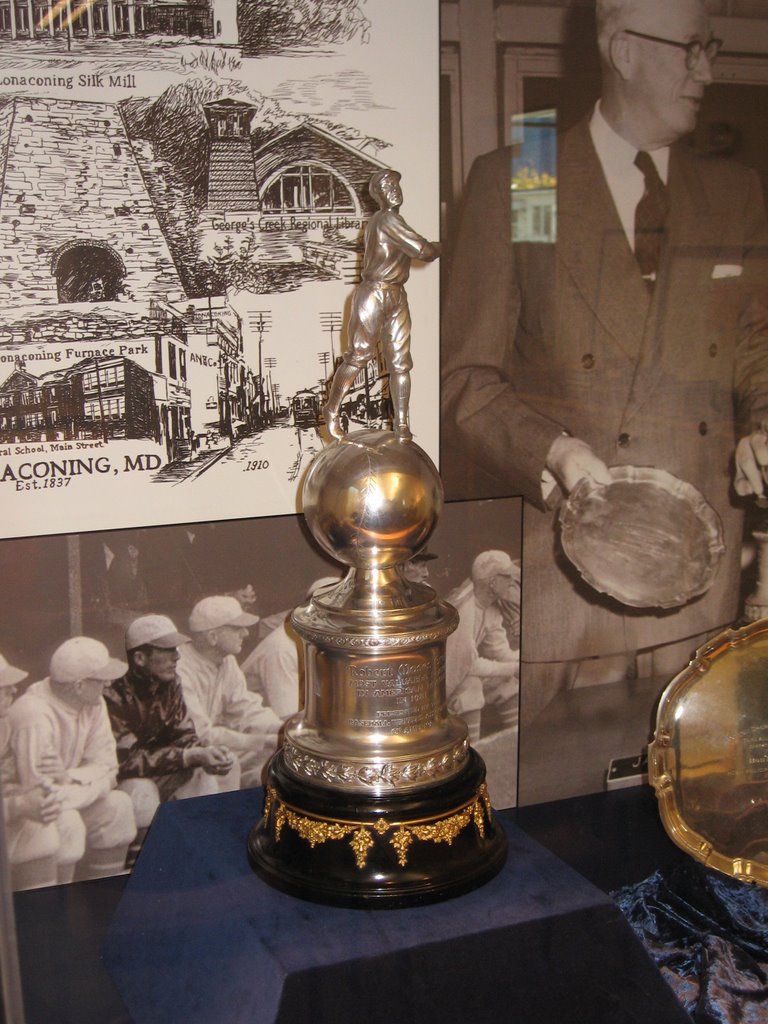
    My first stop (of two) was the George’s Creek Regional Library in downtown Lonaconing, where Grove’s MVP trophy is on display.It reads:
    Robert Moses Grove
    MOST VALUABLE PLAYER
    IN AMERICAN LEAGUE
    IN 1931
    PRESENTED BY THE
    BASEBALL WRITERS ASSOCIATION
    OF AMERICA
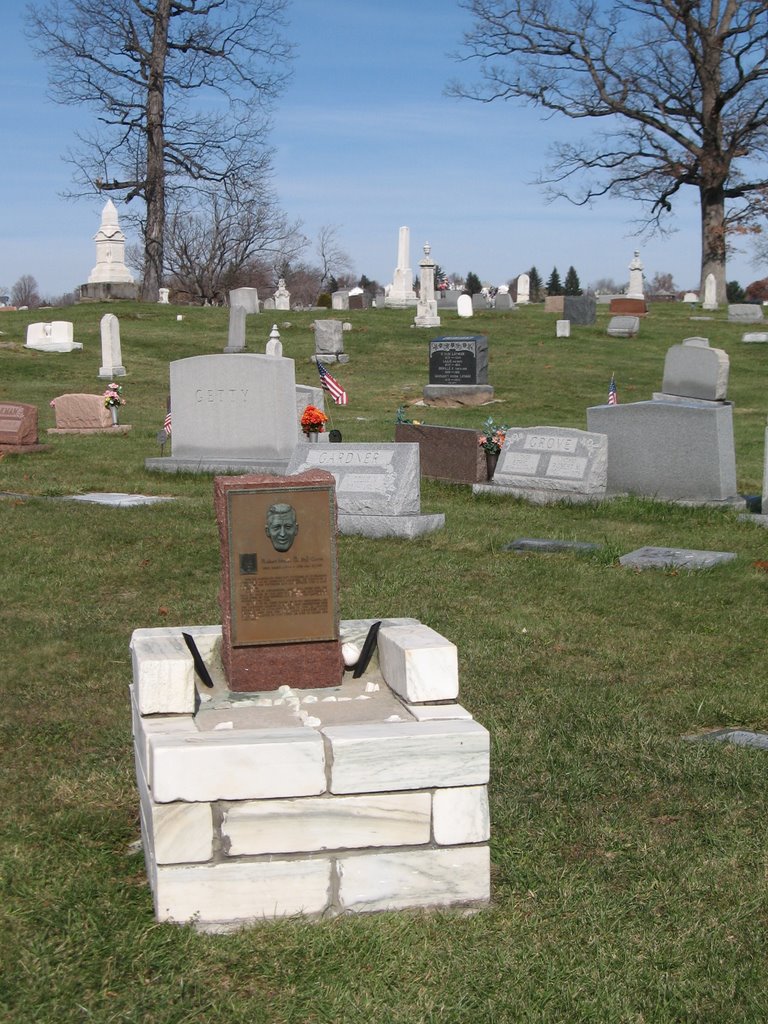
    The figure on the trophy seems to be throwing with his right, but never mind; 1931 was the great left-hander’s best year. He went 31-4 for Connie Mack’s Philadelphia Athletics, including a 16-game winning streak, with an ERA of 2.06.

    That Robert Moses Grove (1900-1975) would be known as Lefty was inevitable. In baseball, it was an era of nicknames. Lefty’s 1931 World Series teammates included Doc, Mule, Bing, Rube and Dib; their Series opponents that year included Sparky, Ripper, Chick, Pepper and Flint.

    Lefty’s story is told by Jim Kaplan in his book Lefty Grove: American Original and by Sarah Moses in the November 2006 issue of Allegany Magazine. Lefty’s dad made $50 a month in the mines, hauling “sixteen tons” a day, as in the (much later) Merle Travis song. Lefty worked briefly alongside his dad and brother in the mines before deciding to do something else with his life. He announced, “I didn’t put that coal in the ground, I ain’t gonna take it out.”

    In 1920, at age 20, he was hired to play Class C pro ball for the Blue Ridge League team in Martinsburg, W.Va., for $125 a month. Later that year, the Martinsburg owner sold Lefty to the Baltimore Orioles, then a top-paying minor-league team, for the cost of a new fence. For the rest of his life, Lefty proudly claimed he was the only player ever traded for a fence.

    During an exhibition game as an Oriole, Lefty struck out Babe Ruth nine times. That sort of thing gets you noticed. In 1925, the Philadelphia Athletics bought his contract for a then-record $100,600 -- you have to wonder how the $600 was negotiated – and Lefty was a major leaguer at last. Ruth soon learned that exhibition game was no fluke; Lefty would hold the Babe to nine homers in 10 years.

    In his 17 major-league seasons (nine with Philadelphia and eight with the Boston Red Sox), Lefty had a lifetime winning percentage of .680, with 300 career wins. His niece, Betty Holshey, told Allegany Magazine that “Uncle Bob” sent the family a case of Wheaties whenever he won a game. “For the longest time,” she said, “we didn’t know there was any other cereal but Wheaties.”

    Prematurely gray, Lefty presented to batters a severe and intimidating figure. A bad loser, he was known to berate teammates, rend uniforms, trash locker rooms in frustration. His United Press International obit would say he had “an explosive fast ball and temper to match.” Betty Holshey’s dad warned her, “You don’t want to cross your Uncle Bob.”

    Batters didn’t cross him often. Lefty was a six-time All-Star, pitched in three World Series (four wins, two losses and two saves) and was on two world championship teams (the 1929 and 1930 Philadelphia A’s). He led the American League in strikeouts for seven seasons and in ERA for nine.

    In his major-league career, he pitched 3,940 innings in 616 games, including 35 shutouts, for a lifetime ERA of 3.06.

    In retirement, he came home to Lonaconing, ran a bowling alley, and taught lots of youngsters the finer points of baseball. The Baseball Hall of Fame in Cooperstown, N.Y., wanted his MVP trophy, the first awarded in the American League, but Grove said no, no one from “Coney” would be able to see it there, so he presented it instead to the local high school.

    The school is long gone, and the trophy was in a bank vault for a while, before the library gave it a home in a $25,000, climate-controlled, high-security case alongside other Grove artifacts, including an autographed baseball and one of the great man’s golf clubs. Elsewhere in the History Room, a three-ring binder of Grove-related newspaper clippings is worth leafing through. His niece, I’m told, still has one of Uncle Bob’s Philadelphia uniforms; the library would love to have that in the case, too.

    In his last years, Grove lived with his son and daughter-in-law in Norwalk, Ohio, and he died there the night of Thursday, May 22, 1975, apparently while watching television. (One wonders what was playing: The Waltons, Ironside, Movin’ On?) He’s buried not in Lonaconing but in Frostburg, a few miles up the road from his hometown; his grave was my second and last stop of the day.LONACONING DIRECTIONS: The George’s Creek Regional Library is easy to find on Lonaconing’s Main Street, a.k.a. Route 36. Take Exit 34 from I-68 at Frostburg and head south. As you enter the library, the History Room is straight ahead. A few blocks north along Main Street is Furnace Park, where a plaque commemorates Grove on the grounds of the old high school.

    FROSTBURG DIRECTIONS: To reach the main entrance of Frostburg Memorial Park, take Grant Street south from U.S. 40, a.k.a. Main Street. The cemetery gate is at Grant and Green. Drive through the main entrance and up the hill past the flagpole, then turn right. At the intersection ahead is a plaque identical to the Lonaconing plaque; Grove’s tombstone is just up the hill behind it.